





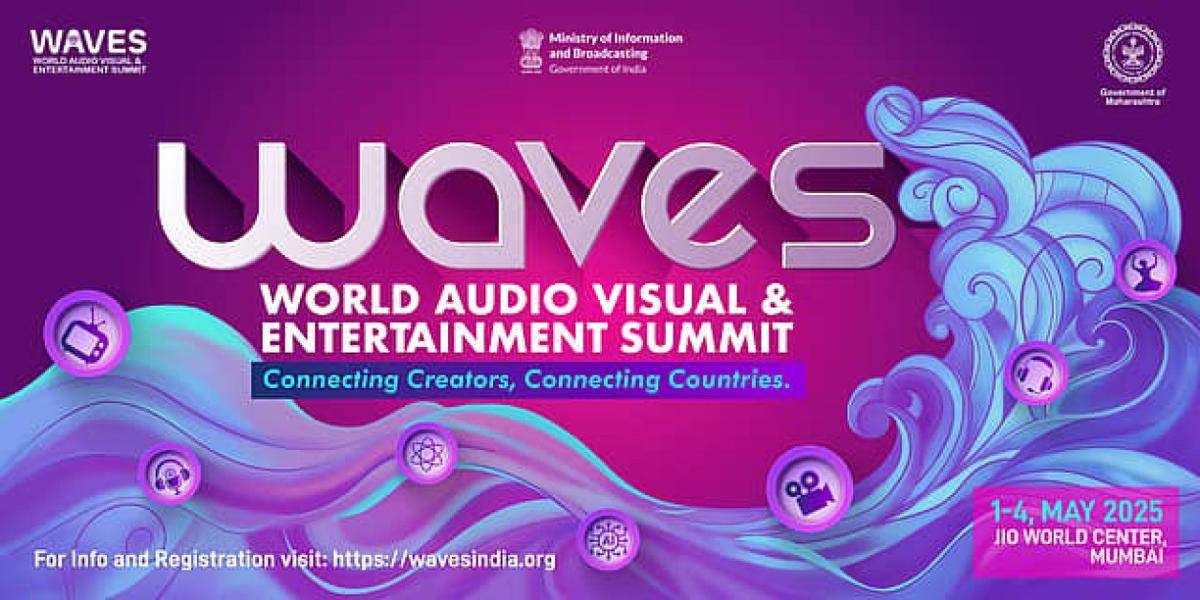
In a significant move to establish India as a global hub for media and entertainment, Prime Minister Narendra Modi inaugurated the first-ever World Audio Visual and Entertainment Summit (WAVES) in Mumbai on May 1, 2025. The four-day extravaganza, themed "Connecting Creators, Connecting Countries," has brought together an unprecedented assembly of creative minds, industry leaders, policymakers, and innovators from over 90 countries.
A Vision Taking Shape
The summit, held at Mumbai's Jio Convention Centre, represents the culmination of a vision that has been brewing within India's corridors of power for some time now. PM Modi, addressing a packed audience of celebrities, filmmakers, and content creators, emphasized that WAVES isn't just an acronym but "truly a wave of culture, creativity, and universal connection."
This statement encapsulates the government's ambition to position India not merely as a consumer of global content but as a dominant creative force driving what Modi termed the "Orange Economy" – a sector encompassing content, creativity, and culture.
"This is the time, the right time for 'create in India, create for the world,'" declared the Prime Minister, signaling a clear policy direction that seeks to leverage India's rich storytelling traditions while embracing cutting-edge technologies and global collaborations.
More Than Just Entertainment
Beyond the glitz and glamour that naturally accompanies an event featuring stalwarts like Shah Rukh Khan, Rajinikanth, and S.S. Rajamouli, WAVES 2025 represents a calculated economic strategy. With over 10,000 delegates, 1,000 creators, more than 300 companies, and over 350 startups participating, the summit is poised to transform India's media and entertainment landscape.
Mukesh Ambani, CEO and MD of Reliance Industries, highlighted this economic potential during his address: "India's entertainment industry's current valuation is $28 million. It will reach $100 million over the next few years." This projected growth trajectory underscores why the government has thrown its weight behind this initiative.
The summit's structure reflects its comprehensive approach to the creative industries. With 42 plenary sessions, 39 breakout sessions, and 32 masterclasses spanning broadcasting, infotainment, AVGC-XR (Animation, Visual Effects, Gaming, Comics and Extended Reality), films, and digital media, WAVES 2025 covers the entire spectrum of the audio-visual ecosystem.
Building the Creative Infrastructure
A key announcement at the summit was the establishment of India's first Institute of Creators' Technology in Mumbai, with an allocation of ₹400 crore. Union Minister Ashwini Vaishnav revealed that the Maharashtra government has already provided land for this institution, which aims to build a skilled workforce capable of meeting global standards.
This focus on skill development aligns perfectly with the summit's objective of driving India's creative economy through IP creation. The government seems to understand that while India has abundant creative talent, systematic nurturing and professional development are essential to compete on the world stage.
Global Partnerships and Technological Innovation
The summit has already catalyzed strategic partnerships. Adobe announced collaborations with WAVES Bazaar, the Indian Institute of Creative Technology, Tata Consultancy Services Interactive, and Accenture. Adobe CEO Shantanu Narayen asserted that "the next boom of India is not in software, but in creativity and entertainment," predicting that India's creative economy is "poised to employ more than the manufacturing industry."
The inclusion of emerging technologies like AI and extended reality in the discussions reflects an understanding that the future of content creation will be deeply intertwined with technological innovation. The Bharat Pavilion at the summit, with its theme "Kala to Code," perfectly encapsulates this marriage of traditional artistry with cutting-edge technology.
Creative Responsibility and Cultural Values
In perhaps the most thought-provoking segment of his address, PM Modi spoke about "creative responsibility," emphasizing the need to "save our young generations from tendencies which are against humanism." He called upon content creators to "take care of human sensitivities and sensibilities" and to "enrich humans and not turn them into robots."
This reflection on the ethical dimensions of content creation comes at a crucial time when concerns about AI's impact on creativity and human experience are growing worldwide. Modi's message resonated with many creators present, suggesting that India's approach to the creative economy will include a strong emphasis on human values.
Looking Ahead: WAVES Awards and Beyond
PM Modi announced plans to launch WAVES awards in the future, suggesting that this summit is not a one-off event but the beginning of a sustained initiative. The promise of future editions indicates the government's long-term commitment to nurturing the creative ecosystem.
The summit also paid homage to India's rich cinematic legacy with the release of commemorative postage stamps honoring legendary figures like Guru Dutt, Ritwik Ghatak, Raj Khosla, Salil Chowdhury, and P. Bhanumathi. This blend of honoring the past while embracing the future epitomizes the balanced approach WAVES seems to be taking.
Challenges and Opportunities
Despite the optimism permeating the summit, challenges remain. Creating globally competitive content requires not just talent but substantial investment in infrastructure, technology, and marketing. Moreover, navigating the complex terrain of intellectual property rights in the digital age presents its own set of challenges.
However, the opportunities are equally significant. With one of the world's largest youth populations, a rich cultural heritage spanning thousands of years, and growing digital connectivity, India possesses unique advantages in the creative economy. As S.S. Rajamouli noted during his address, "India has been a land of storytellers for millions of years... storytelling is in our DNA."
The Road Ahead
As WAVES 2025 unfolds, it marks a decisive step in India's journey toward becoming a creative powerhouse. The government's willingness to engage with industry leaders, invest in infrastructure, and create platforms for global collaboration suggests a comprehensive strategy rather than mere political posturing.
The summit's success will ultimately be measured not by the celebrity attendees or the grandiose declarations but by the tangible outcomes it generates – new collaborations, increased investments, policy reforms, and most importantly, the quality and global reach of content created in India.
If the enthusiasm displayed at the inaugural session translates into sustained action, WAVES might indeed become the catalyst that propels India's creative industries to new heights on the global stage. As Shah Rukh Khan aptly put it, "WAVES is more than a summit. It is a global platform and a catalyst for creators, innovators, disruptors, and dreamers."
In the grand narrative of India's economic rise, the "Orange Economy" might well be the next chapter waiting to be written.
 Related News
POST A COMMENT (0)
All Comments (0)
Replies (0)