





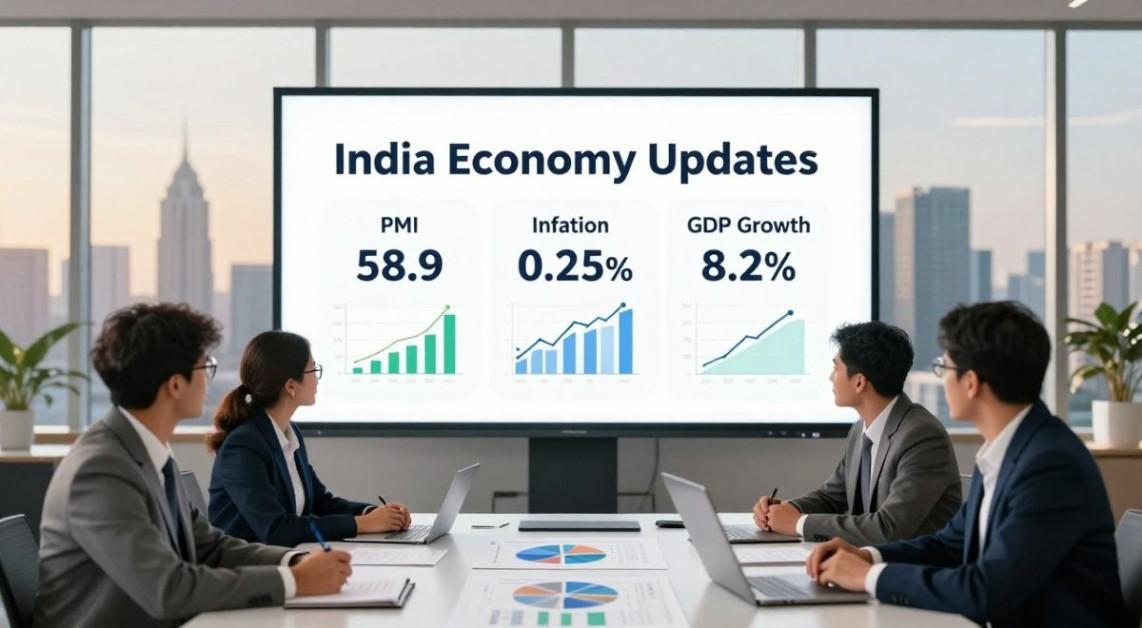
The Indian economy has presented a mixed picture with recent data indicating a slowdown in growth, as reflected by the HSBC PMI dropping to 58.9, its lowest since February.
Despite this deceleration, the rupee has remained stable, and foreign exchange reserves are adequate, providing a sense of stability. The Consumer Price Index (CPI) has fallen to 0.25% in October, a record low, suggesting a favorable inflation outlook.
On the other hand, the GDP growth for Q2 has been robust at 8.2%, indicating a strong underlying economy. This article will explore these economic indicators and their implications for the Indian economy.
Key Takeaways
- The HSBC PMI has slowed to 58.9, indicating a deceleration in growth.
- The rupee remains stable, and foreign exchange reserves are adequate.
- CPI has dropped to a record low of 0.25% in October.
- Q2 GDP growth has been robust at 8.2%.
- India's economy shows mixed signals with recent data releases.
Current Economic Landscape of India
The Indian economy is currently navigating through a complex landscape of growth and challenges. Recent data releases have shed light on the various facets of the economy, providing insights into its current state.
Overview of Key Economic Indicators
The HSBC PMI (Purchasing Managers' Index) is a crucial indicator of manufacturing activity. Although it has slowed down to 58.9, it still indicates a growing manufacturing sector. On the other hand, the services sector continues to show resilience, contributing significantly to the economy.
Key Economic Indicators:
| Indicator | Value | Trend |
|---|---|---|
| HSBC PMI | 58.9 | Slowdown |
| CPI Inflation | 0.25% | Record Low |
| Q2 GDP Growth | 8.2% | Robust Growth |
Significance of Recent Economic Developments
The recent economic data has significant implications for the overall economic trajectory of India. The slowdown in PMI, record low inflation, and robust GDP growth are critical indicators that influence policy decisions, business strategies, and investor sentiments.
The interplay between these indicators will be crucial in shaping the future economic landscape.
HSBC PMI 58.9 (slowest since Feb); rupee stable; CPI 0.25% Oct, Q2 GDP 8.2%
The HSBC PMI has decelerated to 58.9, marking its slowest growth since February, amidst a backdrop of a stable rupee and low inflation.
Comprehensive Analysis of Latest Economic Data
The recent economic data releases have shown a mixed picture. The HSBC PMI at 58.9 indicates a slowdown in growth momentum. Despite this slowdown, the Indian rupee has remained stable against the US dollar, reflecting a robust forex market.
The CPI inflation dropped to a record low of 0.25% in October, signifying a substantial decrease in price pressures. This low inflation rate is a positive indicator for the economy.
Month-on-Month Comparative Assessment
A comparative analysis of the economic indicators on a month-on-month basis reveals interesting trends.
| Indicator | Current Value | Previous Value |
|---|---|---|
| HSBC PMI | 58.9 | 60.2 |
| Rupee (against USD) | Stable | Stable |
| CPI Inflation | 0.25% | 0.5% |
| Q2 GDP Growth | 8.2% | 7.8% |
The Q2 GDP growth has been robust at 8.2%, driven by strong performance across various sectors. This growth indicates a resilient economy despite global uncertainties.
Decoding the HSBC PMI Slowdown to 58.9
The HSBC PMI has dipped to 58.9, its lowest since February, warranting a deeper analysis. This slowdown indicates a deceleration in growth, prompting a closer examination of the underlying factors.
Root Causes Behind Growth Deceleration Since February
The recent slowdown in HSBC PMI can be attributed to various factors, including changes in global market trends and domestic economic conditions. Economic indicators suggest that while there is still growth, the pace has moderated.
Sectoral Performance Breakdown
A sectoral analysis reveals mixed performance across different segments of the economy. The manufacturing sector has shown some signs of weakness, while the services sector continues to contribute positively to overall growth.
Manufacturing Sector Dynamics
The manufacturing sector, a significant component of the PMI, has experienced a slowdown. This can be attributed to factors such as supply chain disruptions and changes in demand patterns.
Services Sector Contribution
In contrast, the services sector has remained resilient, contributing significantly to the overall PMI. The growth in this sector is driven by increasing demand for services, both domestically and internationally.
Understanding the dynamics of both the manufacturing and services sectors is crucial for a comprehensive pmi data analysis. The latest financial news highlights the importance of monitoring these sectors for insights into India's economic trajectory.
Indian Rupee Stability: Maintaining Equilibrium Amid Global Volatility
The rupee's stability is a testament to India's robust economic fundamentals and prudent monetary policies. Despite global economic volatility, the Indian rupee has maintained its equilibrium, reflecting the country's strong economic resilience.
Current Exchange Rate Patterns and Trends
The current exchange rate patterns indicate a stable rupee, with minimal fluctuations against the US dollar. This stability is crucial for India's economic growth, as it attracts foreign investment and boosts trade. Stable exchange rates also help in controlling inflation by reducing the cost of imports.
Key Factors Supporting Rupee Stability
Several factors contribute to the rupee's stability. Two significant factors are:
- The Reserve Bank of India's strategic interventions in the foreign exchange market.
- Steady foreign investment flows into the country.
Reserve Bank of India's Strategic Interventions
The RBI plays a crucial role in maintaining rupee stability through its monetary policies and interventions in the foreign exchange market. By managing liquidity and adjusting interest rates, the RBI ensures that the rupee remains stable. As noted by RBI Governor, "The RBI's proactive measures have been instrumental in maintaining stability in the foreign exchange market."
Impact of Foreign Investment Flows
Foreign investment flows have a significant impact on the rupee's stability. Steady inflows of foreign direct investment (FDI) and foreign institutional investment (FII) bolster the rupee by increasing demand for the currency. According to a recent report, "
FDI inflows into India have been robust, contributing to the stability of the rupee.
"
In conclusion, the Indian rupee's stability amid global volatility is a result of a combination of strong economic fundamentals, prudent monetary policies, and strategic interventions by the RBI, along with steady foreign investment flows.
Foreign Exchange Reserves: Current Status and Management
India's foreign exchange reserves have been a cornerstone of its economic stability, with current levels indicating a robust reserve position. This stability is crucial in maintaining investor confidence and supporting the Indian rupee against global market fluctuations.
Present Forex Reserve Levels and Adequacy
The current foreign exchange reserve levels in India are considered adequate, providing a buffer against external economic shocks. As of the latest data, the reserves have been steadily maintained, ensuring that the country's import cover remains healthy.
RBI's Reserve Management Strategy
The Reserve Bank of India (RBI) has been proactive in managing the foreign exchange reserves through a diversified investment approach. This strategy aims to balance liquidity with returns, ensuring the long-term sustainability of the reserves.
Recent Foreign Exchange Operations
| Month | Forex Reserves (USD billion) | Change |
|---|---|---|
| September | 580 | +2% |
| October | 585 | +0.86% |
| November | 590 | +0.85% |
The RBI's recent foreign exchange operations have focused on maintaining the stability of the rupee, intervening in the market as necessary to prevent excessive volatility.
Record Low Inflation: CPI at 0.25% in October
The CPI inflation rate plummeted to a record low of 0.25% in October, driven by significant declines in food and core inflation. This development has considerable implications for India's economic landscape.
Key Components Driving Inflation Downward
The decline in inflation can be attributed to several key factors, primarily the decrease in food prices and a moderation in core inflation. Food inflation, a significant component of the CPI basket, has seen a notable decrease due to favorable agricultural output and effective supply chain management.
Food Inflation Analysis
Food inflation has been on a downward trend, with prices of essential commodities like vegetables and pulses showing a significant decrease. This trend is largely due to a good monsoon season and government initiatives to control price volatility.
Core Inflation Trends and Implications
Core inflation, which excludes food and fuel, has also moderated, indicating a broader-based easing of inflationary pressures. This moderation is crucial as it reflects underlying demand conditions and price pressures in the economy.
Historical Context and Significance
Historically, such low levels of inflation have been rare in India. The current rate is significant as it indicates a shift in the inflation dynamics, potentially influenced by monetary policy and global economic trends.
| Month | CPI Inflation Rate |
|---|---|
| September | 0.5% |
| October | 0.25% |

Robust Economic Growth: Analyzing Q2 GDP of 8.2%
India's Q2 GDP growth for FY2023-24 has been remarkably robust, standing at 8.2%. This growth is a testament to the country's resilient economic framework and its ability to navigate through global economic uncertainties.
Primary Growth Engines in Q2 FY2023-24
The services sector has been a significant contributor to this growth, driven by advancements in technology and an increase in consumer spending. The industrial growth has also played a crucial role, with manufacturing and construction sectors showing notable expansion.
Sector-wise GDP Contribution Analysis
A detailed analysis of the sector-wise GDP contribution reveals interesting trends. The agricultural sector, industrial growth metrics, and services sector expansion have all contributed to the overall growth.
Agricultural Sector Performance
The agricultural sector has shown resilience, with a growth rate that has positively impacted the overall GDP. Factors such as favorable monsoon conditions and government support have contributed to this performance.
Industrial Growth Metrics
Industrial growth has been driven by the manufacturing and construction sectors. The growth in these areas indicates a strengthening of the economy's productive capacity.
Services Sector Expansion
The services sector, including IT and financial services, has expanded significantly. This growth is attributed to increased demand for digital services and the global competitiveness of Indian IT companies.
The robust Q2 GDP growth of 8.2% underscores India's economic stability and its potential for continued growth. As the economy continues to evolve, monitoring these trends will be crucial for understanding the broader economic landscape.
Interrelationship Between Economic Indicators and Their Collective Impact
Understanding the correlation between key economic indicators is vital for assessing India's economic health. These indicators, including PMI, inflation rates, and GDP growth trends, are interconnected and collectively influence the overall economic trajectory.
How PMI, Inflation, and GDP Data Correlate
The PMI data analysis provides insights into the manufacturing sector's performance, which can impact overall GDP growth. Inflation rates, on the other hand, affect consumer spending and, consequently, GDP. A balanced interplay between these indicators is crucial for sustained economic growth.
Implications for India's Economic Trajectory
The collective impact of these economic indicators has significant implications for India's economic future. A robust GDP growth trend, coupled with stable inflation and a healthy PMI, indicates a strong economic foundation.
Short-term Economic Stability Factors
In the short term, factors such as government policies and global economic trends can influence these indicators. For instance, a rise in inflation might lead to tighter monetary policies, affecting GDP growth.
Long-term Growth Sustainability
For long-term sustainability, it's essential to maintain a balance between growth and inflation.
"A stable economy is characterized by low inflation and steady growth, allowing for sustainable development."
Achieving this balance requires careful economic planning and policy implementation.
Stakeholder Impact Analysis: Businesses, Consumers, and Investors
The current economic climate in India has far-reaching implications for various stakeholders, including businesses, consumers, and investors. As we delve into the impact, it's crucial to understand the responses of different sectors to the prevailing economic conditions.
Business Sector Response to Current Economic Climate
Businesses in India are adapting to the latest economic indicators, such as the HSBC PMI at 58.9, indicating a slowdown in growth since February. According to a recent statement by K.V. Kamath, "The Indian economy is showing resilience despite global headwinds." This sentiment is echoed by many business leaders who are cautiously optimistic about the future.

Consumer Sentiment and Purchasing Power
Consumer sentiment is closely tied to the economic climate, with inflation rates, such as the CPI at 0.25% in October, playing a significant role. As inflation remains low, consumers are likely to experience an increase in purchasing power. This is a positive sign for businesses catering to consumer goods.
Investment Climate and Capital Formation
The investment climate in India is influenced by various factors, including GDP growth and foreign exchange reserves. With a Q2 GDP growth of 8.2%, the outlook for investments appears promising. As Nirmala Sitharaman noted, "The Indian economy is on a robust growth trajectory." This has led to increased capital formation, driven by both domestic and foreign investments.
Employment Trends and Labor Market Conditions
Employment trends are a critical aspect of the overall economic landscape. With a growing economy, labor market conditions are expected to improve. As the economy continues to expand, we can anticipate positive employment trends, contributing to overall economic stability.
In conclusion, the impact of the current economic climate on stakeholders is multifaceted. Businesses are adapting, consumers are benefiting from low inflation, and investors are showing confidence in the economy. As one expert noted, "The Indian economy is poised for sustained growth, driven by favorable demographics and economic reforms." This sentiment is likely to shape the decisions of stakeholders in the coming months.
"The future of India's economy looks bright, with a strong foundation for growth and development."
Expert Opinions and Economic Forecasts
Expert analyses and forecasts are crucial in understanding the dynamics of India's economic landscape, particularly in the context of recent developments. The latest data on economic indicators has prompted a range of reactions from experts, shedding light on the future of India's economic growth.
Leading Economists' Perspectives on Current Data
Leading economists have provided their insights on the current state of economic indicators, highlighting the significance of the HSBC PMI slowing down to 58.9, the stability of the rupee, and the record low inflation rate of 0.25% in October.
"The current economic data presents a mixed picture, with growth deceleration in certain sectors being offset by the stability of the rupee and low inflation," said a leading economist.
Financial Institutions' Outlook for Indian Economy
Financial institutions have shared their outlook on the Indian economy, with a focus on GDP growth trends. According to their forecasts, the Q2 GDP growth rate of 8.2% is expected to continue, driven by key sectors.
Domestic Expert Assessments
Domestic experts have assessed that the rupee stable against major currencies is a positive sign for the economy, indicating a robust forex reserve management strategy by the RBI.
| Economic Indicator | Current Value | Forecast |
|---|---|---|
| HSBC PMI | 58.9 | Stable |
| CPI Inflation | 0.25% | Moderate |
| Q2 GDP Growth | 8.2% | Positive |
International experts have also weighed in on India's economic prospects, noting the resilience of the economy amidst global volatility.
Policy Implications and Expected Government Responses
With the latest financial news indicating a PMI of 58.9, the slowest growth since February, the government's response is under scrutiny. The current economic indicators have significant implications for monetary policy and fiscal measures.
Monetary Policy Trajectory Based on Current Indicators
The RBI's upcoming policy reviews will be crucial in determining the monetary policy trajectory. With a CPI of 0.25% in October, the lowest in recent times, there is a strong case for maintaining a dovish stance on monetary policy to support growth.
Potential Fiscal Measures and Structural Reforms
The Q2 GDP growth of 8.2% indicates a robust economic performance. To sustain this growth, the government may consider fiscal measures such as tax incentives or increased public spending. Structural reforms in sectors like agriculture and manufacturing could also be on the agenda.
RBI's Likely Stance in Upcoming Policy Reviews
The RBI is expected to maintain a accommodative monetary policy to support the economy. The key factors influencing this decision include the PMI data analysis, inflation rates, and overall economic growth.
Government's Economic Strategy Adjustments
In response to the current economic landscape, the government may adjust its economic strategy to focus on sustainable growth. This could involve initiatives to boost domestic consumption and investment.
- Maintaining a dovish stance on monetary policy
- Implementing fiscal measures to support growth
- Structural reforms in key sectors
The government's response will be critical in shaping the economic trajectory. By analyzing the latest financial news and economic indicators, stakeholders can better understand the potential policy implications.
Conclusion
The Indian economy has presented a mixed picture in recent data releases, with the HSBC PMI slowing down to 58.9, indicating a deceleration in growth since February. However, the rupee has maintained stability, and foreign exchange reserves are adequate, providing a cushion against global volatility.
The CPI inflation has dropped to a record low of 0.25% in October, driven by favorable food prices. Meanwhile, the Q2 GDP growth has been robust at 8.2%, indicating a strong economic performance. These india economy updates suggest that while there are challenges, the overall economic trajectory remains positive.
Understanding the interrelationship between these economic indicators is crucial for businesses, investors, and policymakers. The HSBC PMI slowdown to 58.9 and the robust Q2 GDP of 8.2% together paint a nuanced picture of the Indian economy, highlighting both opportunities and challenges.
As the economy continues to evolve, staying informed about these developments will be essential for making informed decisions. With the right policy measures, India is well-positioned to navigate the complexities of the global economy and achieve sustained growth.
 Related News
POST A COMMENT (0)
All Comments (0)
Replies (0)