





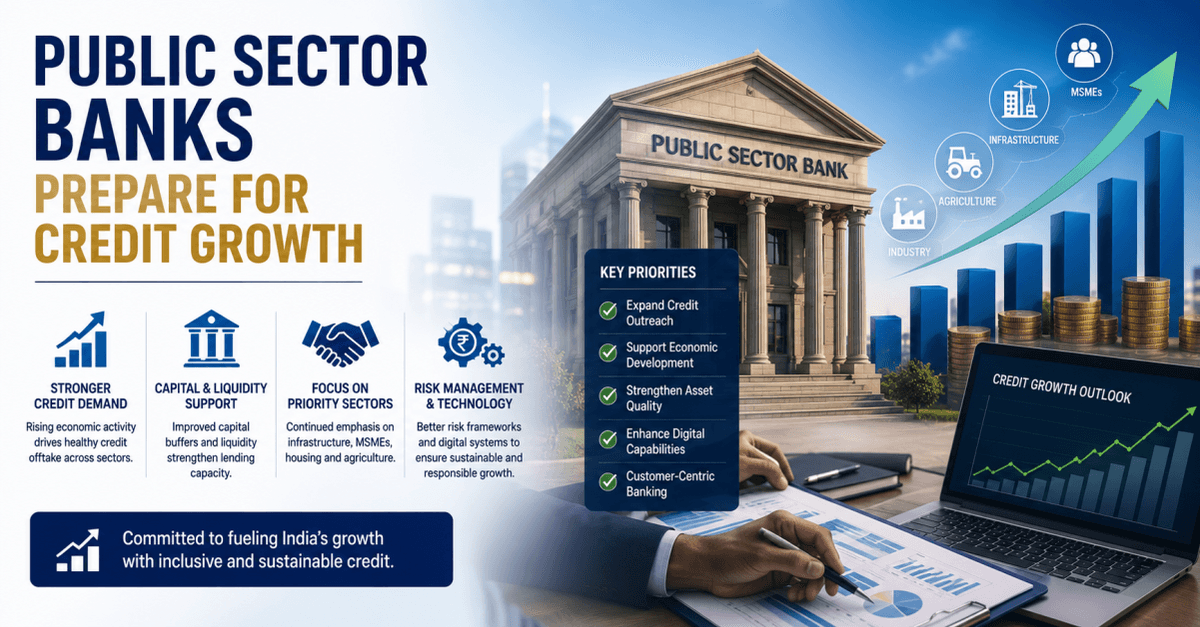
Public Sector Banks Prepare for Credit Growth as Lending Demand Strengthens Across Key Sectors
India's public sector banks (PSBs) are positioning themselves for stronger credit growth as demand for loans is expected to improve across retail, corporate, agriculture, infrastructure, and micro, small and medium enterprises (MSMEs). Supported by healthy balance sheets, improved asset quality, stronger capital positions, and continued digital transformation, state-owned lenders are looking to expand lending while maintaining prudent risk management.
The banking sector enters the new financial year with a focus on supporting economic activity, financing infrastructure projects, and increasing credit access for businesses and households.
Credit Demand Expected to Improve
Public sector banks anticipate steady growth in loan demand across multiple segments, driven by:
-
Infrastructure investment
-
Manufacturing expansion
-
Housing finance
-
Retail consumption
-
MSME financing
-
Renewable energy projects
-
Agriculture and rural development
-
Digital economy businesses
Government capital expenditure, private investment, and resilient domestic consumption are expected to remain important drivers of banking credit.
Focus Areas for Lending
Infrastructure Projects
Banks are expected to increase financing for roads, railways, airports, ports, renewable energy, urban development, and other large infrastructure projects supporting India's long-term economic growth.
MSME Financing
Public sector banks continue to strengthen lending to MSMEs through simplified digital loan processes, government-backed credit guarantee schemes, and specialized financing programs aimed at supporting employment and entrepreneurship.
Retail Banking
Demand for home loans, vehicle loans, education loans, and personal finance products remains an important contributor to overall credit expansion.
Corporate Lending
As corporate investment activity gradually improves, banks are preparing to finance expansion projects, working capital requirements, and capacity additions across manufacturing, services, and infrastructure sectors.
Stronger Financial Position Supports Growth
Public sector banks have significantly strengthened their financial health in recent years through:
-
Lower gross non-performing assets (NPAs)
-
Higher capital adequacy ratios
-
Improved profitability
-
Better provisioning coverage
-
Stronger liquidity positions
-
Enhanced governance practices
These improvements provide banks with greater flexibility to support higher lending while maintaining financial stability.
Digital Transformation Accelerates
Banks continue investing in digital technologies to improve customer experience and operational efficiency.
Key areas of investment include:
-
Artificial intelligence (AI)
-
Digital loan processing
-
Fraud detection systems
-
Cybersecurity
-
Mobile banking platforms
-
Data analytics
-
Cloud-based infrastructure
-
Customer relationship management (CRM)
-
Automated compliance solutions
-
Digital onboarding
Technology adoption is helping reduce processing times while improving credit assessment and customer service.
Key Challenges
Despite positive growth prospects, public sector banks continue to face several challenges.
Asset Quality Monitoring
As lending expands, maintaining disciplined underwriting standards and monitoring credit quality remain essential.
Interest Rate Environment
Changes in monetary policy and borrowing costs could influence credit demand and loan profitability.
Cybersecurity Risks
Growing digital banking activity requires continued investment in cyber resilience and fraud prevention.
Competition
Public sector banks continue to compete with private banks, non-banking financial companies (NBFCs), and fintech firms across lending and digital financial services.
Global Economic Uncertainty
Geopolitical developments, commodity price volatility, and global financial market conditions could affect business sentiment and credit demand.
Government and RBI Support
Public sector banks continue to benefit from policy measures aimed at strengthening the financial system and supporting economic growth.
Areas receiving continued policy attention include:
-
Infrastructure financing
-
Financial inclusion
-
Digital public infrastructure
-
Priority sector lending
-
MSME credit
-
Sustainable finance
-
Responsible AI adoption in banking
-
Risk management and governance
The Reserve Bank of India has also encouraged banks to strengthen operational resilience while leveraging technology responsibly.
Future Outlook
The outlook for public sector banks remains positive as India's economy continues to expand and investment activity gathers momentum.
Key trends expected to shape future credit growth include:
-
Increased infrastructure financing
-
Expansion in MSME lending
-
Higher retail credit demand
-
AI-driven credit assessment
-
Sustainable and green financing
-
Digital banking innovation
-
Improved financial inclusion
-
Greater use of data analytics
-
Enhanced cybersecurity investments
-
Continued balance sheet strengthening
Banks that successfully combine prudent lending practices with technology-led innovation are expected to play a central role in supporting India's long-term economic development.
Conclusion
Public sector banks are preparing for the next phase of credit expansion by strengthening their lending capabilities, improving digital infrastructure, and maintaining healthy balance sheets. Demand from infrastructure, retail, corporate, and MSME sectors is expected to support sustained loan growth while contributing to broader economic activity.
Although challenges such as global uncertainty, cybersecurity risks, and evolving regulatory requirements remain, the sector is better positioned than in previous years to support India's investment cycle. Continued focus on responsible lending, technological innovation, and financial resilience is expected to underpin the long-term growth of public sector banks.
 Public Sector Banks Prepare for Credit Growth Amid Rising Loan Demand FAQs
POST A COMMENT (0)
All Comments (0)
Replies (0)