





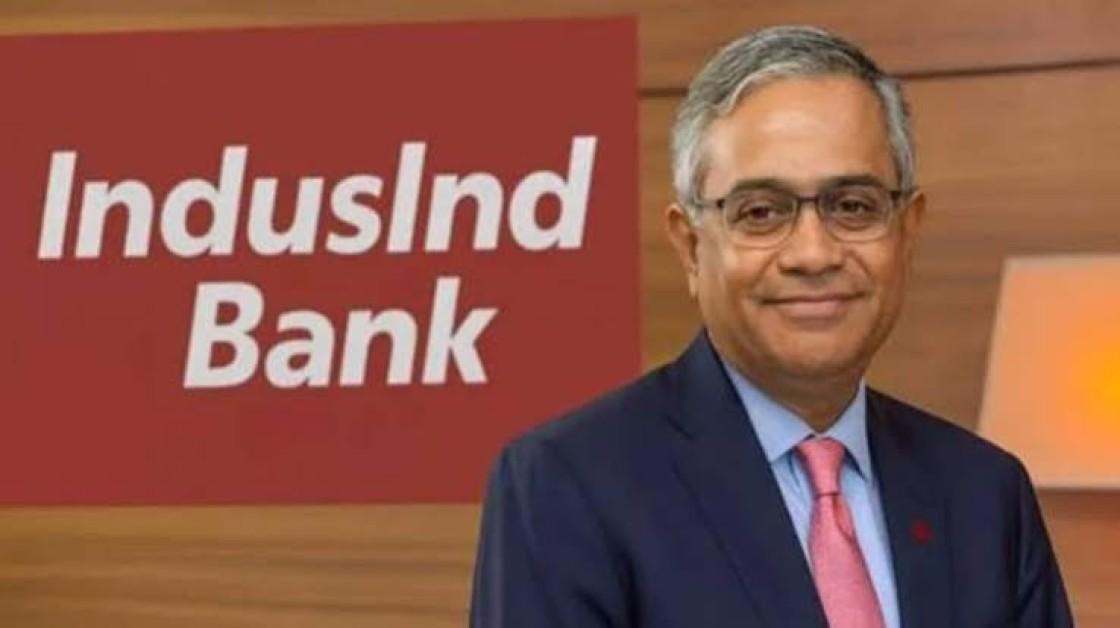
IndusInd Bank Targets 15–20% FY27 Microfinance Growth as Management Says Sector’s Difficult Phase Is Over
IndusInd Bank expects its microfinance portfolio to expand by 15–20% during FY27 as improving risk trends, stronger disbursements and stabilising rural credit conditions give management confidence that the most difficult phase for the business has passed.
Managing Director and Chief Executive Officer Rajiv Anand said growth should begin returning from the:
second quarter of FY27
after the bank scaled up disbursements and saw underlying credit risks develop more favourably.
The outlook represents an important shift for IndusInd Bank after a period in which the lender deliberately became more cautious toward microfinance while dealing with:
asset-quality stress,
slower disbursements,
internal-control weaknesses,
and accounting issues linked to its microfinance operations.
Management now expects the broader microfinance and rural banking franchise to regain momentum as new lending expands and legacy stress continues to recede.
Anand said the bank believes its microfinance business can grow:
15–20% during FY27.
For IndusInd Bank as a whole, management expects asset growth to broadly track the banking market, which it currently estimates at around:
17–18%.
The renewed growth ambition makes microfinance an important part of the bank's wider effort to rebuild disciplined asset growth after several quarters of balance-sheet contraction and heightened scrutiny.
IndusInd Bank Sees Microfinance Growth Returning From Q2

Management expects growth in the microfinance business to return from:
Q2 FY27 onward.
The bank had previously slowed lending as it strengthened underwriting and reviewed the quality of the portfolio.
According to Anand, the bank needed to increase:
disbursements
before the loan book could begin expanding again.
That process has now occurred.
Management believes the combination of higher originations and improving risk indicators creates a foundation for renewed growth through the remainder of FY27.
FY27 Microfinance Growth Target Is 15–20%
IndusInd Bank's current expectation is for its microfinance portfolio to grow approximately:
15–20%
during the financial year.
That is a meaningful target because microfinance had been one of the areas where the bank exercised substantial caution following industry-wide stress and internal problems.
A return to double-digit growth would indicate that management is moving from:
portfolio defence
toward:
controlled expansion.
The key word is controlled.
The bank is not signalling a return to indiscriminate lending.
Instead, it is attempting to rebuild growth while maintaining tighter:
underwriting,
borrower selection,
and risk controls.
Management Says Difficult Phase Is Behind the Business
Anand said the microfinance franchise had experienced a:
fairly difficult period
but indicated that the worst phase is now behind the bank.
Management is seeing risk evolve:
more favourably.
That provides greater confidence that fresh disbursements can be increased without recreating the stress that affected the business previously.
For investors, this is important because microfinance can generate attractive returns when:
collection efficiency is strong
and:
credit costs remain controlled.
But the same portfolio can deteriorate rapidly when borrowers become overleveraged or repayment conditions weaken.
Microfinance Was Hit by Both Sector Stress and Internal Problems
IndusInd Bank's challenges went beyond the wider microfinance downturn.
The bank also faced serious:
governance
and:
accounting issues
during 2025.
Problems involving its microfinance subsidiary:
Bharat Financial Inclusion Limited, or BFIL,
became part of a broader governance crisis at the lender.
The bank later reversed approximately:
₹674 crore
of cumulative interest income that had been incorrectly recognised during FY25.
It separately disclosed approximately:
₹172 crore
of fraud involving employees who had incorrectly reported amounts as fee income within the microfinance business.
These developments significantly increased scrutiny of:
internal controls,
financial reporting,
risk management,
and management oversight.
BFIL Is Central to IndusInd Bank’s Rural Strategy
Bharat Financial Inclusion is an important part of IndusInd Bank's:
rural banking franchise.
The platform has traditionally provided small-ticket credit to customers who may have limited access to conventional bank lending.
Microfinance customers can include:
women borrowers,
small entrepreneurs,
self-employed individuals,
and households
across rural and semi-urban markets.
The business gives IndusInd Bank exposure to a very different customer segment from its:
corporate,
vehicle finance,
credit-card,
or affluent retail businesses.
Rural Banking Is Broader Than Traditional Microfinance
IndusInd Bank is increasingly positioning the rural franchise as broader than:
group-based microfinance.
Management has highlighted businesses such as:
Bharat Superstore
as an important growth area.
This segment provides credit to small merchants such as:
kirana stores,
restaurants,
and other local businesses.
The diversification is strategically important because it reduces reliance on a single type of rural borrower.
Bharat Superstore Continues to Perform Strongly
Management has described Bharat Superstore as:
performing strongly.
The business lends to merchants operating in India's enormous informal and semi-formal retail economy.
Small merchants may require financing for:
inventory,
working capital,
equipment,
store expansion,
and everyday business expenses.
Many of these businesses have stable cash flows but limited access to conventional:
secured bank credit.
That creates a large addressable opportunity for lenders with strong distribution and underwriting capabilities.
Merchant Lending Can Diversify Rural Credit Risk
A merchant loan and a conventional microfinance loan are not identical.
They may differ across:
ticket size,
repayment structure,
customer cash flows,
and underwriting.
Building a larger merchant portfolio can therefore make IndusInd Bank's rural franchise:
more diversified.
It also gives the bank an opportunity to deepen relationships with small businesses that could eventually use additional products such as:
payments,
deposits,
insurance,
and transaction banking.
Rural Banking Could Become a Larger Growth Engine
Management expects the overall:
microfinance and rural banking business
to show stronger growth from the second quarter onward.
That distinction matters.
IndusInd Bank is not relying exclusively on traditional MFI loans to generate rural growth.
The bank is attempting to build a wider franchise across:
micro borrowers,
merchants,
and potentially other rural customers.
A more diversified model can improve long-term economics if the bank can keep:
credit costs
under control.
Disbursement Growth Is Critical
A lending portfolio cannot expand sustainably without:
new disbursements.
During periods of stress, banks often deliberately reduce originations.
This has two consequences.
It lowers near-term risk.
But it also causes the loan book to:
shrink
as existing borrowers repay their loans.
IndusInd Bank has now begun increasing disbursements again.
That is why management expects portfolio growth to resume.
New Lending Needs Better Quality Than Legacy Book
The quality of new disbursements will determine whether the recovery is sustainable.
The bank's challenge is not merely to:
lend more.
It needs to ensure that new borrowers demonstrate:
strong repayment capacity,
reasonable leverage,
accurate documentation,
and acceptable bureau history.
If new vintages perform substantially better than older stressed loans, overall portfolio quality can gradually improve.
Microfinance Stress Had Forced Industry-Wide Caution
The difficulties were not unique to IndusInd Bank.
India's microfinance industry experienced a period of elevated stress as some borrowers accumulated:
multiple loans
from different lenders.
High borrower indebtedness can weaken repayment capacity.
Local disruptions and economic pressures can compound the problem.
When several lenders finance the same household, even relatively small deterioration in income can result in:
missed repayments.
Industry Tightened Lending Standards
The sector responded with tighter:
underwriting
and:
self-regulatory guidelines.
Lenders increasingly focused on limiting exposure to borrowers with:
multiple existing loans
or:
high indebtedness.
Banks and NBFC-MFIs also increased attention to:
credit bureau data,
customer verification,
and collection behaviour.
The result was slower loan growth but improved discipline.
IndusInd Bank Strengthened Internal Processes
IndusInd Bank has also been strengthening its own microfinance processes.
The bank previously highlighted measures including:
revalidating KYC information,
tightening underwriting,
performing loan-utilisation checks,
and strengthening quality controls.
These actions temporarily affected:
disbursement growth.
But management viewed them as necessary to rebuild confidence in the franchise.
Stronger Controls Are Essential After Accounting Issues
The need for stronger internal processes is particularly important because IndusInd Bank's problems included:
financial reporting failures.
A bank can absorb ordinary credit losses if it has:
adequate capital
and:
correct risk information.
Accounting or control failures are potentially more serious because they can distort management's understanding of:
profitability,
portfolio quality,
and capital requirements.
The bank therefore needs both:
better credit performance
and:
stronger governance.
Q1 FY27 Shows Earnings Recovery
IndusInd Bank's June-quarter performance provided early evidence of broader financial stabilisation.
The bank reported consolidated profit after tax of approximately:
₹1,037 crore
for Q1 FY27.
That represented growth of about:
72% year-on-year
from roughly:
₹604 crore
in the corresponding period.
Lower provisions and reduced slippages helped support the earnings improvement.
Standalone Profit Was Around ₹1,003 Crore
On a standalone basis, the bank reported net profit of approximately:
₹1,003 crore.
The difference between standalone and consolidated profit reflects earnings from:
subsidiaries
and:
other consolidated entities.
Both measures showed a significant improvement from the previous year.
For investors, consolidated performance provides a broader view of the overall financial group.
Net Interest Income Remained Relatively Weak
Despite the profit recovery, revenue trends remained mixed.
Net interest income was approximately:
₹4,685 crore
during Q1 FY27.
Growth was only around:
1% year-on-year.
That reflects the fact that the bank's overall loan book remained below year-ago levels.
The next phase of the recovery therefore requires more than:
lower credit costs.
It also requires:
renewed balance-sheet growth.
Loan Book Returned to Sequential Growth
IndusInd Bank's net advances reached approximately:
₹3.26 lakh crore
at the end of June 2026.
The loan book increased approximately:
3.3% sequentially.
This was significant because it marked the first quarterly increase after:
four consecutive quarters of contraction.
On a year-on-year basis, however, advances remained approximately:
2.3% lower.
The numbers illustrate where the bank currently stands:
the contraction appears to have stopped,
but full growth recovery is still underway.
Overall Asset Growth Could Reach 17–18%
Management expects the bank's total asset growth to broadly match the banking industry's pace.
Anand indicated the market is currently growing around:
17–18%.
IndusInd Bank believes it can grow in approximately:
the same range.
That would represent a significant acceleration from the year-on-year contraction visible at the end of June.
Achieving that level will require expansion across multiple lending categories, not merely microfinance.
Bank Is Rebuilding a Diversified Loan Portfolio
IndusInd Bank operates across several lending segments including:
vehicle finance,
corporate banking,
consumer finance,
microfinance,
SME lending,
and rural banking.
Management has emphasised building a more:
diversified portfolio.
This is important because excessive concentration in any one lending category can create earnings volatility when that sector enters a downturn.
Microfinance Can Deliver Attractive Returns
Microfinance has historically been attractive to lenders because it can generate:
relatively high yields.
Small-ticket unsecured loans typically carry higher pricing than:
prime mortgages
or:
large corporate loans.
When credit costs are low, this can support:
strong margins
and:
returns on assets.
But the higher yield exists partly because the underlying credit risk is also greater.
Credit Costs Determine True Profitability
The headline interest rate on a microfinance loan does not determine:
economic profitability.
The lender must subtract:
funding costs,
operating expenses,
collection expenses,
and credit losses.
Microfinance involves large numbers of:
small-value accounts.
That creates substantial operational requirements.
When delinquencies rise, the economics can deteriorate quickly.
This is why management's statement that risk is improving is at least as important as its:
15–20% growth target.
Growth Without Asset Quality Would Be Counterproductive
For IndusInd Bank, the priority will be:
quality-adjusted growth.
Rapid disbursement expansion would provide little benefit if it caused another increase in:
slippages
and:
provisions.
The bank therefore needs to demonstrate that new lending cohorts are performing better.
Investors will likely track:
delinquencies,
collection efficiency,
slippage ratios,
and credit costs
alongside loan growth.
Q1 Asset Quality Improved
At the overall bank level, asset quality improved during Q1 FY27.
Gross non-performing assets were approximately:
3.25% of gross advances
at June 30, 2026.
That compared with:
3.43%
at the end of March.
Net NPAs improved to approximately:
0.95%
from:
1.00%.
The movement suggests that overall credit stress was becoming more manageable.
Provision Coverage Was Above 71%
IndusInd Bank's provision coverage ratio stood at approximately:
71.42%.
Provision coverage indicates the extent to which the bank has already set aside money against:
identified bad loans.
Higher coverage generally provides greater protection against future losses on existing NPAs.
However, investors also need to monitor the emergence of:
new bad loans.
That is particularly relevant in unsecured and microfinance portfolios.
Capital Position Remains Important
IndusInd Bank's capital position provides another layer of protection.
Its total Basel III capital adequacy ratio stood at approximately:
17.15%
at the end of June 2026.
Its Tier 1 capital ratio was approximately:
16.10%.
This capital base gives the lender capacity to absorb losses while continuing to:
grow lending.
ECL Rules Will Create Additional Capital Requirement
Banks are also preparing for India's transition toward:
Expected Credit Loss, or ECL, provisioning.
The framework is scheduled to come into force from:
April 1, 2027.
Unlike older incurred-loss models, ECL requires banks to recognise potential credit losses:
earlier.
This can create an upfront increase in provisions.
IndusInd Estimates ECL Impact at 1–1.5% of Assets
Management currently estimates that the ECL transition could require approximately:
1–1.5% of assets.
This remains a preliminary estimate.
Anand said IndusInd Bank's net worth should be:
more than adequate
to absorb the impact.
The bank estimates the effect on Common Equity Tier 1 capital at approximately:
one percentage point.
CET1 Was Around 16.1% at June End
IndusInd Bank's CET1 ratio was approximately:
16.1%
at the end of June 2026.
A one-percentage-point impact would still leave the bank with a substantial capital buffer, assuming other variables remain broadly stable.
Capital adequacy is particularly important during a growth phase because expanding loans increases:
risk-weighted assets.
The bank therefore needs enough capital to support both:
regulatory changes
and:
business expansion.
ECL Could Encourage Better Risk Pricing
The ECL regime may also change lending behaviour across the banking industry.
If banks need to provision earlier for expected future losses, lenders may become more selective about:
high-risk borrowers.
They may also price risk more accurately.
For microfinance, this could reinforce the shift toward:
stronger borrower screening
and:
more conservative leverage limits.
Governance Recovery Remains as Important as Loan Growth
IndusInd Bank's recovery story cannot be evaluated solely through:
financial metrics.
The governance crisis of 2025 damaged confidence in:
management processes
and:
internal controls.
Rebuilding credibility requires demonstrating that control improvements are:
institutional
rather than temporary.
Investors will therefore look for evidence of:
stronger oversight,
clear accountability,
and accurate disclosures.
New Management Faces a Rebuilding Mandate
Rajiv Anand's leadership comes at an important stage for the bank.
The task is not simply to:
restore growth.
Management must simultaneously improve:
governance,
risk management,
profitability,
deposit quality,
and franchise confidence.
These objectives sometimes conflict.
A bank can generate faster growth by loosening standards.
But during a rebuilding phase, sustainable growth is more valuable than:
headline expansion.
Deposits Provide Funding Base for Recovery
IndusInd Bank's deposits stood at approximately:
₹4.14 lakh crore
at the end of June.
This was higher than about:
₹3.97 lakh crore
a year earlier.
A stable deposit franchise is essential because loan growth requires:
funding.
Banks with stronger retail deposits generally have greater flexibility in managing:
funding costs
and:
liquidity.
CASA Ratio Remains an Area to Watch
The bank's current and savings account ratio stood at approximately:
29.4%.
CASA deposits are generally cheaper than:
term deposits.
A higher CASA ratio can therefore support:
net interest margins.
IndusInd Bank will need to balance faster loan growth with efforts to improve the quality and cost of:
its deposit base.
Net Interest Margin Remains Under Pressure
Margin recovery is another important variable.
The bank's net interest margin remained under pressure during the June quarter.
Loan growth in higher-yielding segments such as microfinance can potentially help:
asset yields.
But that benefit must be weighed against:
credit risk
and:
funding costs.
The optimal strategy is not necessarily to maximise loan yields.
It is to maximise:
risk-adjusted returns.
Rural Credit Remains a Structural Opportunity
Despite recent stress, India's rural credit market remains:
large.
Millions of households and small businesses still have limited access to:
formal banking.
Digital payments,
Aadhaar-based identity systems,
credit bureaus,
and banking technology
have made it easier for lenders to serve these customers.
This creates a long-term opportunity for banks capable of managing the operational complexity.
Formalisation Can Improve Underwriting
India's economic formalisation can also improve rural and small-business credit assessment.
Greater use of:
digital payments,
bank accounts,
GST data,
and transaction records
creates more information about borrower cash flows.
That can help lenders move from purely relationship-based underwriting toward:
data-driven credit assessment.
For merchant lending businesses such as Bharat Superstore, this could become increasingly important.
Microfinance Still Carries Concentration Risks
The sector's structural opportunity does not eliminate risk.
Microfinance portfolios can be geographically concentrated.
A regional disruption caused by:
weather,
political events,
local economic weakness,
or borrower agitation
can affect large numbers of borrowers simultaneously.
Lenders therefore need diversified portfolios across:
states
and:
customer groups.
Borrower Overleveraging Remains Key Sector Risk
One of the industry's most important lessons has been the danger of:
excessive borrower leverage.
A customer may appear able to repay one small loan.
But if the same borrower has several loans from multiple lenders, the total obligation can become unsustainable.
Better bureau checks and industry coordination are therefore essential.
The quality of sector-wide discipline will influence whether the current recovery lasts.
Growth Target Will Be Tested Over Coming Quarters
IndusInd Bank's 15–20% target provides a clear benchmark for:
FY27.
But the more important indicators will be the quality of that growth.
Investors will watch whether:
disbursements increase,
microfinance assets expand,
delinquencies decline,
and provisions remain controlled.
If all four occur simultaneously, management's statement that the difficult phase is over will gain greater credibility.
Q2 Will Be First Major Test
Because management expects growth to return from:
Q2,
the September quarter becomes especially important.
A stronger loan book would show that higher disbursement activity is converting into:
net portfolio expansion.
Asset-quality indicators will then show whether that expansion is:
healthy.
The combination of volume and quality will matter more than either metric alone.
Recovery Could Improve Earnings Mix
If microfinance returns to profitable growth, it could contribute positively to:
net interest income
and:
fee generation.
A stronger rural franchise may also create cross-selling opportunities.
Customers can potentially use:
savings accounts,
payments,
insurance,
and merchant services.
That increases the economic value of the relationship beyond:
a single loan product.
But Management Discipline Will Remain Crucial
The temptation during a recovery is to accelerate growth too quickly.
IndusInd Bank's recent experience makes disciplined execution particularly important.
The bank needs to show that:
internal controls,
credit standards,
and growth ambitions
are aligned.
If those foundations remain strong, the return of microfinance growth can support the broader turnaround.
Conclusion
IndusInd Bank is targeting 15–20% growth in its microfinance portfolio during FY27 as management says improving risk trends and stronger disbursements indicate that the most difficult phase for the business is behind it.
Managing Director and CEO Rajiv Anand expects growth to return from Q2 FY27, with the wider microfinance and rural banking franchise supported by businesses such as Bharat Superstore.
The renewed optimism follows a difficult period marked by both industry stress and serious internal issues at Bharat Financial Inclusion, including the reversal of approximately ₹674 crore of incorrectly recognised cumulative interest income and a separately disclosed ₹172 crore fraud involving misreported fee income.
IndusInd Bank is now attempting to shift from balance-sheet defence toward disciplined expansion.
Its overall advances stood at approximately ₹3.26 lakh crore at June 2026, rising about 3.3% sequentially after four quarters of contraction, although still below the year-earlier level.
The bank also reported ₹1,037 crore of consolidated Q1 FY27 profit, while gross and net NPAs improved to approximately 3.25% and 0.95%, respectively.
Management expects overall asset growth to move broadly in line with the market at around 17–18%, while the bank's 16.1% CET1 ratio provides a capital buffer ahead of the transition to Expected Credit Loss provisioning from April 2027.
For IndusInd Bank, however, FY27 will not be judged only by whether microfinance grows 15–20%.
The more important test will be whether the bank can achieve that growth while maintaining better underwriting, declining stress, stronger internal controls and sustainable risk-adjusted profitability.
 Related News
POST A COMMENT (0)
All Comments (0)
Replies (0)