





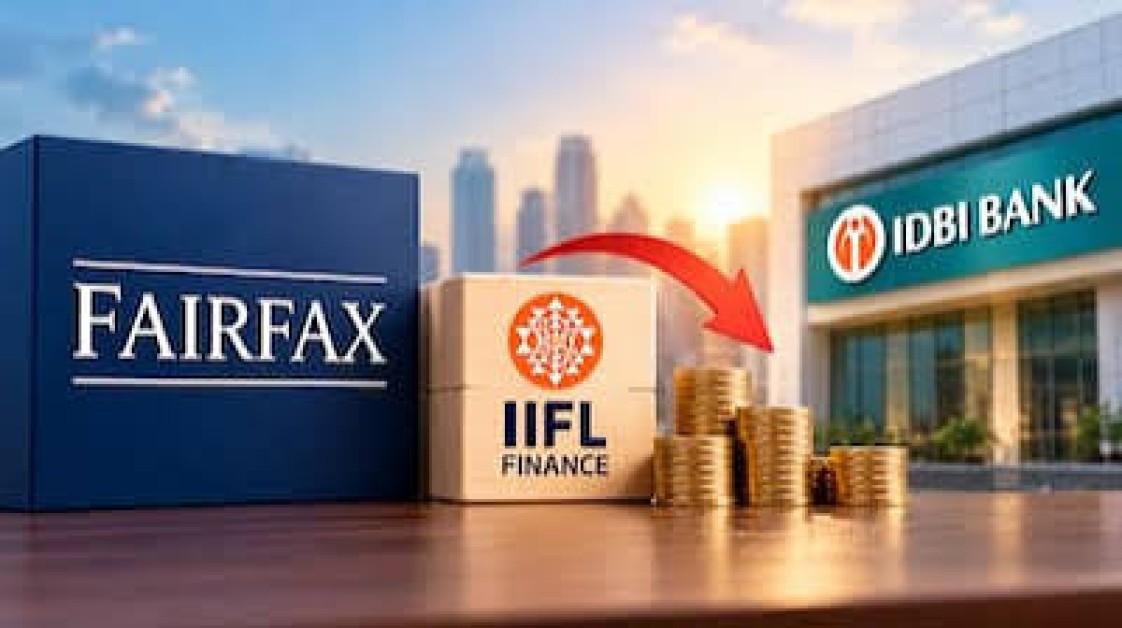
Fairfax Plans IIFL Finance Exit to Help Fund IDBI Bank Acquisition Bid
Prem Watsa-backed Fairfax Financial Holdings is preparing to exit its remaining stake in IIFL Finance and use the proceeds to partly finance its proposed acquisition of a controlling stake in IDBI Bank, as the Canadian investment group reorganises its Indian financial-services portfolio around what could become one of the country's largest banking transactions.
Fairfax is looking to sell its remaining approximately:
13.7% stake in IIFL Finance.
At IIFL Finance's recent market capitalisation of roughly ₹27,700 crore, the holding could be worth approximately:
₹3,800 crore
before any negotiated premium or discount.
The proposed divestment comes as Fairfax moves closer to acquiring the combined 60.72% stake in IDBI Bank being sold by the Government of India and Life Insurance Corporation of India.
The transaction could value the controlling stake at approximately:
₹53,000 crore, or about $5.5 billion,
based on a reported potential offer of around:
₹81 per IDBI Bank share.
Fairfax is also considering a broader restructuring of its Indian financial-services interests following the transaction, including a potential combination of CSB Bank with IDBI Bank and closer integration of IIFL Capital Services with the enlarged banking platform.
Fairfax Plans to Sell Remaining 13.7% IIFL Finance Stake

Fairfax's proposed exit would involve selling its remaining approximately:
13.69% holding in IIFL Finance.
The Canadian investor held:
15.18%
of the non-bank lender at the end of June 2026.
It subsequently sold approximately:
1.49%
to entities associated with Capital Group in July.
That transaction generated approximately:
₹374 crore
and reduced Fairfax's stake to around 13.7%.
A complete exit would release substantially more capital that could be redeployed toward the much larger IDBI Bank transaction.
Remaining Stake Could Be Worth Around ₹3,800 Crore
At an IIFL Finance market capitalisation of approximately:
₹27,700 crore,
Fairfax's remaining stake has an indicative market value of around:
₹3,800 crore.
The actual consideration could differ depending on:
the buyer,
transaction structure,
market conditions,
and any negotiated premium or discount.
Even at current market value, the proceeds would cover only a fraction of the proposed IDBI Bank purchase.
However, the divestment would provide Fairfax with additional liquidity while simultaneously simplifying its Indian lending interests.
Blackstone Is Among Potential Buyers
Fairfax is reportedly in discussions with several private-equity investors regarding the IIFL Finance holding.
Among the potential buyers is:
Blackstone.
The global alternative investment manager has been evaluating a potential investment alongside other interested parties.
The discussions underline the continuing appetite among international investors for India's financial-services industry.
IIFL Finance offers exposure to a large Indian non-bank lending platform at a time when credit demand and formal financial penetration continue to expand.
Fairfax Is Discussing Stake With Multiple PE Investors
Fairfax is understood to be engaging with at least:
four private-equity investors
over the remaining IIFL Finance holding.
A strategic block sale could potentially allow Fairfax to exit more efficiently than selling shares gradually through the public market.
For a buyer, acquiring a large block provides immediate meaningful exposure to IIFL Finance.
For Fairfax, the transaction could accelerate capital mobilisation ahead of the IDBI Bank acquisition.
IDBI Bank Is the Much Larger Strategic Prize
The scale of the two transactions illustrates Fairfax's changing priorities.
IIFL Finance represents a valuable investment, but IDBI Bank would give Fairfax control of a:
large, nationwide commercial banking franchise.
The Government of India and LIC are jointly selling:
60.72% of IDBI Bank.
The stake comprises:
30.48% from the Government of India
and:
30.24% from LIC.
Completing the transaction would fundamentally reshape Fairfax's position in Indian financial services.
IDBI Bank Deal Could Be Worth Around ₹53,000 Crore
Fairfax is currently viewed as the frontrunner in the IDBI Bank privatisation process.
Recent indications suggest a potential acquisition price of approximately:
₹81 per share.
At that level, the controlling stake being sold could be valued at around:
₹53,000 crore, or approximately $5.5 billion.
The final consideration remains dependent on completion of the formal sale process.
If completed around that scale, the transaction would rank among the most significant foreign investments in India's banking industry.
Government and LIC Have Been Seeking to Privatise IDBI Bank
The IDBI Bank sale has been under development for several years.
The Government of India and LIC initiated the strategic divestment process in:
October 2022.
Together, the two shareholders currently control approximately:
94.7% of the lender.
The transaction is designed to transfer management control to a strategic investor while substantially reducing government and LIC ownership.
Following the proposed sale, the government would retain a minority interest, while LIC would also remain a shareholder.
Revised Financial Bids Revived the Sale Process
The privatisation process gained renewed momentum in 2026.
Financial bids had initially been received earlier in the year, but the process faced valuation differences after offers reportedly came below the reserve price.
Authorities subsequently invited:
revised financial bids.
Fairfax and Emirates NBD submitted revised offers.
Fairfax has since emerged as the leading contender as negotiations around valuation and transaction structure progressed.
Fairfax Could Pay Around ₹81 Per Share
The reported potential ₹81-per-share price represents an important reference point for the transaction.
For the government and LIC, valuation is critical because IDBI Bank's financial position has improved substantially from the period when it faced severe asset-quality problems.
The bank has returned to profitability and strengthened its balance sheet.
That turnaround increases the strategic value of the franchise and gives the sellers greater incentive to seek a price reflecting its improved fundamentals.
IIFL Finance Exit Would Part-Fund the Acquisition
Selling IIFL Finance would not independently finance the IDBI transaction.
The estimated ₹3,800 crore value of Fairfax's remaining holding represents only a relatively small portion of a deal potentially worth ₹53,000 crore.
The strategic significance is broader.
The exit can:
release capital,
reduce overlapping lending interests,
simplify regulatory positioning,
and concentrate Fairfax's Indian financial-services exposure around IDBI Bank.
That makes the transaction both a financing measure and a portfolio restructuring.
Fairfax Has Already Brought Capital Into India
Fairfax-linked entities have taken steps that indicate preparations for a major Indian transaction.
Earlier in 2026, entities associated with the group acquired a substantial amount of Indian government securities.
The movement of capital into India was viewed as potentially connected with preparations for the IDBI Bank transaction.
For an acquisition worth several billion dollars, financing and currency management need to be organised well before closing.
The IIFL Finance sale adds another potential source of domestic liquidity.
Fairfax Wants to Simplify Its Lending Interests
Fairfax already has exposure to multiple Indian financial-services businesses.
These include interests in:
IIFL Finance,
CSB Bank,
IIFL Capital Services,
and other financial companies.
Acquiring IDBI Bank would create significant overlap, particularly across lending and banking.
Fairfax is therefore considering a restructuring that would establish a clearer operating architecture.
IDBI Bank could become the central platform around which several of these businesses are organised.
IDBI Bank Could Become Fairfax’s Anchor Banking Investment
The proposed transaction represents a major strategic shift for Fairfax.
Rather than maintaining several separate banking and lending interests, the group could use IDBI Bank as its:
anchor banking platform in India.
The attraction is scale.
IDBI Bank provides an established:
deposit franchise,
branch network,
corporate relationships,
retail customers,
digital infrastructure,
and banking licence.
Building a comparable institution organically would take many years and require substantial investment.
Acquisition provides immediate scale.
Fairfax Also Owns 40% of CSB Bank
Fairfax currently owns approximately:
40% of CSB Bank.
The Kerala-headquartered private-sector lender has been one of Fairfax's most important banking investments in India.
Fairfax originally invested in the institution when it was known as Catholic Syrian Bank and subsequently supported its transformation and stock-market listing.
The IDBI Bank transaction creates an important strategic question:
what happens to CSB Bank?
Maintaining significant interests in two separate banks creates regulatory and strategic complications.
Fairfax Now Plans to Merge CSB Bank With IDBI Bank
The latest proposed structure involves:
merging CSB Bank with IDBI Bank
after Fairfax completes the acquisition.
This differs from earlier reports suggesting Fairfax could sell its CSB Bank stake.
A merger would allow the investor to retain the value it has built in CSB while consolidating both institutions under:
a single banking licence.
Such a transaction would remain subject to regulatory approvals and detailed transaction structuring.
CSB Bank Sale Had Previously Been Considered
Fairfax had earlier explored the possibility of divesting its CSB Bank holding.
However, potential valuations reportedly did not adequately reflect the capital Fairfax believed it had invested in building the lender.
A merger with IDBI Bank provides an alternative.
Instead of selling CSB to another investor, Fairfax could potentially combine its franchise with the much larger IDBI platform.
That could preserve strategic value while addressing concerns around holding interests in multiple banks.
A Merger Could Create a Larger Banking Platform
Combining CSB Bank and IDBI Bank could create a broader financial institution with complementary strengths.
IDBI Bank brings:
national scale,
corporate banking relationships,
a large customer base,
and an established branch network.
CSB Bank brings:
a strong regional franchise,
retail banking capabilities,
SME exposure,
and a substantial presence in southern India.
A combination could potentially strengthen the enlarged bank's geographic and customer diversification.
Regulatory Approval Would Be Critical
Any CSB-IDBI merger would require extensive regulatory review.
Indian banking transactions involve oversight from authorities including:
the Reserve Bank of India
and other relevant government and market regulators.
Issues would include:
ownership,
capital adequacy,
governance,
management,
minority shareholders,
valuation,
and systemic considerations.
The proposed combination should therefore be viewed as a post-acquisition strategic intention rather than a completed transaction.
IIFL Finance Exit Could Reduce Business Overlap
Selling the IIFL Finance stake could also simplify the structure from a regulatory perspective.
IIFL Finance is a major:
non-banking financial company.
Its activities include lending across several retail and secured-credit categories.
Owning a controlling interest in IDBI Bank while retaining a significant strategic investment in a major NBFC could create overlapping financial-services interests.
A complete exit reduces that complexity.
Fairfax Is Separately Increasing Its IIFL Capital Exposure
Interestingly, Fairfax's plans for:
IIFL Capital Services
are moving in the opposite direction.
Rather than exiting the capital-markets company, Fairfax has been increasing its exposure.
In May 2026, Fairfax's India investment vehicle agreed to invest approximately:
₹2,000 crore
to increase its stake and become the majority owner of IIFL Capital Services.
The distinction reflects the different nature of the businesses.
IIFL Finance is primarily a lending institution.
IIFL Capital operates across:
wealth management,
broking,
investment banking,
and capital markets.
IIFL Capital Could Complement IDBI Bank
Fairfax is considering integrating IIFL Capital more closely with the wider IDBI Bank platform.
That could give the bank access to capabilities beyond conventional lending.
A combined financial-services ecosystem could potentially offer:
retail banking,
corporate banking,
wealth management,
brokerage,
investment banking,
and capital-markets services.
This resembles the diversified financial-services models operated by several of India's largest private-sector banking groups.
IDBI Bank Could Become a Universal Financial Platform
The strategic logic appears to extend beyond simply buying a bank.
Fairfax could potentially use IDBI Bank as the foundation for a:
broader universal financial-services platform.
Banks possess valuable customer relationships.
A retail banking customer may also require:
investments,
insurance,
wealth management,
loans,
and brokerage services.
A corporate client may need:
credit,
cash management,
capital raising,
investment banking,
and treasury products.
Integrating specialist businesses around a bank can therefore increase revenue per customer.
Fairfax Has a Long History of Investing in India
Fairfax Financial Holdings, led by Indian-born Canadian investor:
Prem Watsa,
has invested in India for decades.
Its portfolio has included businesses across:
banking,
insurance,
financial services,
infrastructure,
and other sectors.
Unlike investors focused primarily on shorter investment cycles, Fairfax has historically presented itself as a:
long-term capital provider.
The potential IDBI acquisition would take that strategy to a substantially larger scale.
IDBI Bank Offers Immediate Nationwide Distribution
One of IDBI Bank's greatest strategic assets is its established distribution network.
Banking is difficult to scale because deposits require:
consumer trust,
regulatory compliance,
technology,
branches,
and long-term relationships.
An investor entering the Indian market from scratch would need years to build those capabilities.
IDBI Bank already has them.
This allows Fairfax to acquire not simply financial assets but an operating banking platform with national reach.
Deposit Franchise Is Particularly Valuable
Banks have a structural advantage over many non-bank lenders because they can access:
retail deposits.
Deposits can provide relatively stable and cost-effective funding compared with relying heavily on:
wholesale borrowing,
bonds,
or bank loans.
This funding advantage can become particularly important during periods of market volatility.
For Fairfax, controlling a large deposit-taking institution would materially strengthen its position in Indian lending.
India’s Credit Market Remains Attractive to Global Investors
The IDBI transaction also reflects broader international interest in Indian financial services.
India offers:
rising household incomes,
formalisation of savings,
increasing credit penetration,
rapid digital payments adoption,
and long-term economic growth.
Global investors are therefore seeking exposure to:
banks,
NBFCs,
insurance,
wealth management,
and capital markets.
Large transactions demonstrate that international investors increasingly view Indian financial institutions as strategic long-term assets rather than minority portfolio holdings.
Banking Consolidation Could Accelerate
A successful Fairfax-IDBI transaction could also influence future banking consolidation.
India's financial sector includes:
large public-sector banks,
private banks,
small finance banks,
regional institutions,
and NBFCs.
As competition increases and technology investment becomes more expensive, scale becomes increasingly valuable.
Larger banks can spread spending on:
digital infrastructure,
cybersecurity,
compliance,
and product development
across a broader customer base.
Mergers and acquisitions could therefore become a more important route to scale.
IDBI Deal Would Be a Landmark Privatisation
The transaction is also significant for the Indian government's disinvestment programme.
IDBI Bank represents one of the most prominent banking privatisations attempted in India.
Successful completion would demonstrate that the government can transfer control of a large financial institution to a strategic private investor while retaining minority ownership.
It could also provide a reference point for future asset sales.
Valuation Remains a Key Issue
Despite progress, valuation remains central to the transaction.
The IDBI sale process has already experienced delays because earlier financial bids reportedly fell below the reserve price.
The government and LIC need to balance:
maximising sale proceeds
with:
successfully completing the privatisation.
Fairfax, meanwhile, must ensure that the acquisition price allows it to generate an adequate long-term return after accounting for:
capital requirements,
integration costs,
and future investment.
IIFL Finance Sale Could Attract Strong Institutional Interest
The potential disposal of Fairfax's IIFL Finance stake creates a significant secondary transaction in its own right.
A block worth roughly:
₹3,800 crore
would provide a large institutional investor with meaningful exposure to one of India's established NBFCs.
The reported interest from Blackstone and other private-equity firms indicates that Fairfax may have multiple options.
Competitive interest could also influence the final valuation achieved for the holding.
Fairfax’s India Portfolio Could Look Very Different After the Deal
If the proposed transactions proceed, Fairfax's Indian financial-services portfolio could undergo a substantial transformation.
The group could:
exit IIFL Finance,
acquire control of IDBI Bank,
combine CSB Bank with IDBI Bank,
and integrate IIFL Capital capabilities around the broader platform.
The result would be a more concentrated structure centred on:
one major banking franchise.
This would represent a shift from a portfolio of separate investments toward a more integrated financial-services strategy.
Execution Will Be the Next Major Challenge
Completing the acquisition would only be the beginning.
Fairfax would then need to manage:
governance transition,
regulatory approvals,
capital allocation,
technology integration,
employee alignment,
and potential business combinations.
If CSB Bank is eventually merged, the integration challenge becomes considerably larger.
Bank mergers can create substantial long-term value, but they can also disrupt operations if systems, cultures and customer propositions aren't aligned effectively.
Conclusion
Prem Watsa-backed Fairfax Financial Holdings is preparing to exit its remaining approximately 13.7% stake in IIFL Finance, potentially generating around ₹3,800 crore that could be used to partly fund its proposed acquisition of a controlling stake in IDBI Bank.
Fairfax is the leading contender for the 60.72% IDBI Bank stake being sold by the Government of India and LIC, with the transaction potentially worth around ₹53,000 crore, based on a reported offer of approximately ₹81 per share.
The strategy extends beyond financing the acquisition. Fairfax is seeking to simplify its Indian lending interests and could ultimately position IDBI Bank as the centre of a much larger financial-services platform.
Its latest plans include a potential merger of CSB Bank with IDBI Bank, while IIFL Capital Services could provide complementary wealth management, broking, investment-banking and capital-markets capabilities.
If completed, the transaction would represent not only a landmark Indian banking privatisation but a fundamental restructuring of Fairfax's financial-services strategy in India.
 Related News
POST A COMMENT (0)
All Comments (0)
Replies (0)