





Banking Sector Outlook for FY27: Credit Growth, Digital Transformation, and Opportunities Ahead
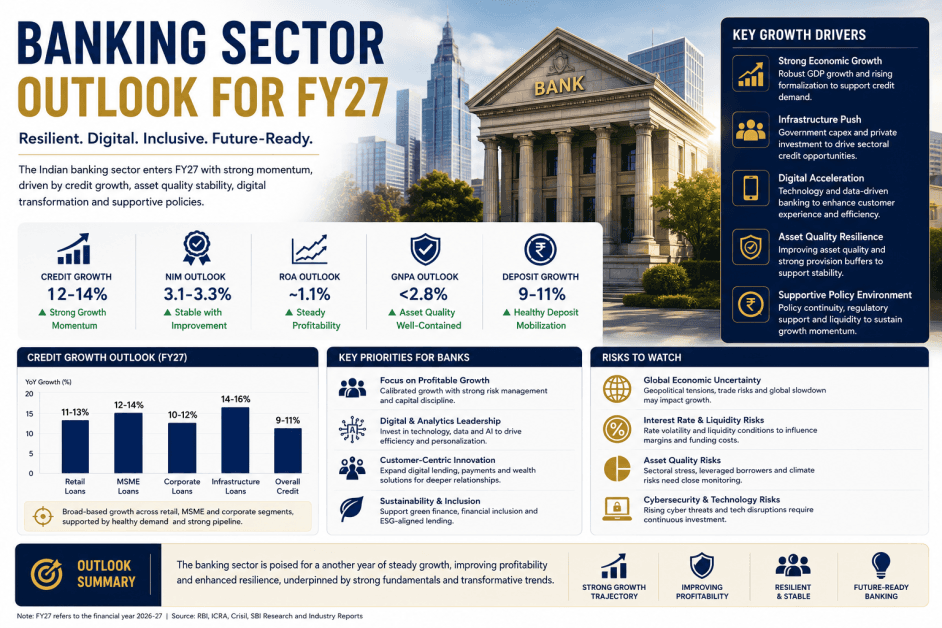
India's banking sector is expected to enter FY27 with a positive outlook, supported by steady economic growth, improving credit demand, continued digital transformation, and strong regulatory oversight. Public and private sector banks are preparing to expand lending across retail, corporate, infrastructure, agriculture, and micro, small and medium enterprises (MSMEs) while maintaining prudent risk management and capital discipline.
The sector is also expected to benefit from continued investments in technology, artificial intelligence (AI), digital payments, and financial inclusion initiatives that are reshaping banking services across the country.
Credit Growth Expected to Remain Healthy
Banks anticipate sustained lending activity across multiple segments, driven by:
-
Infrastructure development
-
Manufacturing expansion
-
Retail consumption
-
Housing finance
-
MSME financing
-
Renewable energy investments
-
Agriculture and rural lending
-
Services sector growth
Government infrastructure spending and private capital expenditure are expected to remain important contributors to overall credit demand.
Digital Banking Continues to Expand
Digital banking is becoming a key competitive differentiator as financial institutions invest in technology to improve efficiency and customer experience.
Major areas of focus include:
-
Mobile banking platforms
-
Digital lending
-
AI-powered customer service
-
Cloud computing
-
Real-time payments
-
Data analytics
-
Robotic process automation (RPA)
-
Digital onboarding
-
Open banking capabilities
-
Enhanced cybersecurity
Banks are increasingly offering paperless account opening, instant loan approvals, and personalized financial services through digital channels.
AI and Automation Gain Importance
Artificial intelligence is expected to play a larger role across banking operations in FY27.
Key applications include:
-
Credit risk assessment
-
Fraud detection
-
Customer support chatbots
-
Predictive analytics
-
Regulatory compliance
-
Anti-money laundering (AML) monitoring
-
Personalized financial recommendations
-
Process automation
Responsible AI deployment, supported by strong governance and cybersecurity frameworks, is likely to remain a regulatory priority.
Asset Quality Remains a Focus
Banks continue to prioritize maintaining healthy balance sheets through:
-
Prudent lending standards
-
Improved credit monitoring
-
Strong provisioning
-
Recovery of stressed assets
-
Effective risk management
-
Portfolio diversification
Improving asset quality over recent years has strengthened the sector's ability to support future credit expansion.
Retail and Corporate Lending Outlook
Retail Banking
Demand for home loans, vehicle finance, education loans, personal loans, and credit cards is expected to remain stable, supported by rising incomes and increasing digital adoption.
Corporate Banking
Corporate lending is likely to benefit from investment in infrastructure, manufacturing, logistics, renewable energy, and digital infrastructure projects.
MSME Financing
Banks are expected to continue expanding lending to MSMEs through digital credit platforms, faster loan processing, and government-supported financing initiatives.
Opportunities Across the Sector
Key opportunities for banks during FY27 include:
-
Expansion of digital lending
-
Infrastructure financing
-
Green and sustainable finance
-
Financial inclusion initiatives
-
Wealth management services
-
Cross-border banking
-
Embedded finance solutions
-
AI-driven banking services
-
Digital payments ecosystem
-
Rural banking expansion
These areas are expected to contribute to revenue growth and customer acquisition.
Key Challenges
Despite positive growth prospects, the banking industry continues to face several challenges.
Global Economic Uncertainty
Geopolitical developments, inflationary pressures, and global financial market volatility may influence business confidence and borrowing activity.
Cybersecurity Risks
As digital banking expands, financial institutions must strengthen cyber resilience to protect customer data and financial infrastructure.
Regulatory Compliance
Banks will continue adapting to evolving regulatory requirements related to digital finance, data privacy, consumer protection, and risk management.
Competitive Landscape
Competition from private banks, fintech companies, non-banking financial companies (NBFCs), and digital-first financial platforms is expected to intensify.
Interest Rate Movements
Changes in interest rates may influence lending demand, funding costs, and net interest margins across the sector.
Future Outlook
The banking sector is expected to remain an important pillar of India's economic growth throughout FY27.
Key trends likely to shape the industry include:
-
Continued credit expansion
-
Greater AI adoption
-
Growth in digital lending
-
Expansion of digital payments
-
Cloud-based banking infrastructure
-
Enhanced cybersecurity investments
-
Sustainable finance initiatives
-
Embedded financial services
-
Improved customer personalization
-
Stronger financial inclusion
Banks that successfully balance innovation, regulatory compliance, operational efficiency, and prudent risk management are expected to strengthen their market position in the evolving financial landscape.
Conclusion
India's banking sector enters FY27 from a position of relative strength, supported by improving asset quality, healthy capital levels, expanding digital capabilities, and resilient credit demand. Continued investment in technology, AI, digital banking, and customer-centric financial services is expected to drive the next phase of industry growth.
While global uncertainties, cybersecurity risks, and regulatory developments will require careful management, the overall outlook remains constructive. Public and private sector banks are well positioned to support India's economic expansion while adapting to the rapidly changing financial services environment.
 Banking Sector Outlook for FY27: Growth Trends, Challenges, and Future Prospects FAQs
POST A COMMENT (0)
All Comments (0)
Replies (0)