





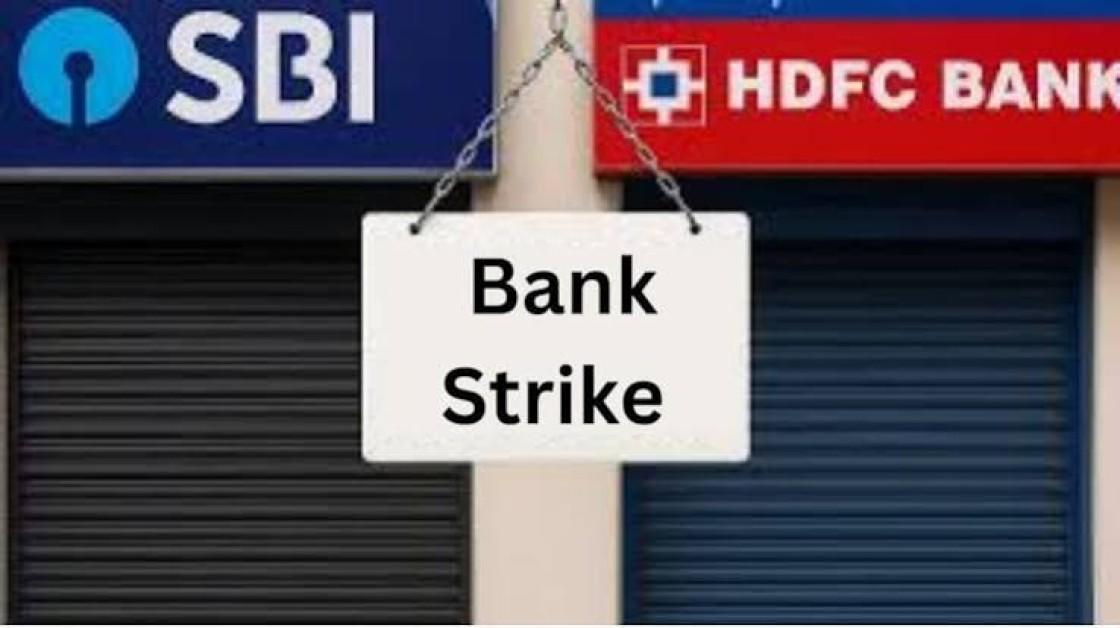
Bank Unions Call Nationwide Strike for September 11 Over Demand for Five-Day Banking Week
Bank employees and officers across India are preparing for a nationwide strike on September 11, 2026, escalating a long-running dispute over the implementation of a five-day banking week and several other unresolved employment issues.
The strike has been called by the United Forum of Bank Unions, an umbrella organisation representing nine major bank employee and officer unions.
The unions say the introduction of five-day banking was already agreed with the Indian Banks' Association under the 12th Bipartite Settlement and 9th Joint Note signed in March 2024, but government approval has remained pending for more than two years.
The September 11 action is also linked to differences over a revised performance-linked incentive framework and outstanding pension-related demands.
If the strike goes ahead, public-sector banking operations could face particularly significant disruption because September 11 falls on a Friday and will immediately be followed by the weekend.
UFBU Announces Nationwide Strike for September 11

UFBU decided to launch the strike after a meeting held on August 23.
The union grouping said the government's response to its major demands remained unsatisfactory.
The immediate action plan includes:
a nationwide strike on September 11,
a three-day nationwide strike from September 28 to September 30,
and an indefinite strike from October 26 if the issues remain unresolved.
The escalating schedule demonstrates how seriously unions are treating the dispute.
Five-Day Banking Is Central Demand
The most prominent demand is the implementation of a five-day banking week.
Bank unions want all Saturdays declared holidays.
At present, banks generally remain closed on the second and fourth Saturdays of each month while operating on the first, third and fifth Saturdays where applicable.
The proposed system would make every Saturday a bank holiday.
Five-Day Banking Was Agreed With IBA in 2024
According to UFBU, the Indian Banks' Association agreed to the five-day banking proposal in the 12th Bipartite Settlement and 9th Joint Note signed on March 8, 2024.
The arrangement included a proposal to increase working hours by approximately 40 minutes from Monday through Friday to compensate for Saturdays becoming non-working days.
The IBA subsequently recommended the proposal to the government.
However, formal implementation still requires government approval and notification.
Delay Has Become Main Source of Union Frustration
The unions argue that the delay is particularly difficult to accept because the industry-level negotiation has already concluded.
Their position is that the issue is no longer primarily a negotiation between bank management and employees.
Instead, the final decision remains pending at the government level.
The prolonged waiting period has become a major source of frustration among bank employees and officers.
Banks Already Operate Two Saturday Holidays
India moved to the current alternate-Saturday structure in 2015.
Under that arrangement:
second Saturdays are holidays,
fourth Saturdays are holidays,
while other Saturdays generally remain working days.
A full five-day banking week would complete the transition by making every Saturday a holiday.
Union Says Longer Weekday Hours Would Protect Customer Service
A common concern surrounding five-day banking is whether reducing branch operating days would inconvenience customers.
The agreement proposed longer working hours during weekdays.
The objective is to compensate partly for the loss of Saturday banking hours.
Unions argue that digital banking has also dramatically reduced the need for customers to visit branches for routine transactions.
Digital Banking Has Changed Customer Behaviour
The five-day banking debate is occurring in a fundamentally different environment from a decade ago.
Indian customers increasingly use:
UPI,
mobile banking,
internet banking,
ATMs,
and digital payment platforms.
Many transactions that once required a branch visit can now be completed around the clock.
This has strengthened the union argument that Saturday branch operations are less essential than they once were.
Physical Branches Still Remain Important
Digital adoption does not mean branches have become irrelevant.
Customers continue to visit banks for:
loan documentation,
cash transactions,
account-related issues,
and complex financial services.
Businesses may also depend on physical branches for operational requirements.
The policy challenge is therefore balancing employee working conditions with customer access.
Strike Could Affect Public-Sector Banks Most
If the September 11 strike materialises, public-sector banks are expected to face the largest operational impact because union membership is particularly strong within those institutions.
Services that could be affected include:
branch transactions,
cash deposits and withdrawals,
cheque processing,
and administrative operations.
The actual scale of disruption will depend on participation across individual banks and locations.
Major Private Banks May Face Less Disruption
Large private-sector institutions generally have lower participation in the unions behind the strike.
Banks such as HDFC Bank, ICICI Bank and Axis Bank may therefore experience less direct disruption than public-sector lenders.
However, interconnected banking processes can still create indirect delays.
Customers should therefore monitor advisories from their individual banks closer to the strike date.
Digital Services Are Likely to Remain Available
UPI, mobile banking and internet banking generally operate through automated technology infrastructure rather than branch employees.
These channels are therefore usually less affected by staff strikes.
Customers can still potentially complete many routine transactions digitally.
However, services requiring manual intervention could experience delays.
September 11 Timing Could Extend Disruption
The timing of the strike is particularly important.
September 11, 2026 is a Friday.
The following two days form the weekend, creating the possibility of prolonged branch disruption.
In some states, September 14 will also be a bank holiday for Ganesh Chaturthi.
That means banking services could effectively be interrupted for four consecutive days in certain regions if the strike proceeds.
Businesses Could Face Greater Impact Than Retail Customers
Individual customers increasingly rely on digital banking.
Businesses may face greater operational difficulties.
Companies still depend on banks for:
large cash transactions,
document processing,
and certain trade-finance services.
A multi-day branch disruption can therefore create working-capital and settlement challenges.
Cheque Clearing Could Face Delays
Cheque usage has declined but remains important for businesses and some individuals.
A nationwide strike can slow cheque processing if employees responsible for clearing and related operational functions do not work.
Customers using cheques around September 11 may therefore need additional time for settlements.
Cash Management Could Be Important
ATMs generally continue operating during bank strikes.
However, extended branch closures can create pressure on cash replenishment in some locations.
Banks typically prepare in advance to maintain ATM availability.
Still, customers requiring significant cash withdrawals may prefer to plan ahead.
UFBU Represents Nine Unions
The United Forum of Bank Unions combines multiple employee and officer organisations.
This gives the grouping substantial bargaining power because industrial action can involve employees across several banks and job categories simultaneously.
A coordinated strike therefore has a larger potential impact than action by one individual union.
PLI Scheme Is Second Major Dispute
Five-day banking is not the only issue.
The unions are also challenging changes to the performance-linked incentive scheme.
They argue that the government's revised model differs from the arrangement originally reached with the Indian Banks' Association.
The dispute concerns how incentives are calculated and which employees benefit.
Existing Understanding Linked PLI to Bank Performance
The unions say the earlier framework tied performance-linked incentives primarily to the overall performance of individual banks.
The incentive structure was intended to operate relatively uniformly across eligible employee and officer categories.
That approach emphasised collective institutional performance.
The newer proposal places much greater emphasis on individual performance for senior officers.
Senior Officers Could Receive Much Larger Incentives
Under the government-backed framework described by the unions, officers in Scale IV and above can potentially receive incentives equivalent to as much as 365 days of basic pay, depending on individual performance.
By comparison, workmen employees and officers up to Scale III may receive a maximum equivalent to around 15 days of basic pay plus dearness allowance.
The unions argue that the gap creates excessive inequality across employee groups.
Union Says PLI Could Divide Workforce
UFBU's objection is partly philosophical.
Banking involves collective performance.
Branches, credit departments, technology teams and operational employees all contribute to institutional results.
The unions argue that heavily differentiated incentives could weaken teamwork.
They prefer a framework where benefits remain more closely connected to the performance of the bank rather than a narrow group of senior officers.
Government May See PLI Differently
From a management perspective, performance-based compensation can be used to reward:
leadership,
productivity,
and accountability.
Private companies routinely use variable compensation for senior executives.
The central policy debate is therefore not whether performance should matter, but how incentives should be distributed within public-sector banking institutions.
PLI Dispute Is Under Conciliation
The disagreement has already entered formal labour-resolution processes.
The PLI issue is under conciliation before the Chief Labour Commissioner following earlier union action.
The matter is also linked to proceedings before the Delhi High Court.
This makes the dispute more complex than an ordinary internal compensation disagreement.
UFBU Objects to Implementation During Conciliation
The unions allege that banks have begun crediting incentives under the government-backed PLI structure even though conciliation proceedings remain pending.
UFBU argues that implementation should not proceed while the dispute remains formally unresolved.
The government and bank managements may take a different interpretation of their obligations.
The disagreement has therefore become another driver of industrial action.
Pension Issues Remain Unresolved
The strike agenda also includes long-standing pension-related demands.
These include:
pension updation,
improvement of pension benefits,
and a uniform dearness allowance formula for pensioners.
Retired bank employees have raised these issues for years.
The unions want them addressed as part of the broader employment settlement.
NPS-to-OPS Option Is Another Demand
UFBU has also sought an option for employees covered under the National Pension System to shift to the older pension framework.
Pension policy remains a sensitive issue across many parts of India's public sector.
Employees often prefer defined-benefit arrangements because retirement income is more predictable.
Governments, however, need to consider the long-term fiscal cost of such commitments.
Banking Workforce Has Changed Dramatically
The dispute is occurring while the structure of banking employment changes rapidly.
Technology is automating many traditional branch functions.
Employees increasingly work on:
relationship management,
credit,
digital adoption,
and customer service.
The unions argue that changing workloads justify updating work schedules and employment conditions.
Five-Day Week Is Common Across Financial Services
Many private financial companies and corporate offices already operate primarily on a five-day workweek.
Bank unions therefore argue that employees should receive similar working conditions.
Their position is also linked to work-life balance and employee wellbeing.
However, banks provide essential public services, which creates additional operational considerations.
Longer Weekdays Could Reduce Operational Difference
The proposal to add approximately 40 minutes to Monday-Friday working hours is intended to ensure that total banking service availability does not fall proportionately with the elimination of Saturdays.
This is an important component of the original industry agreement.
The issue therefore involves redistribution of working hours rather than simply reducing total employee time.
International Banking Practices Vary
Five-day banking is common in many international markets.
However, digital infrastructure, customer behaviour and banking practices differ between countries.
India has a large and diverse customer base, including millions of customers in rural and semi-urban areas.
Any schedule change therefore needs to account for accessibility across different regions.
Rural Customers May Depend More on Branches
Digital adoption is expanding rapidly across rural India.
Still, physical branches remain more important for some customer groups.
Older customers and people requiring complex documentation may prefer in-person banking.
Five-day banking could therefore create different levels of impact across regions.
Banks may need stronger digital-support and business-correspondent networks if Saturdays become holidays.
Business Correspondents Could Help Maintain Access
India has developed a large network of banking correspondents providing services outside conventional branches.
These agents can support:
cash deposits,
withdrawals,
and basic banking transactions.
If formal branches move to five days, such networks could become even more important for maintaining local access.
ATMs and Digital Infrastructure Reduce Dependency
Technology has already separated bank access from bank opening hours.
UPI operates continuously.
ATMs operate continuously.
Mobile banking operates continuously.
A five-day banking week therefore does not mean financial services disappear during weekends.
The most significant change would affect services requiring direct employee involvement.
Strike Threats Are Escalating
September 11 is only the first stage of the union action plan.
UFBU has announced another three-day nationwide strike from September 28 to September 30.
That timing is especially significant because it coincides with the banking industry's half-yearly closing period.
Disruption during financial closing can create additional operational pressure.
September 28 Strike Could Be More Disruptive
Half-yearly closure involves substantial:
accounting,
reconciliation,
and reporting work.
A three-day strike during that period could affect internal operations even if digital customer services remain functional.
This increases pressure on policymakers and bank managements to resolve the dispute before the second phase begins.
Indefinite Strike Threatened From October 26
The unions have gone further by warning that they may begin an indefinite nationwide strike from October 26 if their demands are not addressed.
An indefinite strike would represent a far more serious escalation than a one-day protest.
It could affect banking operations across multiple working days and place substantial pressure on the financial system.
The announcement is therefore intended partly as leverage in negotiations.
Negotiations Could Still Prevent Strike
Strike announcements do not guarantee that industrial action ultimately occurs.
Government representatives, banks and unions can continue negotiations before September 11.
Labour authorities may also intervene through conciliation.
Previous bank strikes have sometimes been postponed following progress in discussions.
Customers should therefore monitor official bank and union updates closer to the date.
Public-Sector Banks Usually Issue Advisories
Listed banks generally inform stock exchanges when union actions could affect operations.
They may also say that contingency arrangements have been made.
These arrangements can reduce disruption but cannot always eliminate it if a large proportion of employees participate.
Customers should watch communications from their own institutions.
Strike Could Affect Financial Markets Indirectly
Banking operations are foundational to the wider economy.
Large disruptions can affect:
corporate settlements,
and transaction processing.
India's financial infrastructure is increasingly automated, reducing these risks.
Still, prolonged industrial action would create greater concern than a single isolated strike.
Five-Day Banking Could Change Branch Workforce Planning
If eventually approved, five-day banking would require operational changes.
Banks would need to redesign:
staff scheduling,
customer appointments,
and branch workflows.
Friday and Monday traffic could increase.
Banks may also need to encourage greater digital adoption for weekend transactions.
Longer Daily Hours Could Change Customer Access
The proposed extension of weekday working hours could benefit customers who struggle to visit banks during conventional schedules.
Even modestly longer hours can provide more flexibility.
The practical value would depend on the final notified branch timings.
A five-day system therefore could potentially improve weekday availability while eliminating Saturday operations.
Employee Wellbeing Is Central Union Argument
Banking can involve substantial pressure from:
sales targets,
customer service,
and compliance requirements.
Union representatives argue that a predictable two-day weekend would improve employee wellbeing and work-life balance.
They contend that better working conditions could also support productivity and retention.
Banks Also Need to Consider Productivity
For bank managements and policymakers, any change must maintain service efficiency.
The industry needs to determine whether:
longer weekday hours,
digital banking,
and automation
can adequately compensate for Saturday closures.
The strong growth of digital transactions suggests the answer may increasingly be yes, but implementation still requires careful planning.
Digital Transaction Growth Strengthens Five-Day Case
India's banking system today processes enormous volumes through UPI and other digital networks.
Many customers can conduct almost all routine banking without entering a branch.
This is fundamentally different from the environment in which six-day branch operations originally developed.
Technology therefore forms an important part of the economic case for modernising working schedules.
Banking Remains an Essential Service
At the same time, banks cannot operate exactly like ordinary corporate offices.
They support:
household finances,
business payments,
and credit.
Availability matters to the economy.
Any settlement therefore needs to balance employee conditions with uninterrupted financial access.
Customers Can Prepare for September 11
If the strike remains scheduled, customers may want to complete branch-dependent transactions before September 11.
This could include:
large cash requirements,
document submissions,
and other in-person work.
Digital transactions should remain the preferred option where available.
Advance planning can minimise disruption.
Businesses Should Pay Attention to Four-Day Window
The combination of the September 11 strike and subsequent holidays creates a particularly important operational window.
Companies that depend heavily on branch services should review:
cash requirements,
and settlement schedules.
This is especially relevant in states where September 14 is also a holiday.
The Dispute Reflects Larger Transformation of Banking Work
The five-day banking demand is ultimately part of a larger question.
How should banking employment evolve when technology allows customers to transact 24 hours a day?
Branches are no longer the only banking channel.
But employees remain essential for complex decisions and relationship management.
Working schedules therefore need to adapt to a financial system that is simultaneously more digital and more demanding.
Conclusion
The United Forum of Bank Unions' nationwide strike call for September 11, 2026 marks a significant escalation in the dispute over the long-pending implementation of a five-day banking week.
UFBU says the five-day framework was agreed with the Indian Banks' Association in March 2024, including an increase of around 40 minutes in weekday working hours, but the required government approval has still not been issued.
The strike also covers disagreements over the government's revised performance-linked incentive system and unresolved pension demands.
The timing could create substantial disruption. September 11 is a Friday, followed by the weekend, while September 14 is a bank holiday in some states for Ganesh Chaturthi.
UFBU has also announced a three-day strike from September 28 to September 30 and threatened an indefinite strike from October 26 if the dispute remains unresolved.
The growing use of digital banking means UPI, mobile banking and many automated services should remain available even if branch operations are affected.
But the larger dispute is unlikely to disappear without a policy decision.
For unions, five-day banking represents completion of an industry settlement and an overdue change in working conditions.
For policymakers and banks, the challenge is ensuring that any new schedule protects customer access, operational continuity and the efficiency of one of India's most important public-service industries.
 Bank Unions Call September 11 Nationwide Strike Over Five-Day Banking Demand FAQs
POST A COMMENT (0)
All Comments (0)
Replies (0)