What Is Fine-Tuning in AI? How It Works, Benefits and Applications
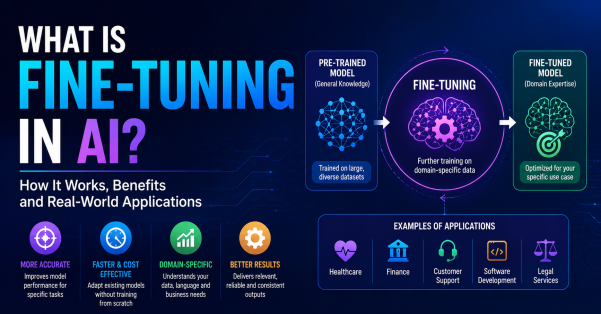
Fine-tuning is a technique in Artificial Intelligence (AI) that improves a pre-trained model by training it further on a specific dataset or task. Instead of building an AI model from scratch, developers adapt an existing model to perform better in specialized domains such as healthcare, finance, legal services, customer support, and software development. Fine-tuning has become an essential part of modern AI because it enables organizations to create more accurate, efficient, and domain-specific AI applications while reducing development time and costs.
What Is Fine-Tuning in AI?
Fine-tuning is the process of taking a pre-trained AI model and continuing its training using a smaller, task-specific dataset. This allows the model to retain its general knowledge while learning industry-specific terminology, workflows, and business requirements.
How Fine-Tuning Works
Developers begin with a foundation model that has already learned from massive datasets. The model is then trained on carefully selected domain-specific data, allowing it to improve its performance for targeted applications without starting from the beginning.
Why Fine-Tuning Matters
Fine-tuning enables organizations to customize AI models for their unique business needs. It improves response accuracy, reduces irrelevant outputs, and enhances performance in specialized tasks where general-purpose AI models may be less effective.
Key Components of Fine-Tuning
Several factors contribute to successful AI fine-tuning.
Pre-Trained Models
Fine-tuning starts with a pre-trained model that already possesses broad language or pattern recognition capabilities. These models serve as the foundation for specialized AI applications.
Domain-Specific Data
The quality of the training dataset significantly affects fine-tuning performance. Accurate, relevant, and well-structured data helps the model learn industry-specific knowledge more effectively.
Model Optimization
During fine-tuning, developers adjust model parameters to improve task performance while preserving the model's existing capabilities and minimizing unnecessary changes.
Applications of Fine-Tuning in AI
Fine-tuning is widely used across industries to build AI solutions tailored to specific business requirements.
Healthcare
Healthcare organizations fine-tune AI models to understand medical terminology, summarize clinical records, assist with diagnostics, and support healthcare professionals.
Financial Services
Banks and financial institutions use fine-tuned AI models for fraud detection, financial analysis, customer support, regulatory compliance, and risk assessment.
Customer Service
Businesses customize AI assistants using company-specific knowledge bases, enabling more accurate responses, faster issue resolution, and improved customer experiences.
Software Development
Developers fine-tune coding models to generate better code suggestions, automate documentation, detect bugs, and support software engineering workflows.
Benefits of Fine-Tuning
Fine-tuning offers several advantages over developing AI models from scratch.
Improved Accuracy
Fine-tuned models deliver more accurate responses because they are trained on data directly related to the target domain or application.
Faster Deployment
Organizations can build specialized AI solutions more quickly by adapting existing models instead of investing significant time and resources in training entirely new models.
Cost Efficiency
Fine-tuning reduces computational costs and infrastructure requirements compared with developing large AI models from the ground up.
Challenges of Fine-Tuning
Although fine-tuning is highly effective, it also presents several practical challenges.
Data Quality
Poor-quality or biased training data can negatively affect model performance, making careful dataset preparation essential.
Computational Resources
Fine-tuning large AI models may require powerful computing infrastructure, specialized hardware, and technical expertise.
Model Maintenance
As industries evolve, fine-tuned models require periodic updates and retraining to maintain accuracy and remain aligned with changing business needs.
Future of Fine-Tuning
Fine-tuning is expected to remain a critical technique in Artificial Intelligence as businesses increasingly adopt domain-specific AI solutions. Advances in transfer learning, parameter-efficient fine-tuning, and foundation models will enable organizations to customize AI more quickly and cost-effectively. As enterprise AI adoption grows, fine-tuning will continue supporting more accurate, secure, and industry-focused intelligent applications.
Conclusion
Fine-tuning has become one of the most important methods for adapting Artificial Intelligence models to specialized business requirements. By refining pre-trained models with domain-specific data, organizations can improve accuracy, reduce development costs, and deploy AI solutions more efficiently. As AI continues to evolve, fine-tuning will play a central role in creating intelligent systems tailored to diverse industries and real-world applications.