





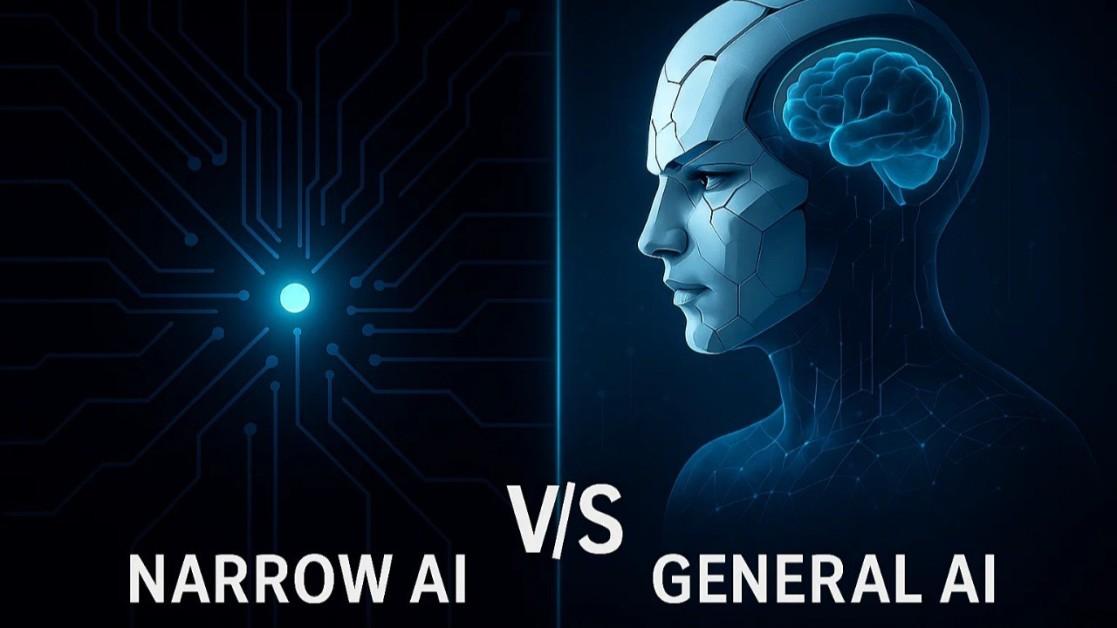
Narrow AI vs General AI: Understanding the Key Differences
Artificial Intelligence (AI) has evolved rapidly over the past decade, transforming industries through automation, data analysis, and intelligent decision-making. However, AI is not a single technology. It is broadly categorized into Narrow AI and General AI based on its capabilities. While Narrow AI powers most of today's intelligent applications, General AI remains a long-term research goal. Understanding the differences between these two forms of AI is essential for businesses, technology professionals, and anyone interested in the future of intelligent systems.
What Is Narrow AI?
Narrow AI, also known as Weak AI, is designed to perform specific tasks with high accuracy. It operates within predefined boundaries and cannot perform tasks outside its training or programming.
How Narrow AI Works
Narrow AI uses machine learning, deep learning, and other AI techniques to analyze data, recognize patterns, and make decisions for a particular task. It excels at solving specialized problems but lacks human-like reasoning across unrelated domains.
Common Applications of Narrow AI
Narrow AI is widely used in virtual assistants, recommendation systems, fraud detection, language translation, image recognition, medical diagnostics, customer support, and autonomous driving technologies.
What Is General AI?
General AI, also known as Artificial General Intelligence (AGI), refers to a theoretical form of AI capable of performing any intellectual task that a human can accomplish.
How General AI Would Work
Unlike Narrow AI, General AI would understand, reason, learn, and adapt across multiple domains without requiring separate programming for every task. It would transfer knowledge between different problems and continuously improve through experience.
Potential Applications of General AI
If developed, General AI could revolutionize healthcare, scientific research, education, engineering, business strategy, robotics, and public services by solving highly complex problems with human-level intelligence.
Narrow AI vs General AI: Key Differences
Scope of Intelligence
Narrow AI specializes in one specific task or a limited set of functions, while General AI would possess broad intelligence capable of handling diverse tasks across multiple fields.
Learning Ability
Narrow AI improves performance within its designated domain, whereas General AI would learn new skills independently and apply knowledge from one area to another.
Current Availability
Narrow AI is already integrated into everyday applications and business operations worldwide. General AI has not yet been achieved and remains an active area of research.
Flexibility
Narrow AI performs exceptionally well within defined boundaries but cannot adapt beyond its programming. General AI would demonstrate flexible thinking and problem-solving similar to human intelligence.
Benefits and Challenges
Benefits of Narrow AI
Narrow AI improves efficiency, automates repetitive tasks, enhances accuracy, reduces operational costs, and supports better decision-making across industries.
Potential Benefits of General AI
General AI could dramatically accelerate innovation, improve scientific discoveries, solve global challenges, and automate complex cognitive tasks that currently require human expertise.
Challenges
While Narrow AI faces challenges related to bias, privacy, and transparency, General AI introduces additional concerns around safety, governance, ethics, regulation, and alignment with human values.
Future Outlook
Narrow AI will continue to expand across industries, becoming more capable and integrated into business operations. Meanwhile, researchers are exploring the technological breakthroughs needed to develop General AI. Although there is no confirmed timeline for AGI, advancements in machine learning, neural networks, computing power, and AI architectures continue to move the field forward.
Conclusion
Narrow AI and General AI represent two distinct stages in the evolution of Artificial Intelligence. Narrow AI already powers many of the technologies people use every day, while General AI remains a future objective with the potential to fundamentally reshape society. Understanding the differences between these two forms of AI helps organizations make informed decisions about AI adoption while preparing for the next generation of intelligent technologies.
 Narrow AI vs General AI: Key Differences Explained | NEX NEWS FAQs
POST A COMMENT (0)
All Comments (0)
Replies (0)