





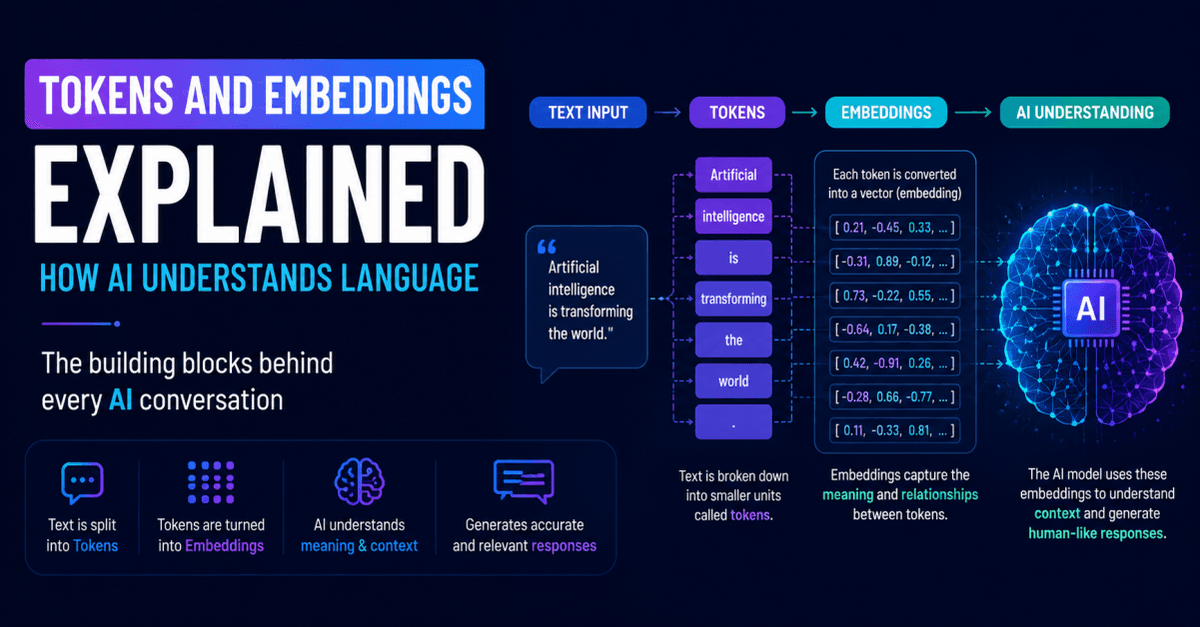
Tokens and Embeddings Explained: How AI Understands Language
Tokens and embeddings are two fundamental concepts that enable modern Artificial Intelligence systems to understand and generate human language. Every interaction with a Large Language Model begins by breaking text into smaller units called tokens. These tokens are then converted into mathematical representations known as embeddings, allowing AI models to understand meaning, context, and relationships between words. Together, tokens and embeddings form the foundation of technologies such as chatbots, search engines, language translation, recommendation systems, and Generative AI applications.
What Are Tokens?
Tokens are the smallest units of text that an AI model processes. Depending on the model, a token can represent a whole word, part of a word, punctuation, or even individual characters.
How Tokens Work
When a user enters text, the AI system divides it into tokens before processing. Instead of reading complete sentences like humans, the model analyzes these tokens to understand the structure and meaning of the input.
Why Tokens Matter
Tokenization enables AI models to process language efficiently. It helps determine how much text a model can handle at one time and directly influences response generation, processing speed, and computational efficiency.
What Are Embeddings?
Embeddings are numerical representations of tokens that allow AI systems to understand relationships between words and concepts. Instead of treating words as simple text, embeddings convert them into vectors that capture meaning and context.
How Embeddings Work
Each token is transformed into a set of numerical values representing its semantic meaning. Words with similar meanings have embeddings that are mathematically closer together, helping AI recognize context and relationships.
Why Embeddings Matter
Embeddings enable AI models to understand synonyms, context, sentence meaning, and conceptual relationships. They are essential for tasks such as search, recommendations, document retrieval, translation, and conversational AI.
How Tokens and Embeddings Work Together
Tokens and embeddings operate as complementary technologies within modern AI systems.
From Text to Understanding
When users submit text, it is first divided into tokens. Each token is then converted into an embedding before being processed by transformer models that analyze context and generate responses.
Building Context
Embeddings help AI understand that different words or phrases may express similar ideas. This contextual understanding enables more accurate responses, summaries, translations, and recommendations.
Applications of Tokens and Embeddings
These technologies power many of today's most advanced Artificial Intelligence applications.
Large Language Models
Large Language Models rely on tokens and embeddings to understand prompts, generate responses, summarize information, and answer complex questions.
Search and Recommendation Systems
Modern search engines and recommendation platforms use embeddings to identify semantic similarity, improving search accuracy and delivering more relevant results.
Natural Language Processing
Natural Language Processing applications such as language translation, sentiment analysis, document classification, and chatbot interactions depend heavily on tokenization and embeddings.
Enterprise AI
Businesses use embeddings to improve knowledge management, intelligent document search, customer support automation, and enterprise search platforms.
Benefits of Tokens and Embeddings
Tokens and embeddings provide several advantages that improve AI performance.
Better Language Understanding
Embeddings allow AI models to interpret meaning instead of simply matching keywords, leading to more accurate and context-aware responses.
Improved Search Accuracy
Semantic embeddings help AI retrieve information based on meaning rather than exact keyword matches, significantly improving search quality.
Efficient AI Processing
Breaking text into tokens enables AI models to process language efficiently while maintaining consistency across different applications.
Challenges of Tokens and Embeddings
Despite their effectiveness, these technologies also present several challenges.
Context Limitations
AI models have maximum token limits, meaning very long documents may need to be divided before processing.
Computational Requirements
Generating and processing embeddings requires significant computing resources, especially for large-scale AI systems.
Language Complexity
Different languages, writing systems, and specialized terminology can make tokenization and embedding generation more complex, requiring sophisticated AI models.
Future of Tokens and Embeddings
As Artificial Intelligence continues to evolve, tokenization and embedding techniques are expected to become more efficient and context-aware. Future advancements will improve multilingual understanding, semantic search, enterprise knowledge management, and multimodal AI systems capable of processing text, images, audio, and video together. These improvements will strengthen the performance of Large Language Models and other AI applications across industries.
Conclusion
Tokens and embeddings are the building blocks that enable Artificial Intelligence to understand and generate human language. While tokens break text into manageable units, embeddings give those units meaningful mathematical representations that AI systems can interpret. Together, they power Large Language Models, search engines, conversational AI, and countless other intelligent applications. As AI technology advances, tokens and embeddings will remain essential components driving more accurate, efficient, and context-aware digital experiences.
 What Are Tokens and Embeddings in AI? Complete Guide | NEX NEWS FAQs
POST A COMMENT (0)
All Comments (0)
Replies (0)