What Is Data Augmentation? A Simple Guide
Artificial intelligence models require large amounts of high-quality data to learn effectively. However, collecting and labeling massive datasets can be expensive, time-consuming, and sometimes impractical. Data augmentation helps solve this challenge by creating additional training examples from existing data.
Instead of collecting entirely new data, data augmentation applies controlled transformations to existing samples while preserving their essential meaning. These additional examples expose AI models to greater variety, helping them learn more robust patterns and perform better on unseen data.
Today, data augmentation is widely used in computer vision, natural language processing (NLP), speech recognition, healthcare, autonomous vehicles, and many other AI applications. Although it improves model performance, human expertise remains important to ensure that augmented data is realistic, representative, and appropriate for the specific task.
What Is Data Augmentation?
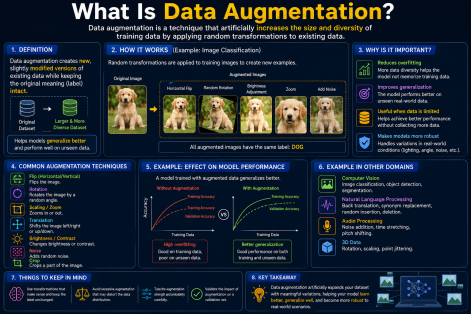
Data augmentation is a machine learning technique that increases the diversity of a training dataset by creating modified versions of existing data.
These modifications preserve the original label or meaning while introducing natural variations that the AI model may encounter in real-world situations.
For example:
-
An image can be rotated or flipped.
-
An audio recording can include background noise.
-
A sentence can be rewritten using similar wording while keeping the same meaning.
By training on these variations, AI models become more accurate and better at generalizing to new data.
How Does Data Augmentation Work?
Data augmentation is typically performed before or during model training.
1. Start with Original Data
The process begins with an existing labeled dataset.
Examples include:
-
Images
-
Text documents
-
Audio recordings
-
Medical scans
-
Sensor data
-
Video clips
2. Apply Transformations
Different augmentation techniques create new versions of the original data.
Examples:
For Images
-
Rotation
-
Horizontal flipping
-
Cropping
-
Scaling
-
Brightness adjustment
-
Color changes
-
Random noise
For Text
-
Synonym replacement
-
Word insertion
-
Sentence paraphrasing
-
Back translation
-
Controlled word deletion
For Audio
-
Background noise
-
Pitch shifting
-
Time stretching
-
Volume adjustment
-
Speed variation
3. Expand the Dataset
The transformed samples are added to the original dataset.
The AI model now trains using both original and augmented examples.
4. Train the Model
Exposure to greater data diversity helps the model learn more generalized patterns and improves its performance on unseen data.
Common Types of Data Augmentation
1. Image Augmentation
The most widely used form of augmentation.
Common techniques include:
-
Rotation
-
Flipping
-
Cropping
-
Zooming
-
Color jitter
-
Blur
-
Random noise
2. Text Augmentation
Used in Natural Language Processing (NLP).
Methods include:
-
Synonym substitution
-
Sentence rewriting
-
Back translation
-
Token replacement
-
Controlled word removal
3. Audio Augmentation
Frequently used in speech recognition.
Examples include:
-
Noise addition
-
Speed changes
-
Pitch adjustment
-
Echo simulation
-
Time shifting
4. Video Augmentation
Video datasets may be augmented using:
-
Frame cropping
-
Rotation
-
Frame skipping
-
Color adjustments
-
Temporal transformations
5. Synthetic Data Generation
Artificially generated samples created using simulations or generative AI models can supplement real training data, particularly when collecting real-world data is difficult or expensive.
Key Characteristics of Data Augmentation
1. Increases Dataset Diversity
Creates more varied training examples without requiring entirely new data collection.
2. Reduces Overfitting
Helps models learn general patterns instead of memorizing specific training examples.
3. Improves Generalization
Models become better at handling real-world variations they have not previously encountered.
4. Preserves Labels
Augmented data retains the same correct label or meaning as the original sample.
5. Supports Efficient AI Training
Allows developers to improve model performance while reducing the need for additional labeled data.
Common Applications of Data Augmentation
Data augmentation is widely used in:
-
Image recognition
-
Computer vision
-
Medical imaging
-
Natural language processing (NLP)
-
Large Language Models (LLMs)
-
Speech recognition
-
Autonomous vehicles
-
Facial recognition
-
Robotics
-
Recommendation systems
-
Fraud detection
-
Predictive analytics
Benefits of Data Augmentation
Improves Model Accuracy
Additional training examples help AI models learn more representative patterns.
Reduces Overfitting
Greater data diversity prevents models from memorizing the training dataset.
Lowers Data Collection Costs
Existing datasets can be expanded without collecting and labeling large amounts of new data.
Enhances Robustness
Models become better at handling variations such as lighting changes, background noise, or different writing styles.
Supports Better Generalization
AI systems perform more reliably when making predictions on previously unseen data.
Challenges of Data Augmentation
Choosing Appropriate Transformations
Not every transformation is suitable for every dataset or AI task.
Risk of Unrealistic Samples
Poorly designed augmentation can create examples that do not represent real-world conditions.
Increased Training Time
Larger augmented datasets require additional computational resources.
Task-Specific Requirements
Different domains such as healthcare, finance, and autonomous driving require carefully designed augmentation strategies.
Human Expertise Required
Developers must evaluate whether augmented data improves model performance without introducing bias or reducing data quality.
Best Practices for Using Data Augmentation
Match Transformations to the Task
Choose augmentation methods that reflect realistic variations the model is likely to encounter.
Preserve Data Meaning
Ensure transformations do not alter the correct label or intended meaning of the data.
Combine Multiple Techniques
Using several complementary augmentation methods often improves model robustness.
Validate Model Performance
Measure accuracy on validation and test datasets to confirm augmentation is beneficial.
Monitor for Bias
Regularly review augmented datasets to ensure they remain representative and do not introduce unintended bias.
Future of Data Augmentation
Data augmentation continues to advance as artificial intelligence models become more sophisticated. Modern AI systems increasingly use automated augmentation techniques that learn which transformations improve performance, reducing the need for manual experimentation.
Generative AI technologies, including diffusion models and generative adversarial networks (GANs), are also enabling the creation of realistic synthetic data for applications where collecting large datasets is difficult, expensive, or restricted by privacy requirements. These methods are especially valuable in healthcare, autonomous driving, robotics, and scientific research.
As AI development progresses, data augmentation will remain an essential part of building accurate and reliable models. Combined with high-quality datasets, responsible evaluation, and human oversight, it helps machine learning systems perform effectively across a wide range of real-world environments.
Conclusion
Data augmentation is a powerful technique that improves machine learning and deep learning models by creating additional training examples from existing data. By introducing realistic variations while preserving the original labels, it increases dataset diversity, reduces overfitting, and improves model generalization.
From image recognition and speech processing to natural language understanding and medical AI, data augmentation has become a standard practice in modern AI development. Selecting appropriate augmentation techniques depends on the data type, application, and learning objectives.
As artificial intelligence continues to evolve, data augmentation will remain a key component of successful model training, helping developers build AI systems that are more accurate, robust, and capable of handling real-world variability.