What Is an Epoch in AI Training? A Simple Guide
Training an artificial intelligence model involves showing it large amounts of data so it can learn patterns and improve its predictions. One of the most commonly used terms during this process is "epoch." Whether you're learning about machine learning, deep learning, or neural networks, understanding epochs is essential because they determine how many times a model learns from the complete training dataset.
Every modern AI system—from image recognition and recommendation engines to speech recognition and large language models—uses epochs during training. By repeatedly exposing a model to the same dataset, the AI gradually reduces errors and improves its ability to make accurate predictions.
Although increasing the number of epochs can improve learning, more is not always better. Human expertise is needed to determine the appropriate number of epochs so that the model learns effectively without overfitting.
What Is an Epoch in AI Training?
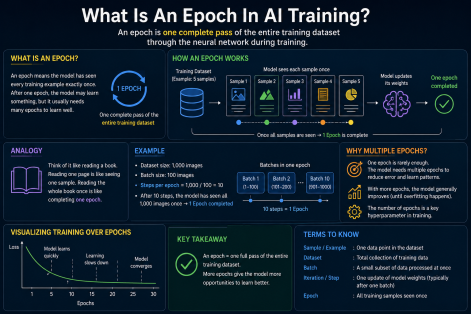
An epoch is one complete pass of the entire training dataset through a machine learning or deep learning model during training.
If a training dataset contains 100,000 examples, one epoch means the model has processed all 100,000 examples once. During each epoch, the model makes predictions, calculates errors using a loss function, and updates its internal weights through optimization algorithms such as gradient descent.
Training usually requires multiple epochs because one pass through the data is rarely enough for the model to learn complex patterns accurately.
How Does an Epoch Work?
Training progresses through repeated epochs until the model reaches satisfactory performance.
1. Load the Training Data
The AI model receives the complete training dataset.
This dataset may contain:
-
Images
-
Text documents
-
Audio recordings
-
Medical records
-
Financial data
-
Sensor information
2. Process the Data
The model analyzes every example in the dataset, generates predictions, and compares them with the correct answers.
3. Calculate Errors
A loss function measures how far the model's predictions differ from the actual results.
The model then calculates how its parameters should change to reduce future errors.
4. Update the Model
Optimization algorithms adjust the model's weights and biases.
Once every training example has been processed, one epoch is complete.
The process repeats for additional epochs until training finishes.
Key Characteristics of Epochs
1. Complete Dataset Pass
Each epoch represents one full pass through the entire training dataset.
2. Progressive Learning
With each additional epoch, the model generally improves by learning from previous mistakes.
3. Multiple Epochs Required
Most AI models require many epochs before achieving good accuracy.
4. Works with Batches
Large datasets are usually divided into smaller groups called batches.
Several batches together make up one complete epoch.
5. Training Performance Monitoring
Developers monitor metrics such as loss and accuracy after each epoch to evaluate learning progress.
Common Applications of Epochs
Epochs are used when training many types of AI models, including:
-
Image recognition models
-
Natural language processing (NLP)
-
Large Language Models (LLMs)
-
Speech recognition systems
-
Recommendation engines
-
Fraud detection systems
-
Medical AI
-
Autonomous vehicles
-
Financial forecasting
-
Robotics
-
Predictive analytics
-
Computer vision
Benefits of Using Multiple Epochs
Improves Learning
Repeated exposure to training data helps AI models identify more accurate patterns.
Reduces Prediction Errors
Each epoch provides another opportunity for the model to minimize its loss and improve performance.
Supports Deep Learning
Deep neural networks often require many epochs to learn complex relationships within large datasets.
Enables Performance Monitoring
Developers can observe improvements in accuracy and loss after each epoch and adjust training accordingly.
Flexible Training Process
The number of epochs can be adjusted depending on the dataset, model complexity, and desired performance.
Challenges of Epochs
Overfitting
Training for too many epochs may cause the model to memorize the training data instead of learning general patterns.
Underfitting
Using too few epochs may prevent the model from learning enough, resulting in poor performance.
Long Training Times
Large datasets and complex neural networks may require many epochs, increasing computational time and cost.
Computing Resources
Training over many epochs often requires powerful hardware such as GPUs or specialized AI accelerators.
Human Oversight
Developers must monitor training progress and decide when to stop training using validation metrics and early stopping techniques.
Best Practices for Choosing Epochs
Monitor Validation Performance
Track validation loss and accuracy after each epoch to evaluate model generalization.
Use Early Stopping
Stop training when validation performance no longer improves to reduce overfitting.
Select an Appropriate Batch Size
Choose a batch size that balances training speed, memory usage, and model performance.
Evaluate Multiple Configurations
Experiment with different numbers of epochs to identify the optimal training duration.
Combine with Proper Optimization
Use appropriate learning rates, optimization algorithms, and regularization techniques to improve training efficiency.
Future of Epoch-Based Training
Epochs will continue to play a central role in training machine learning and deep learning models. As AI models become larger and more complex, researchers are developing techniques that improve learning efficiency while reducing the number of required epochs. Advances in optimization algorithms, distributed computing, and specialized AI hardware are helping accelerate model training.
Future AI systems may rely more heavily on adaptive training methods that automatically determine when sufficient learning has occurred. Techniques such as transfer learning, self-supervised learning, curriculum learning, and continual learning are also reducing the amount of retraining required for many applications.
Responsible AI development will remain essential throughout the training process. Developers will continue monitoring accuracy, fairness, bias, and energy efficiency while ensuring models are trained using high-quality datasets and appropriate human oversight.
Conclusion
An epoch is a fundamental concept in artificial intelligence and deep learning that represents one complete pass through the training dataset. Multiple epochs allow AI models to gradually improve by learning from prediction errors and refining their internal parameters.
Choosing the right number of epochs is important because too few can result in underfitting, while too many may cause overfitting. Monitoring training metrics throughout the learning process helps developers build more accurate and reliable AI systems.
As AI technology continues to advance, epochs will remain an essential part of model training. Combined with high-quality data, effective optimization techniques, and responsible human oversight, they help create machine learning systems that are increasingly capable, efficient, and trustworthy.