





What Is a Generative Adversarial Network? A Simple Guide
Generative Adversarial Networks (GANs) are one of the most influential technologies in modern artificial intelligence. They enable computers to generate realistic images, videos, audio, and other types of synthetic content by learning patterns from existing data. Since their introduction, GANs have become an important tool in fields such as computer vision, digital art, entertainment, scientific research, and product design.
Many AI-powered applications use GANs to create photorealistic faces, enhance image quality, generate artwork, restore damaged photos, and simulate realistic environments. These capabilities have opened new opportunities for creative professionals, researchers, and businesses. Rather than replacing human creativity, GANs act as intelligent tools that help users explore ideas, automate repetitive creative tasks, and accelerate content creation.
Although GANs can produce impressive results, responsible use remains essential. Human oversight helps ensure generated content is accurate, ethical, and appropriate for its intended purpose.
What Is a Generative Adversarial Network?
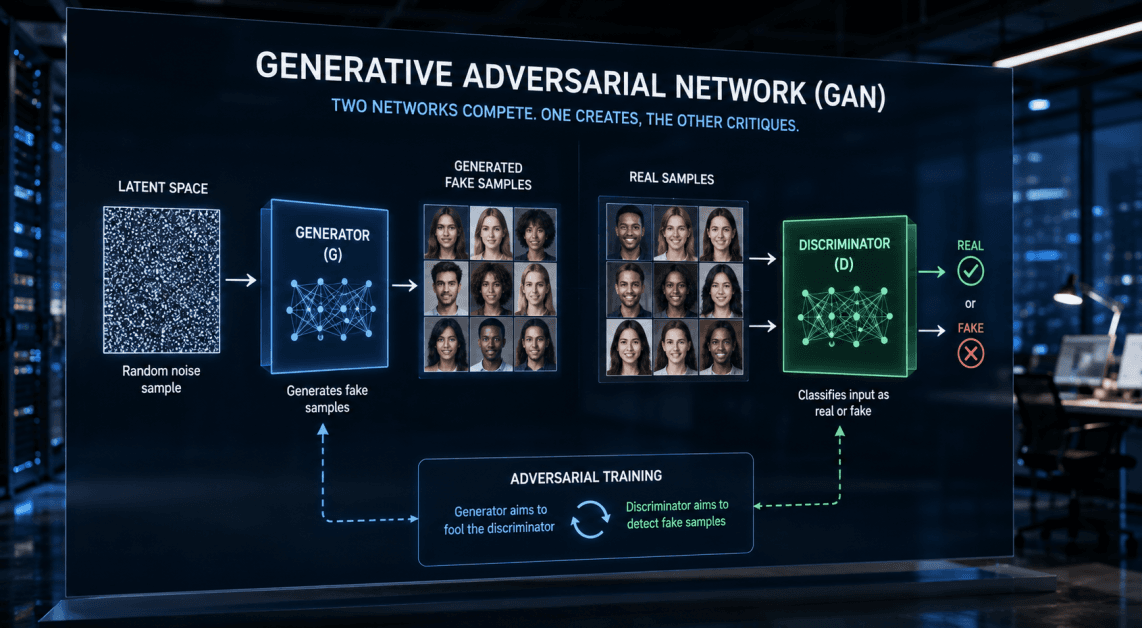
A Generative Adversarial Network (GAN) is a type of deep learning model that generates new data by training two neural networks to compete against each other.
One network, called the Generator, creates new content such as images or audio. The other network, known as the Discriminator, evaluates whether the generated content appears real or fake.
Through continuous competition, both networks improve over time. The Generator learns to produce increasingly realistic outputs, while the Discriminator becomes better at identifying generated content. This adversarial training process enables GANs to create highly realistic synthetic data.
How Do Generative Adversarial Networks Work?
GANs operate through two neural networks working together during training.
1. Generator
The Generator starts with random input and attempts to create realistic content based on patterns learned from the training data.
It may generate:
-
Images
-
Artwork
-
Human faces
-
Videos
-
Audio samples
-
Product designs
Initially, the generated results are poor, but they improve as training continues.
2. Discriminator
The Discriminator compares real training data with content produced by the Generator.
Its job is to determine whether the content is genuine or artificially generated.
Whenever the Discriminator successfully detects fake content, the Generator adjusts its approach and learns how to produce more convincing outputs.
Over many training cycles, this competition helps improve the quality of generated content.
Key Characteristics of Generative Adversarial Networks
1. Realistic Content Generation
GANs can generate highly realistic images, audio, videos, and other digital content by learning complex patterns from large datasets.
2. Two-Network Architecture
Unlike many AI models, GANs rely on two neural networks—the Generator and the Discriminator—that continuously improve each other through competition.
3. Data Learning
GANs learn the underlying structure of training data rather than simply copying existing examples, enabling them to generate entirely new content.
4. Creative Flexibility
GANs can create many different types of content, including portraits, landscapes, animations, artwork, textures, and virtual environments.
5. Continuous Improvement
As training progresses, the Generator produces increasingly realistic outputs while the Discriminator becomes more accurate at evaluating them.
Common Applications of Generative Adversarial Networks
GANs are widely used across many industries, including:
-
AI image generation
-
Photo enhancement
-
Image restoration
-
Super-resolution imaging
-
Face generation
-
Medical image analysis
-
Video generation
-
Fashion design
-
Product visualization
-
Game development
-
Film and visual effects
-
Scientific research
Benefits of Generative Adversarial Networks
High-Quality Image Generation
GANs are capable of producing realistic visuals with detailed textures, lighting, and facial features.
Creative Content Production
Artists, designers, and marketers can use GANs to generate ideas, concept art, illustrations, and design variations more efficiently.
Improved Image Restoration
GANs help restore old photographs, improve image resolution, remove noise, and reconstruct damaged visuals.
Supports Research and Innovation
Researchers use GANs to simulate data, enhance medical imaging, and develop new machine learning techniques.
Broad Industry Applications
GANs support numerous fields, including healthcare, entertainment, manufacturing, architecture, education, and digital media.
Challenges of Generative Adversarial Networks
Training Complexity
GANs can be difficult to train because the Generator and Discriminator must remain balanced throughout the learning process.
High Computing Requirements
Training GANs often requires powerful GPUs, significant memory, and large datasets.
Ethical Concerns
GANs can generate highly realistic synthetic content, making responsible use important to reduce misuse such as deceptive media or misinformation.
Bias in Training Data
If training datasets contain biases, generated outputs may reflect those same biases.
Human Oversight
AI-generated content should always be reviewed before professional, educational, commercial, or scientific use.
Best Practices for Using Generative Adversarial Networks
Use High-Quality Training Data
Better datasets generally produce higher-quality and more reliable generated content.
Review Generated Results
Always verify AI-generated images, videos, and other outputs for quality, accuracy, and appropriateness.
Respect Copyright and Privacy
Ensure generated content complies with intellectual property rights, licensing requirements, and privacy regulations.
Apply Ethical AI Practices
Use GANs responsibly and avoid generating misleading, harmful, or deceptive content.
Continue Improving Models
Regularly update datasets and evaluate model performance to improve output quality and reduce bias.
Future of Generative Adversarial Networks
Generative Adversarial Networks continue to evolve alongside other forms of generative AI. Researchers are improving GAN architectures to generate more realistic images, videos, audio, and 3D models while reducing training complexity and improving stability.
Future applications may include more advanced medical imaging, digital twins, virtual reality, product design, scientific simulations, and entertainment production. GANs are also expected to work alongside foundation models, diffusion models, and large language models to create richer multimodal AI systems capable of generating multiple forms of content.
Responsible AI development will remain essential. Researchers, businesses, and policymakers continue to focus on transparency, fairness, copyright protection, and ethical governance to encourage trustworthy use of GAN technology.
Rather than replacing artists, designers, or researchers, GANs will continue to serve as creative assistants that support innovation, improve productivity, and expand the possibilities of digital content creation.
Conclusion
Generative Adversarial Networks have transformed artificial intelligence by introducing a powerful method for generating realistic synthetic content. Through the competition between the Generator and Discriminator, GANs learn to create images, videos, audio, and other data that closely resemble real-world examples.
Their versatility has made them valuable across industries such as healthcare, entertainment, scientific research, marketing, and design. While GANs continue to advance, responsible use and human oversight remain essential to ensure ethical and reliable outcomes.
As AI technology progresses, GANs will remain an important part of the generative AI ecosystem, helping professionals and creators develop innovative solutions while enhancing—not replacing—human creativity and expertise.
 What Is a Generative Adversarial Network? GANs Explained FAQs
POST A COMMENT (0)
All Comments (0)
Replies (0)