What Is an AI Evaluation Framework? A Complete Guide
Artificial intelligence systems are increasingly used for critical tasks such as customer support, medical assistance, financial analysis, software development, legal research, and business automation. Before these systems can be trusted in real-world environments, organizations must ensure they are accurate, reliable, secure, and aligned with business objectives. This is the purpose of an AI Evaluation Framework.
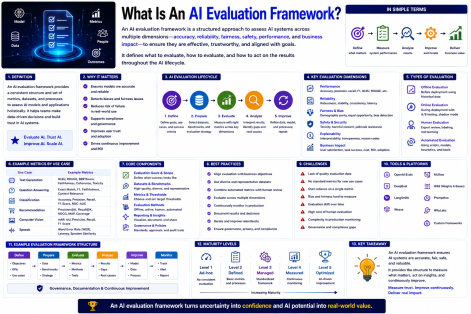
An AI evaluation framework is a structured approach for measuring the quality, performance, safety, and effectiveness of AI models throughout their lifecycle. Instead of relying on a single accuracy score, modern evaluation frameworks assess multiple aspects of AI behavior, including correctness, robustness, fairness, efficiency, and compliance.
Organizations use AI evaluation frameworks to compare models, validate improvements, detect weaknesses, reduce risks, and continuously improve AI systems before and after deployment.
What Is an AI Evaluation Framework?
An AI Evaluation Framework is a standardized methodology for testing and measuring how well an artificial intelligence system performs against defined objectives and quality criteria.
It provides repeatable processes, datasets, metrics, and evaluation methods to determine whether an AI model is suitable for production use.
Evaluation frameworks are commonly applied to:
-
Large Language Models (LLMs)
-
Machine learning models
-
Computer vision systems
-
Speech recognition systems
-
Recommendation engines
-
AI agents
-
Generative AI applications
-
Predictive analytics models
How Does an AI Evaluation Framework Work?
AI evaluation generally follows a structured process.
1. Define Evaluation Goals
Organizations identify what the AI system should achieve.
Examples include:
-
Answer questions accurately
-
Generate high-quality content
-
Detect fraud
-
Classify images
-
Summarize documents
-
Recommend products
2. Prepare Evaluation Data
Representative datasets are collected to test the AI across normal, edge-case, and challenging scenarios.
3. Run Evaluation Tests
The AI model is tested using predefined prompts, datasets, or tasks under controlled conditions.
4. Measure Performance
Results are evaluated using quantitative and qualitative metrics such as:
-
Accuracy
-
Precision
-
Recall
-
Response quality
-
Latency
-
Robustness
-
Fairness
-
User satisfaction
5. Improve and Re-evaluate
Based on evaluation results, organizations refine the model, prompts, data, or workflows and repeat the evaluation process.
Key Components of an AI Evaluation Framework
1. Evaluation Datasets
Curated data used to test AI performance across different scenarios.
2. Performance Metrics
Standardized measurements used to assess model quality and business effectiveness.
3. Automated Testing
Tools that repeatedly evaluate AI systems as models or prompts change.
4. Human Review
Experts assess outputs that require judgment, contextual understanding, or domain expertise.
5. Reporting and Analytics
Dashboards and reports summarize evaluation results, trends, and areas for improvement.
Common Evaluation Metrics
Organizations may evaluate AI using metrics such as:
Accuracy
Measures how often the AI produces correct results.
Precision
Measures how many positive predictions are actually correct.
Recall
Measures how many relevant items or cases the AI successfully identifies.
F1 Score
Balances precision and recall into a single performance measure.
Latency
Measures how quickly the AI generates a response.
Robustness
Evaluates how well the AI performs under unusual, incomplete, or unexpected inputs.
Fairness
Assesses whether the AI produces equitable outcomes across different groups or scenarios.
User Satisfaction
Measures how useful, relevant, and trustworthy users find AI-generated outputs.
Key Characteristics of an AI Evaluation Framework
1. Standardized Testing
Uses consistent procedures to compare AI performance over time.
2. Repeatability
The same evaluation can be performed whenever models or prompts are updated.
3. Comprehensive Measurement
Evaluates technical performance, business impact, and responsible AI considerations.
4. Continuous Monitoring
Supports ongoing evaluation after deployment rather than one-time testing.
5. Human-AI Collaboration
Combines automated metrics with expert review for a more complete assessment.
Common Applications of AI Evaluation Frameworks
AI evaluation frameworks are widely used in:
-
Enterprise AI platforms
-
AI copilots
-
Large language models
-
Customer support systems
-
Healthcare AI
-
Financial services
-
Fraud detection
-
Autonomous systems
-
Computer vision
-
Software development
-
Search and recommendation systems
-
Document processing
-
AI research
-
Regulatory compliance
Benefits of an AI Evaluation Framework
Improves AI Quality
Identifies weaknesses before AI systems are deployed.
Supports Better Decision-Making
Provides objective evidence when comparing AI models and selecting production systems.
Reduces Risk
Detects errors, unsafe behavior, and performance issues early.
Encourages Responsible AI
Helps monitor fairness, transparency, privacy, and compliance.
Enables Continuous Improvement
Regular evaluations support ongoing optimization as models, data, and business requirements evolve.
Challenges of AI Evaluation
Measuring Complex Outputs
Tasks such as creative writing or open-ended conversations can be difficult to evaluate objectively.
Evolving AI Models
Rapid model updates require continuous testing and benchmark maintenance.
Dataset Bias
Evaluation datasets must represent diverse and realistic scenarios to avoid misleading conclusions.
Balancing Metrics
Optimizing one metric, such as speed, may negatively affect another, such as accuracy.
Human Oversight Required
Expert reviewers remain essential for evaluating context, reasoning, ethics, legal compliance, and domain-specific quality that automated metrics alone cannot fully measure.
AI Evaluation Framework vs AI Benchmark
| Feature | AI Evaluation Framework | AI Benchmark |
|---|---|---|
| Purpose | Comprehensive assessment of AI systems | Standardized comparison of model performance |
| Scope | Metrics, testing, governance, reporting | Fixed tasks and datasets |
| Frequency | Continuous throughout the AI lifecycle | Periodic performance measurement |
| Focus | Technical, business, and responsible AI outcomes | Comparative model scoring |
| Best For | Enterprise AI quality management | Comparing different AI models |
Best Practices for AI Evaluation
Define Clear Objectives
Establish measurable goals aligned with business and user needs.
Use Representative Test Data
Include normal, edge-case, and adversarial scenarios in evaluation datasets.
Combine Automated and Human Evaluation
Use objective metrics alongside expert judgment for balanced assessment.
Monitor AI Continuously
Evaluate models regularly after deployment to detect performance changes over time.
Document Results
Maintain detailed records of datasets, metrics, model versions, evaluation outcomes, and improvement actions.
Future of AI Evaluation Frameworks
AI evaluation frameworks are expected to become more sophisticated as organizations deploy increasingly capable large language models (LLMs), AI agents, multimodal AI systems, and autonomous workflows. Future frameworks will move beyond traditional accuracy metrics to evaluate reasoning quality, factual consistency, safety, explainability, adaptability, and long-term reliability.
Organizations are also adopting automated evaluation pipelines that continuously monitor AI performance in production environments. Advances in synthetic test generation, adversarial testing, retrieval-augmented generation (RAG) evaluation, and agent performance assessment will enable more comprehensive quality assurance across complex AI ecosystems.
As artificial intelligence becomes a critical part of business operations, AI evaluation frameworks will play an essential role in ensuring that AI systems remain trustworthy, compliant, efficient, and aligned with organizational goals. Strong evaluation practices will help organizations improve AI quality while reducing operational, ethical, and regulatory risks.
Conclusion
An AI evaluation framework is a structured methodology for assessing the performance, reliability, safety, and effectiveness of artificial intelligence systems. By combining standardized datasets, performance metrics, automated testing, human review, and continuous monitoring, organizations can make informed decisions about deploying and improving AI solutions.
From enterprise AI and healthcare to finance and customer support, AI evaluation frameworks help ensure that AI systems deliver consistent, high-quality results while supporting responsible AI practices. Their ability to measure both technical performance and business impact makes them an essential component of successful AI adoption.
As AI technologies continue to evolve, robust evaluation frameworks will remain fundamental to building trustworthy, scalable, and high-performing AI systems across industries.