





What Is AI Orchestration? A Complete Guide
Modern businesses rarely rely on a single artificial intelligence model to complete complex tasks. Instead, they often combine multiple AI models, data sources, software applications, APIs, and automation tools to deliver complete business solutions. Managing these components efficiently requires coordination, scheduling, and monitoring. This process is known as AI orchestration.
AI orchestration enables organizations to connect and manage multiple AI services so they work together as part of a unified workflow. Rather than operating independently, AI models, business systems, databases, and software applications collaborate to complete end-to-end processes with minimal manual intervention.
Today, AI orchestration plays a critical role in enterprise AI, AI copilots, multi-agent systems, customer service automation, software development, healthcare, manufacturing, finance, cybersecurity, and intelligent business operations.
What Is AI Orchestration?
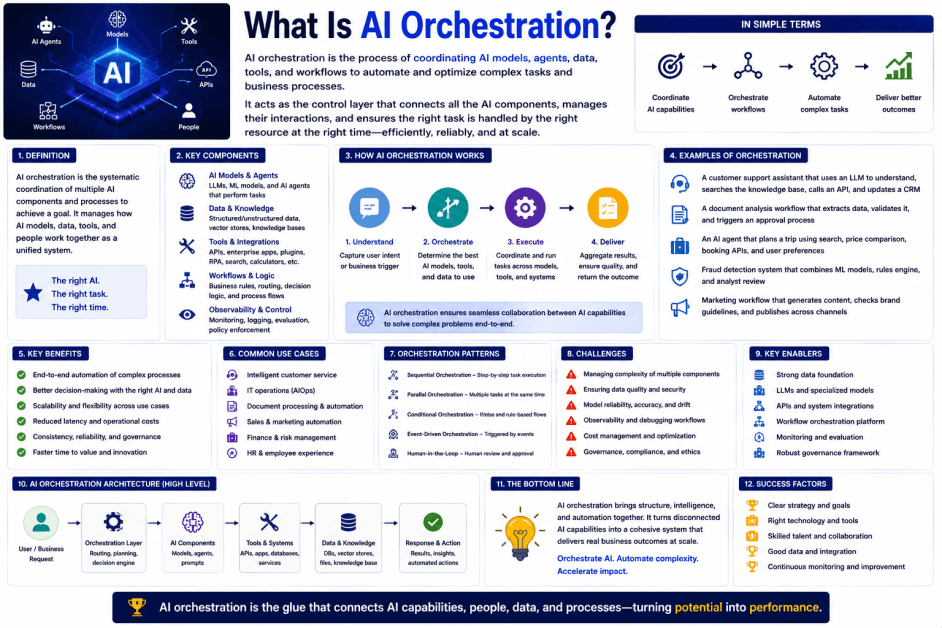
AI orchestration is the process of coordinating multiple artificial intelligence models, AI agents, enterprise systems, data sources, and automated workflows so they work together to accomplish complex tasks efficiently.
Instead of relying on one AI model, orchestration determines:
-
Which AI model should perform each task
-
When each task should run
-
How data moves between systems
-
How different AI services communicate
-
How results are combined into a final output
The goal is to create reliable, scalable, and efficient AI-powered workflows across an organization.
How Does AI Orchestration Work?
AI orchestration generally follows a structured workflow.
1. Receive a Business Request
A user or application initiates a task.
Examples include:
-
Generate a financial report
-
Process customer support tickets
-
Analyze legal contracts
-
Build a software application
-
Create a marketing campaign
2. Break the Task into Smaller Steps
The orchestration system divides the request into manageable tasks that can be completed by different AI models, software services, or business applications.
3. Assign the Right Resources
Each task is routed to the most appropriate resource, such as:
-
Large language models (LLMs)
-
Computer vision models
-
Predictive analytics models
-
AI agents
-
Enterprise software
-
Databases
-
APIs
4. Coordinate Execution
The orchestration platform manages communication between systems, tracks progress, handles dependencies, and ensures tasks are completed in the correct order.
5. Combine and Deliver Results
Outputs from multiple AI systems are integrated into a final response, workflow, or business action, which may then be reviewed by a human when appropriate.
Key Components of AI Orchestration
1. Orchestration Engine
Coordinates tasks, workflows, scheduling, and execution across AI systems.
2. AI Models and AI Agents
Perform specialized tasks such as text generation, prediction, classification, reasoning, or image analysis.
3. Enterprise Integrations
Connect AI workflows with CRM systems, ERP platforms, databases, cloud services, and other business applications.
4. Workflow Automation Layer
Defines task sequences, business rules, approvals, and error handling.
5. Monitoring and Governance
Tracks system performance, logs activities, manages security, and supports compliance requirements.
Key Characteristics of AI Orchestration
1. Workflow Coordination
Manages complex AI processes from start to finish.
2. Multi-System Integration
Connects multiple AI models, software platforms, APIs, and data sources.
3. Intelligent Task Routing
Assigns work to the most appropriate AI service or application.
4. Scalability
Supports increasing workloads by coordinating resources efficiently.
5. Human-in-the-Loop Support
Allows people to review, approve, or modify AI-generated outputs before important actions are completed.
Common Applications of AI Orchestration
AI orchestration is widely used in:
-
Enterprise AI platforms
-
AI copilots
-
Customer service automation
-
Software development
-
Document processing
-
Financial operations
-
Healthcare workflows
-
Supply chain management
-
Manufacturing automation
-
Cybersecurity operations
-
Marketing automation
-
Business intelligence
-
HR processes
-
Legal services
-
Intelligent virtual assistants
Benefits of AI Orchestration
Improves Efficiency
Coordinates multiple AI systems to automate complex business processes.
Enhances Scalability
Allows organizations to expand AI workloads without manually managing every task.
Better Resource Utilization
Ensures the most suitable AI model or service handles each part of a workflow.
Consistent Business Processes
Standardized orchestration reduces errors and improves workflow reliability.
Faster AI Deployment
Organizations can build sophisticated AI solutions by combining existing services instead of creating entirely new systems.
Challenges of AI Orchestration
Integration Complexity
Connecting many enterprise systems, AI models, and APIs requires careful planning and maintenance.
Security and Privacy
Organizations must protect sensitive information as it moves between multiple systems.
Workflow Reliability
Failures in one service can affect downstream tasks if error handling is not implemented properly.
Monitoring Requirements
Large AI workflows require continuous monitoring to ensure performance, availability, and compliance.
Human Oversight Required
Critical business decisions, legal matters, financial approvals, and customer-facing communications should continue to involve human review to maintain accountability and accuracy.
AI Orchestration vs Agent Orchestration
| Feature | AI Orchestration | Agent Orchestration |
|---|---|---|
| Scope | Coordinates AI models, software, data, and workflows | Coordinates multiple AI agents working together |
| Components | AI models, APIs, enterprise systems, automation tools | Specialized AI agents with distinct roles |
| Primary Goal | End-to-end workflow management | Collaboration among AI agents |
| Flexibility | Broad enterprise workflows | Agent-based problem solving |
| Best For | Enterprise automation | Multi-agent AI systems |
Best Practices for Implementing AI Orchestration
Design Modular Workflows
Break complex business processes into smaller, reusable tasks.
Integrate Trusted Systems
Connect only reliable and well-governed data sources and applications.
Build Strong Security Controls
Use authentication, encryption, access management, and auditing throughout AI workflows.
Monitor Performance Continuously
Track workflow success rates, response times, costs, and model quality.
Keep Humans in the Loop
Maintain human oversight for high-impact decisions and regularly review AI-driven workflows to ensure accuracy and compliance.
Future of AI Orchestration
AI orchestration is expected to become a foundational capability for enterprise AI as organizations deploy increasingly complex AI ecosystems. Advances in large language models (LLMs), AI agents, multimodal AI, retrieval-augmented generation (RAG), and autonomous systems are creating workflows that require intelligent coordination across many services and platforms.
Future AI orchestration platforms are likely to include dynamic task planning, self-optimizing workflows, real-time resource allocation, automated governance, and deeper integration with enterprise software. Organizations will also increasingly orchestrate multiple AI agents, cloud services, robotics, Internet of Things (IoT) devices, and business applications within a single operational framework.
As artificial intelligence continues to evolve, AI orchestration will help businesses build scalable, secure, and efficient AI-powered operations. By coordinating diverse AI technologies into unified workflows, organizations can accelerate innovation while maintaining governance, transparency, and human oversight.
Conclusion
AI orchestration is the process of coordinating multiple AI models, agents, enterprise systems, and automation tools to execute complex workflows efficiently. It enables organizations to integrate diverse AI capabilities into seamless business processes rather than relying on isolated AI applications.
From customer service and software development to finance and healthcare, AI orchestration helps enterprises improve productivity, streamline operations, and scale artificial intelligence across the organization. Its ability to connect AI with existing business systems makes it a critical component of modern enterprise automation.
As AI adoption continues to grow, AI orchestration will become increasingly important for managing sophisticated AI ecosystems, ensuring that intelligent systems work together effectively while supporting security, governance, and responsible decision-making.
 What Is AI Orchestration? How AI Orchestration Works in Enterprise AI FAQs
POST A COMMENT (0)
All Comments (0)
Replies (0)