





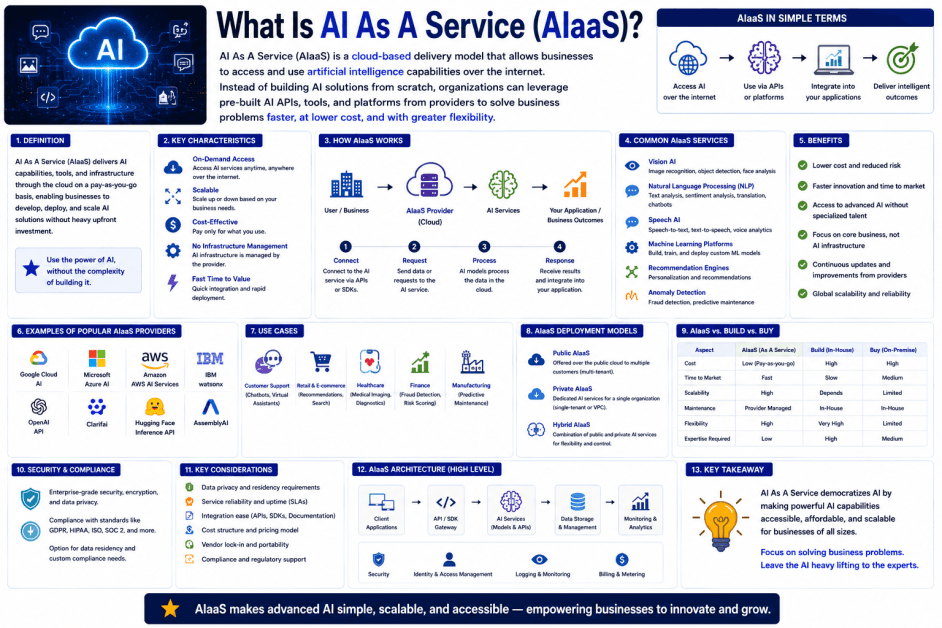
What Is AI as a Service (AIaaS)? A Simple Guide
Artificial intelligence has become an important tool for businesses, but developing AI systems from scratch often requires significant investment in computing infrastructure, skilled engineers, and large datasets. Many organizations want to use AI without building and maintaining complex AI platforms themselves. This is where AI as a Service (AIaaS) comes in.
AI as a Service is a cloud-based delivery model that allows organizations to access artificial intelligence capabilities through subscription-based or pay-as-you-go services. Instead of creating AI infrastructure internally, businesses can use ready-made AI tools, APIs, and machine learning platforms provided by cloud vendors.
Today, AIaaS is widely used for chatbots, document processing, predictive analytics, computer vision, speech recognition, recommendation systems, fraud detection, generative AI, and workflow automation. It enables organizations of all sizes to adopt AI more quickly while reducing upfront costs and technical complexity.
What Is AI as a Service (AIaaS)?
AI as a Service (AIaaS) is a cloud computing model that provides artificial intelligence technologies over the internet, allowing businesses to use AI without developing or hosting their own AI infrastructure.
An AIaaS provider manages:
-
AI models
-
Cloud infrastructure
-
Model updates
-
Security
-
Performance optimization
-
Scaling
Customers simply access AI services through web applications, APIs, or software integrations.
Examples of AIaaS capabilities include:
-
Text generation
-
Image recognition
-
Speech-to-text
-
Language translation
-
Predictive analytics
-
AI chatbots
-
Recommendation engines
-
Document analysis
How Does AI as a Service Work?
AIaaS typically follows a cloud-based workflow.
1. User Submits a Request
A business application sends data or a prompt to the AI service.
Examples include:
-
Analyze a document
-
Generate marketing content
-
Detect fraud
-
Recognize an image
-
Answer customer questions
2. Cloud Platform Processes the Request
The AIaaS provider receives the request and routes it to the appropriate AI model running in the cloud.
3. AI Model Performs the Task
Depending on the service, the model may:
-
Generate text
-
Analyze images
-
Detect patterns
-
Classify data
-
Translate languages
-
Predict outcomes
4. Return the Results
The processed output is securely returned to the business application through APIs or integrated software.
5. Continuous Improvement
The AIaaS provider maintains the infrastructure, deploys updates, improves models, and scales resources as demand changes.
Key Components of AI as a Service
1. Cloud Infrastructure
Provides scalable computing resources for AI workloads.
2. AI Models
Large language models, machine learning models, computer vision systems, and other AI technologies perform the requested tasks.
3. APIs and SDKs
Allow developers to integrate AI capabilities into websites, mobile apps, and enterprise software.
4. Data Processing Layer
Prepares, validates, and securely transfers data between applications and AI services.
5. Security and Governance
Protects customer data through authentication, encryption, access controls, and compliance features.
Common Types of AI as a Service
1. Machine Learning as a Service (MLaaS)
Provides tools for building, training, deploying, and managing machine learning models.
2. Generative AI Services
Offer text generation, image generation, code generation, summarization, and conversational AI.
3. Computer Vision Services
Analyze images and videos for object detection, facial recognition, quality inspection, and document processing.
4. Natural Language Processing (NLP) Services
Support translation, sentiment analysis, entity extraction, speech recognition, and language understanding.
5. Predictive Analytics Services
Use AI to forecast demand, detect anomalies, assess risks, and generate business insights.
Key Characteristics of AI as a Service
1. Cloud-Based Delivery
AI capabilities are accessed over the internet without local infrastructure.
2. On-Demand Scalability
Organizations can increase or decrease AI usage based on business needs.
3. Subscription or Usage-Based Pricing
Businesses typically pay monthly fees or based on API usage.
4. Rapid Deployment
Organizations can implement AI solutions much faster than building custom AI systems.
5. Managed Infrastructure
The provider handles maintenance, updates, and infrastructure management.
Common Applications of AI as a Service
AIaaS is widely used in:
-
Customer support chatbots
-
AI copilots
-
Virtual assistants
-
Document processing
-
Fraud detection
-
Financial analysis
-
Marketing automation
-
Content generation
-
Software development
-
Healthcare diagnostics support
-
Predictive maintenance
-
Retail recommendation systems
-
Enterprise search
-
Business intelligence
Benefits of AI as a Service
Lower Initial Costs
Organizations avoid large investments in AI hardware and infrastructure.
Faster AI Adoption
Businesses can deploy AI solutions quickly using ready-made services.
Easy Scalability
Cloud platforms automatically adjust computing resources as demand changes.
Access to Advanced AI
Organizations benefit from continually updated AI models without managing them directly.
Reduces Technical Complexity
Providers handle infrastructure, maintenance, and model improvements, allowing businesses to focus on their core operations.
Challenges of AI as a Service
Data Privacy
Organizations must ensure sensitive business information is protected when using cloud-based AI services.
Vendor Dependence
Businesses may become reliant on a specific AI provider's technology and pricing.
Integration Complexity
Connecting AI services with existing enterprise systems may require technical expertise.
Cost Management
Usage-based pricing can increase costs if AI services are heavily used without proper monitoring.
Human Oversight Required
Organizations should review AI-generated outputs, monitor system performance, and ensure compliance with legal, regulatory, and ethical requirements.
AI as a Service vs Traditional AI Development
| Feature | Traditional AI Development | AI as a Service (AIaaS) |
|---|---|---|
| Infrastructure | Built and managed internally | Managed by cloud provider |
| Deployment Time | Months or longer | Often days or weeks |
| Initial Investment | High | Lower |
| Scalability | Organization-managed | Cloud-managed |
| Best For | Highly customized AI systems | Rapid AI adoption and enterprise integration |
Best Practices for Using AI as a Service
Choose Trusted Providers
Evaluate providers based on security, compliance, reliability, and performance.
Protect Sensitive Data
Use encryption, access controls, and privacy policies to safeguard business information.
Monitor AI Performance
Regularly measure accuracy, response quality, and operational costs.
Integrate Carefully
Ensure AI services work seamlessly with existing business applications and workflows.
Maintain Human Oversight
Keep people responsible for reviewing high-impact decisions and validating AI-generated outputs.
Future of AI as a Service
AI as a Service is expected to become one of the fastest-growing segments of cloud computing as organizations increasingly adopt artificial intelligence without building their own infrastructure. Advances in large language models (LLMs), multimodal AI, AI agents, retrieval-augmented generation (RAG), and agent orchestration are expanding the range of AI services available through cloud platforms.
Future AIaaS platforms are likely to provide more specialized industry solutions, improved security and governance, real-time model customization, and deeper integration with enterprise software. Businesses will also benefit from automated scaling, lower deployment complexity, and access to increasingly capable AI models through standardized APIs.
As artificial intelligence continues to evolve, AI as a Service will remain a key enabler of enterprise AI adoption. By combining cloud infrastructure with advanced AI capabilities, AIaaS will help organizations innovate faster while maintaining flexibility, security, and operational efficiency.
Conclusion
AI as a Service (AIaaS) is a cloud-based model that gives organizations access to artificial intelligence capabilities without requiring them to build and manage their own AI infrastructure. By offering scalable AI tools, APIs, and managed services, AIaaS lowers the barriers to AI adoption for businesses of all sizes.
From customer support and predictive analytics to generative AI and enterprise automation, AIaaS is helping organizations deploy intelligent solutions more quickly and cost-effectively. Its flexibility and scalability make it an attractive option for companies seeking to accelerate digital transformation.
As cloud computing and artificial intelligence continue to advance, AIaaS will play an increasingly important role in making powerful AI technologies accessible across industries while enabling organizations to focus on innovation rather than infrastructure.
 What Is AI as a Service (AIaaS)? How AIaaS Works for Businesses FAQs
POST A COMMENT (0)
All Comments (0)
Replies (0)