





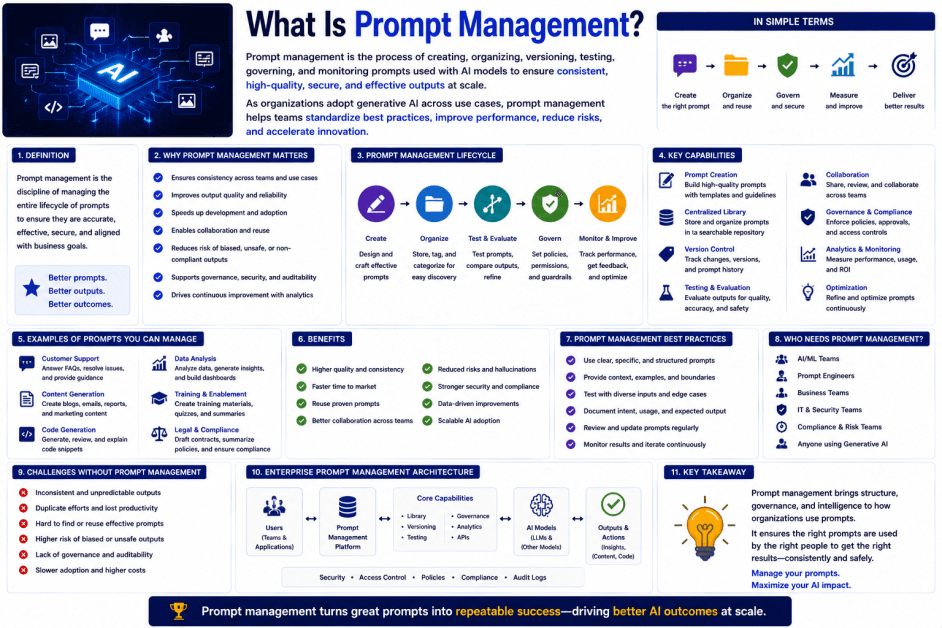
What Is Prompt Management? A Complete Guide
As organizations increasingly rely on large language models (LLMs) for chatbots, AI copilots, content generation, customer support, software development, and workflow automation, the quality of AI responses depends heavily on the prompts provided to these models. A poorly written prompt can produce inaccurate, inconsistent, or incomplete results, while a well-designed prompt can significantly improve performance.
Managing prompts becomes even more important when hundreds or thousands of prompts are used across multiple AI applications. This is where Prompt Management plays a vital role.
Prompt management is the process of organizing, storing, testing, updating, securing, and monitoring AI prompts throughout their lifecycle. It helps organizations ensure prompts remain accurate, reusable, version-controlled, and aligned with business objectives while improving the reliability and consistency of AI systems.
What Is Prompt Management?
Prompt management is the practice of creating, organizing, maintaining, testing, and governing prompts used by artificial intelligence systems, particularly large language models (LLMs).
Rather than treating prompts as simple text instructions, prompt management treats them as valuable assets that require:
-
Version control
-
Documentation
-
Testing
-
Optimization
-
Security
-
Collaboration
-
Performance monitoring
-
Continuous improvement
Prompt management helps organizations build AI applications that deliver consistent, high-quality outputs over time.
How Does Prompt Management Work?
Prompt management typically follows a structured lifecycle.
1. Create Prompts
Develop prompts tailored to a specific AI task, such as:
-
Content generation
-
Customer support
-
Code generation
-
Data analysis
-
Document summarization
-
Question answering
2. Store and Organize
Prompts are saved in a centralized repository where they can be categorized, documented, and reused across projects.
3. Test and Evaluate
Teams test prompts using different inputs to evaluate:
-
Accuracy
-
Relevance
-
Consistency
-
Response quality
-
Safety
4. Version and Update
As AI models, business requirements, or regulations evolve, prompts are refined while previous versions remain available for comparison or rollback.
5. Monitor and Improve
Organizations continuously track prompt performance using user feedback, analytics, and quality metrics to optimize future results.
Key Components of Prompt Management
1. Prompt Repository
A centralized library for storing prompts, templates, and reusable instructions.
2. Version Control
Tracks prompt revisions, enabling teams to compare changes and restore earlier versions when needed.
3. Testing Framework
Evaluates prompts against predefined datasets, scenarios, and performance metrics.
4. Documentation
Records the purpose, expected outputs, limitations, and usage guidelines for each prompt.
5. Governance and Security
Controls who can create, edit, approve, and deploy prompts while protecting sensitive information.
Key Characteristics of Prompt Management
1. Centralized Organization
Keeps prompts accessible, searchable, and reusable across teams.
2. Consistency
Ensures AI systems generate reliable outputs using standardized prompts.
3. Collaboration
Allows developers, AI engineers, subject matter experts, and business users to work together on prompt design.
4. Continuous Optimization
Prompts are regularly improved based on testing, analytics, and user feedback.
5. Enterprise Governance
Supports compliance, approval workflows, auditing, and responsible AI practices.
Common Applications of Prompt Management
Prompt management is widely used in:
-
AI chatbots
-
Enterprise AI copilots
-
Customer service automation
-
Content generation
-
Software development
-
Marketing automation
-
Document analysis
-
Knowledge management
-
Legal AI
-
Healthcare AI
-
Financial services
-
Education platforms
-
Research assistants
-
Business intelligence
Benefits of Prompt Management
Improves AI Response Quality
Well-managed prompts produce more accurate, consistent, and relevant outputs.
Enhances Collaboration
Teams can share and reuse proven prompts instead of creating new ones from scratch.
Reduces Development Time
Reusable prompt libraries accelerate AI application development.
Supports Governance
Version control and approval processes improve accountability and compliance.
Simplifies Maintenance
Organizations can update prompts centrally as business needs or AI models change.
Challenges of Prompt Management
Rapid AI Evolution
New AI models may require prompt adjustments to maintain performance.
Prompt Complexity
Sophisticated workflows often require detailed prompts that can be difficult to design and maintain.
Testing at Scale
Evaluating thousands of prompts across multiple scenarios requires significant planning and automation.
Security Risks
Prompts may unintentionally expose sensitive business information if not properly governed.
Human Oversight Required
Prompt quality should be reviewed regularly by experienced professionals to ensure outputs remain accurate, safe, compliant, and aligned with organizational objectives.
Prompt Management vs Prompt Engineering
| Feature | Prompt Engineering | Prompt Management |
|---|---|---|
| Primary Focus | Designing effective prompts | Managing prompts throughout their lifecycle |
| Scope | Individual prompts | Organization-wide prompt governance |
| Activities | Writing and optimizing prompts | Storage, versioning, testing, governance, monitoring |
| Users | AI developers and prompt engineers | Enterprise AI teams, developers, administrators |
| Best For | Improving prompt quality | Scaling and maintaining AI applications |
Best Practices for Prompt Management
Build a Central Prompt Library
Store approved prompts in a searchable repository with clear documentation.
Implement Version Control
Track every prompt revision and maintain rollback capability.
Test Regularly
Evaluate prompts across different datasets, edge cases, and AI model versions.
Establish Governance Policies
Define approval workflows, access permissions, and security guidelines.
Monitor Performance
Measure response quality, user satisfaction, accuracy, and business outcomes to continuously improve prompts.
Future of Prompt Management
Prompt management is expected to become a core discipline in enterprise AI as organizations deploy increasingly sophisticated large language models (LLMs), AI copilots, AI agents, and generative AI applications. As AI systems become more capable, managing prompts systematically will be essential for maintaining consistent performance, reducing operational risks, and supporting responsible AI practices.
Future prompt management platforms are likely to include automated prompt optimization, AI-assisted prompt generation, prompt analytics, semantic search, collaborative editing, policy enforcement, and integration with model evaluation tools. Organizations may also combine prompt management with retrieval-augmented generation (RAG), agent orchestration, and enterprise knowledge bases to build more reliable AI workflows.
As artificial intelligence continues to evolve, prompt management will play a critical role in ensuring that AI applications remain accurate, secure, scalable, and aligned with changing business requirements. Well-managed prompts will become an important organizational asset, supporting high-quality AI experiences across departments and industries.
Conclusion
Prompt management is the organized process of creating, storing, testing, updating, governing, and monitoring prompts used by AI systems. It enables organizations to manage prompts as valuable assets rather than simple text instructions, improving consistency, collaboration, and long-term maintainability.
From AI copilots and customer service to software development and enterprise automation, prompt management helps businesses deliver more reliable AI-powered solutions while reducing errors and supporting governance. Its emphasis on version control, testing, and continuous improvement makes it an essential capability for organizations adopting generative AI at scale.
As enterprise AI continues to expand, prompt management will become increasingly important for maintaining high-quality AI interactions, supporting responsible AI deployment, and enabling organizations to build scalable, trustworthy AI applications.
 What Is Prompt Management? How AI Prompt Management Works FAQs
POST A COMMENT (0)
All Comments (0)
Replies (0)