What Is an Activation Function? A Simple Guide
Activation functions are one of the fundamental building blocks of artificial neural networks. They enable AI models to learn complex patterns, recognize relationships in data, and solve problems that cannot be addressed using simple mathematical calculations alone. Every modern deep learning model—including image recognition systems, speech recognition software, recommendation engines, and large language models—relies on activation functions during training and prediction.
Without activation functions, neural networks would behave like simple linear models and would struggle to solve real-world tasks such as recognizing faces, translating languages, detecting fraud, or understanding natural language. Activation functions introduce non-linearity, allowing neural networks to model complex relationships found in images, text, audio, and other forms of data.
Although activation functions are essential for AI learning, they are only one component of a neural network. Human experts remain responsible for designing AI models, selecting suitable activation functions, evaluating performance, and ensuring responsible AI development.
What Is an Activation Function?
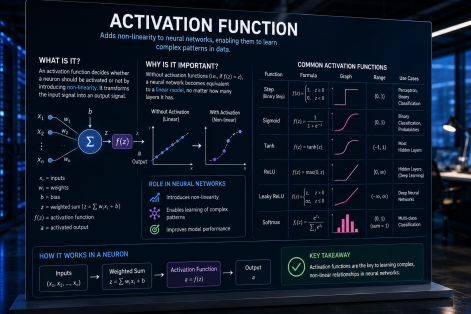
An activation function is a mathematical function used in artificial neural networks to determine whether a neuron should pass information to the next layer.
After a neuron receives weighted input values, the activation function transforms the result into an output that is passed forward through the network. This process allows neural networks to learn complex and non-linear patterns that would not be possible using only basic mathematical operations.
Different activation functions are designed for different types of AI models and learning tasks.
How Does an Activation Function Work?
Activation functions operate during the forward pass of a neural network.
1. Receive Input Values
Each neuron receives one or more input values from the previous layer.
These inputs are multiplied by weights and combined with a bias value.
2. Calculate the Weighted Sum
The neuron computes a weighted sum of all incoming values.
This value represents the neuron's raw output before activation.
3. Apply the Activation Function
The activation function transforms the weighted sum into a new output.
This transformation determines whether the neuron should become active and how strongly it should influence the next layer.
4. Pass the Output Forward
The activated output is sent to the next layer, where the same process repeats until the neural network produces its final prediction.
Common Types of Activation Functions
1. ReLU (Rectified Linear Unit)
ReLU is one of the most widely used activation functions in deep learning.
It outputs zero for negative values and passes positive values unchanged.
Benefits include:
-
Fast computation
-
Efficient training
-
Strong performance in deep neural networks
2. Sigmoid Function
The sigmoid function converts values into a range between 0 and 1.
It is commonly used for binary classification problems where predictions represent probabilities.
3. Tanh (Hyperbolic Tangent)
The tanh activation function produces outputs between -1 and 1.
It often provides better-centered outputs than the sigmoid function.
4. Softmax Function
Softmax converts multiple outputs into probability values that add up to 100%.
It is commonly used in multi-class classification tasks such as image recognition and language classification.
5. Leaky ReLU
Leaky ReLU is a variation of ReLU that allows a small output for negative values, helping reduce the "dying ReLU" problem in deep networks.
Key Characteristics of Activation Functions
1. Introduce Non-Linearity
Activation functions enable neural networks to solve complex real-world problems by modeling non-linear relationships.
2. Control Information Flow
They determine how much information each neuron passes to the next layer.
3. Improve Learning
Appropriate activation functions help neural networks learn faster and achieve better accuracy.
4. Support Deep Learning
Activation functions allow deep neural networks with many hidden layers to learn sophisticated patterns.
5. Task-Specific Design
Different activation functions are suitable for different AI applications, depending on the model architecture and prediction task.
Common Applications of Activation Functions
Activation functions are used in numerous AI systems, including:
-
Image recognition
-
Natural language processing (NLP)
-
Speech recognition
-
Recommendation systems
-
Medical diagnosis support
-
Fraud detection
-
Autonomous vehicles
-
Robotics
-
Financial forecasting
-
Predictive analytics
-
Large language models
-
Computer vision
Benefits of Activation Functions
Enable Complex Learning
Activation functions allow neural networks to recognize intricate relationships within data.
Improve Model Accuracy
Selecting an appropriate activation function helps AI models generate more reliable predictions.
Support Deep Neural Networks
Without activation functions, deep learning would not be practical for most real-world applications.
Efficient Computation
Modern activation functions such as ReLU enable faster model training and inference.
Broad AI Applications
Activation functions support a wide variety of machine learning and deep learning systems across multiple industries.
Challenges of Activation Functions
Choosing the Right Function
Different AI models may require different activation functions depending on the task and architecture.
Vanishing Gradient Problem
Functions such as sigmoid and tanh can slow learning in very deep networks because gradients become extremely small.
Dying ReLU Problem
Standard ReLU neurons may stop learning if they consistently receive negative inputs.
Computational Trade-Offs
Some activation functions require more computation than others, affecting training speed and efficiency.
Human Expertise Required
Selecting, tuning, and evaluating activation functions requires knowledge of machine learning and neural network design.
Best Practices for Using Activation Functions
Match the Function to the Task
Choose activation functions based on the model architecture and learning objective.
Test Multiple Functions
Experiment with different activation functions to identify the best-performing option.
Monitor Training Performance
Track accuracy, loss, and convergence throughout model training.
Combine with Proper Optimization
Activation functions work best when paired with suitable optimization algorithms, learning rates, and regularization techniques.
Continue Model Evaluation
Regularly evaluate neural network performance and update model configurations as new techniques become available.
Future of Activation Functions
Activation functions continue evolving alongside advances in artificial intelligence and deep learning. While established functions such as ReLU, Sigmoid, Tanh, and Softmax remain widely used, researchers are developing newer activation functions that improve training stability, computational efficiency, and model accuracy.
Future deep learning models may benefit from adaptive activation functions that automatically adjust their behavior during training based on the data and network architecture. Such innovations could further improve applications in healthcare, autonomous systems, scientific research, computer vision, and natural language processing.
Responsible AI development will remain important as neural networks become more sophisticated. Researchers and organizations will continue focusing on transparency, fairness, robustness, and human oversight while refining the mathematical foundations that make modern AI possible.
Rather than replacing human expertise, activation functions will continue serving as one of the core mathematical components that enable AI systems to learn efficiently and solve increasingly complex problems.
Conclusion
Activation functions are essential components of artificial neural networks. By introducing non-linearity, they enable AI models to learn complex patterns, recognize relationships in data, and make accurate predictions across a wide range of applications.
From image recognition and speech processing to large language models and recommendation systems, activation functions play a critical role in modern deep learning. Choosing the appropriate activation function significantly influences how effectively a neural network learns and performs.
As artificial intelligence continues advancing, activation functions will remain a fundamental part of neural network design. Combined with high-quality data, powerful computing resources, and responsible human oversight, they help create AI systems that are more capable, accurate, and reliable.