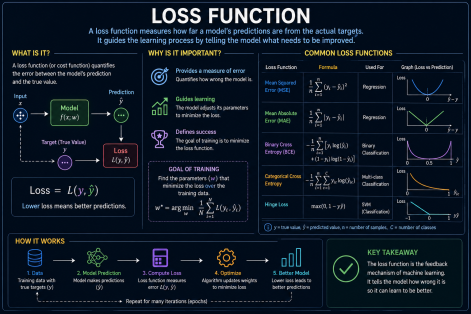
What Is a Loss Function? A Simple Guide
A loss function is one of the most important concepts in artificial intelligence and machine learning. It acts as a measuring tool that tells an AI model how well or how poorly it is performing during training. Every time a machine learning model makes a prediction, the loss function calculates the difference between the predicted result and the actual correct answer. This information helps the model improve over time.
Whether an AI system is recognizing images, translating languages, detecting fraud, recommending products, or generating text, a loss function plays a central role in the learning process. By continuously measuring prediction errors, it guides the model toward more accurate results through repeated training.
Although loss functions help AI models learn efficiently, they do not make decisions independently. Human experts remain responsible for selecting appropriate loss functions, preparing quality datasets, evaluating model performance, and ensuring AI systems are trained responsibly.
What Is a Loss Function?
A loss function is a mathematical function used in machine learning and deep learning to measure how far an AI model's predictions are from the correct answers.
A smaller loss value generally indicates better predictions, while a larger loss value means the model has made greater errors. During training, optimization algorithms use the loss value to adjust the model's parameters so that future predictions become more accurate.
Different AI tasks require different types of loss functions depending on the problem being solved.
How Does a Loss Function Work?
A loss function operates throughout the model training process.
1. Make a Prediction
The AI model receives input data and generates a prediction.
Examples include:
-
Identifying objects in an image
-
Predicting house prices
-
Translating text
-
Detecting spam emails
-
Classifying medical images
2. Compare with the Correct Answer
The prediction is compared with the actual result from the training dataset.
Any difference between the prediction and the correct answer represents the model's error.
3. Calculate the Loss
The loss function converts the prediction error into a numerical value.
Lower values indicate better performance, while higher values indicate larger prediction errors.
4. Update the Model
Optimization algorithms such as Gradient Descent use the calculated loss to update the model's weights and biases.
This process repeats many times until the model achieves satisfactory performance.
Common Types of Loss Functions
1. Mean Squared Error (MSE)
Mean Squared Error is commonly used for regression problems such as predicting prices, temperatures, or sales.
It calculates the average squared difference between predicted and actual values.
2. Mean Absolute Error (MAE)
MAE measures the average absolute difference between predictions and actual values.
It is generally less sensitive to extreme values than MSE.
3. Binary Cross-Entropy
Binary Cross-Entropy is widely used for binary classification tasks where the model predicts one of two possible outcomes, such as spam or not spam.
4. Categorical Cross-Entropy
Categorical Cross-Entropy is commonly used in multi-class classification problems where the model chooses among multiple categories.
Examples include:
-
Image classification
-
Language identification
-
Document categorization
5. Hinge Loss
Hinge Loss is often used in Support Vector Machines (SVMs) for classification tasks.
It encourages the model to create clear separation between different classes.
Key Characteristics of Loss Functions
1. Measure Prediction Error
Loss functions quantify how far model predictions differ from actual results.
2. Guide Model Learning
The calculated loss provides the feedback needed for optimization algorithms to improve the model.
3. Task-Specific Design
Different machine learning problems require different loss functions depending on the prediction objective.
4. Continuous Optimization
Loss values are repeatedly calculated throughout training to improve model accuracy.
5. Foundation of Machine Learning
Nearly every supervised machine learning and deep learning model relies on a loss function during training.
Common Applications of Loss Functions
Loss functions are used in numerous AI applications, including:
-
Image recognition
-
Natural language processing (NLP)
-
Speech recognition
-
Recommendation systems
-
Fraud detection
-
Medical diagnosis support
-
Financial forecasting
-
Autonomous vehicles
-
Machine translation
-
Predictive analytics
-
Large language models
-
Computer vision
Benefits of Loss Functions
Measure Learning Progress
Loss functions provide a clear numerical measure of how well a model is learning.
Improve Model Accuracy
By minimizing prediction errors, they help AI systems become more accurate over time.
Support Many AI Models
Loss functions are essential for neural networks, regression models, classification algorithms, and many other machine learning techniques.
Enable Automated Optimization
Loss values guide optimization algorithms that automatically improve model parameters.
Broad Industry Applications
Loss functions support AI systems used across healthcare, finance, manufacturing, education, transportation, and many other industries.
Challenges of Loss Functions
Choosing the Right Loss Function
Different AI problems require different loss functions. Selecting an inappropriate one can reduce model performance.
Sensitive to Data Quality
Poor-quality or biased training data can produce misleading loss values and reduce prediction accuracy.
Computational Cost
Large deep learning models may require substantial computing resources to repeatedly calculate loss values during training.
Risk of Overfitting
Minimizing training loss alone does not always guarantee good performance on new, unseen data.
Human Expertise Required
Developers must carefully evaluate model behavior and select suitable loss functions for each application.
Best Practices for Using Loss Functions
Match the Loss Function to the Task
Choose a loss function appropriate for regression, classification, or other machine learning objectives.
Use High-Quality Training Data
Accurate and representative datasets improve model learning and reduce misleading errors.
Monitor Both Loss and Accuracy
Track multiple evaluation metrics during training to better understand model performance.
Prevent Overfitting
Use validation datasets and regularization techniques to ensure the model performs well beyond the training data.
Continuously Evaluate Models
Regularly assess model performance and update training strategies as new data becomes available.
Future of Loss Functions
Loss functions continue evolving alongside advances in machine learning and deep learning. Researchers are developing specialized loss functions for complex AI tasks such as image generation, reinforcement learning, multimodal AI, and large language models. These newer approaches aim to improve training efficiency, robustness, and overall model performance.
As AI systems become larger and more sophisticated, customized loss functions are increasingly being designed for specific industries and applications, including healthcare, autonomous vehicles, finance, robotics, and scientific research. Better optimization techniques are also helping models learn faster while using fewer computational resources.
Responsible AI development will remain essential. Researchers and organizations continue working to improve fairness, transparency, and reliability by combining appropriate loss functions with high-quality datasets, rigorous evaluation methods, and human oversight.
Rather than replacing human expertise, loss functions will continue serving as one of the core mathematical tools that enable AI systems to learn effectively and improve through experience.
Conclusion
Loss functions are fundamental components of machine learning and deep learning because they measure how well an AI model is performing during training. By calculating prediction errors and guiding optimization algorithms, they enable models to improve their accuracy over time.
From image recognition and language translation to recommendation systems and autonomous vehicles, loss functions play a vital role in training modern AI systems. Choosing the appropriate loss function is essential for building reliable and effective machine learning models.
As artificial intelligence continues advancing, loss functions will remain a critical part of model development. Combined with quality data, optimization algorithms, and responsible human oversight, they help create AI systems that are increasingly accurate, efficient, and trustworthy.