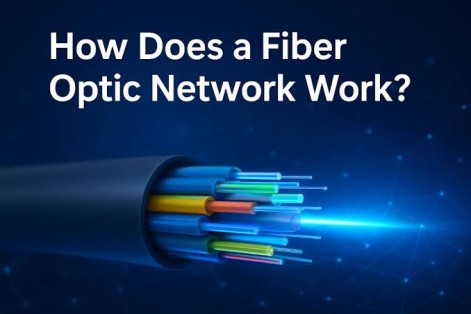
How Fiber Optic Internet Works: A Beginner's Guide to High-Speed Broadband
Fiber optic internet is a broadband technology that transmits data as pulses of light through extremely thin strands of glass or plastic called optical fibers. Unlike traditional copper cables that use electrical signals, fiber optic cables use light to carry information, enabling significantly faster speeds, lower latency, and greater reliability over long distances.
Today, fiber optic networks power homes, businesses, cloud computing, data centers, mobile networks, and global internet infrastructure.
What Is Fiber Optic Internet?

Fiber optic internet is a broadband connection that delivers internet access using optical fiber cables instead of copper telephone or coaxial cables.
Because light travels incredibly fast and experiences very little signal loss in optical fibers, fiber internet supports high-speed data transmission over long distances.
How Fiber Optic Internet Works
Fiber optic internet relies on several coordinated technologies.
Step 1: Data Is Converted into Light
When you send or receive data, networking equipment converts digital information into rapid pulses of light using laser transmitters or light-emitting diodes (LEDs), depending on the system design.
Step 2: Light Travels Through Optical Fibers
The light pulses travel through hair-thin optical fibers. Thanks to total internal reflection, the light repeatedly reflects off the inner walls of the fiber, allowing it to travel long distances with very little signal loss.
Step 3: The Signal Passes Through the Fiber Network
The optical signal moves through local fiber infrastructure, regional networks, and high-capacity backbone networks. Along the route, optical equipment may amplify or regenerate signals when necessary for extremely long-distance transmission.
Step 4: The Signal Reaches Your Home or Business
At the destination, an Optical Network Terminal (ONT) or similar device converts the incoming light signals back into electrical signals that routers, computers, smartphones, and other devices can use.
Step 5: Your Devices Connect
A Wi-Fi router or Ethernet connection distributes the internet connection throughout the home or office, allowing multiple devices to access online services simultaneously.
The entire transmission process occurs within milliseconds.
Key Components of a Fiber Optic Network
Several technologies work together to deliver fiber internet.
Optical Fiber Cable
Thin strands of glass or plastic carry light signals over long distances.
Optical Line Terminal (OLT)
Located at the service provider's network, the OLT manages communication between the provider and multiple customer connections.
Optical Network Terminal (ONT)
Installed at the customer's location, the ONT converts optical signals into electrical signals for local networking equipment.
Fiber Distribution Network
Connects central offices, neighborhoods, businesses, and homes through a network of fiber cables.
Router
Distributes the internet connection to computers, smartphones, televisions, and other connected devices.
Types of Fiber Internet
Fiber broadband is deployed in several ways.
Fiber to the Home (FTTH)
Fiber runs directly to individual homes, providing the highest performance and reliability.
Fiber to the Building (FTTB)
Fiber reaches a building, while internal wiring distributes connectivity to individual units.
Fiber to the Curb (FTTC)
Fiber extends close to homes, with the final connection completed using existing copper cables.
Fiber to the Node (FTTN)
Fiber reaches a neighborhood node, and existing copper infrastructure connects nearby customers.
Why Fiber Internet Is Faster
Several characteristics make fiber superior to many older broadband technologies.
Light-Based Transmission
Light travels extremely quickly and carries enormous amounts of data.
High Bandwidth
Optical fibers support significantly greater data capacity than traditional copper cables.
Low Latency
Fiber networks typically deliver lower delays, improving responsiveness for online gaming, video conferencing, cloud applications, and real-time communications.
Minimal Signal Loss
Optical signals degrade much less over long distances compared with electrical signals carried by copper cables.
Benefits of Fiber Optic Internet
Fiber internet offers numerous advantages.
Ultra-Fast Speeds
Supports high-speed downloads and uploads suitable for demanding applications.
Reliable Connections
Less susceptible to electrical interference and weather-related signal degradation.
Symmetrical Speeds
Many fiber services offer similar upload and download speeds, benefiting cloud storage, video conferencing, and content creation.
Supports Multiple Devices
Handles many connected devices simultaneously without significant performance loss.
Future Scalability
Fiber infrastructure can support increasing bandwidth demands through upgrades to networking equipment.
Common Applications of Fiber Internet
Fiber connectivity supports many industries and everyday activities.
Remote Work
Enables reliable video conferencing, cloud collaboration, and secure remote access.
Video Streaming
Supports high-resolution streaming, including 4K and 8K content where available.
Cloud Computing
Provides fast access to cloud applications and storage.
Online Gaming
Low latency improves multiplayer gaming and cloud gaming experiences.
Healthcare
Supports telemedicine, medical imaging, and digital health services.
Business Networks
Powers enterprise communication, cloud infrastructure, and large-scale data transfers.
Challenges of Fiber Internet
Despite its advantages, fiber deployment has several considerations.
Infrastructure Costs
Installing fiber networks requires significant investment.
Limited Availability
Fiber service is not yet available in all locations, particularly in some rural or remote areas.
Installation Complexity
Deploying new fiber cables may require construction and specialized equipment.
Physical Damage
Fiber cables can be damaged during construction or excavation if not properly protected.
Fiber Internet vs. Cable Internet
Both technologies provide broadband internet but differ in important ways.
Fiber Internet
- Uses light transmitted through optical fibers.
- Typically offers higher speeds and lower latency.
- Often provides symmetrical upload and download speeds.
- Better suited for future bandwidth growth.
Cable Internet
- Uses coaxial cables carrying electrical signals.
- Performance may vary during periods of heavy neighborhood usage.
- Upload speeds are often lower than download speeds.
- Widely available in many regions.
Best Practices for Getting the Most from Fiber Internet
Users should follow these recommendations.
Use a Modern Router
A current-generation Wi-Fi router helps take advantage of high-speed fiber connections.
Connect High-Demand Devices with Ethernet
Wired connections provide maximum speed and stability for gaming, workstations, and streaming devices.
Keep Networking Equipment Updated
Regular firmware updates improve performance and security.
Position Wi-Fi Equipment Properly
Place routers centrally to maximize wireless coverage.
Secure Your Network
Use WPA3 encryption when supported and protect your network with a strong password.
Future of Fiber Optic Internet
Fiber optic technology continues to evolve through higher-capacity optical networking, 5G backhaul, Artificial Intelligence-powered network management, quantum communication research, and expanding fiber-to-the-home deployments. AI increasingly helps optimize traffic routing, predict equipment failures, and improve network performance. As cloud computing, streaming, smart cities, and Artificial Intelligence applications continue to grow, fiber optic infrastructure will remain the backbone of the global internet.
Conclusion
Fiber optic internet has transformed broadband connectivity by transmitting data as pulses of light through optical fibers, delivering exceptional speed, reliability, and low latency. From remote work and cloud computing to online gaming and video streaming, fiber supports the growing demands of today's digital world. As global internet usage continues to expand, fiber optic technology will remain one of the most important foundations of modern communication infrastructure.