How AI Colorizes Old Photos: A Complete Guide
Millions of historical photographs exist only in black and white. While these images preserve important moments in history, they often lack the visual richness that color provides. Traditionally, adding color to old photographs required skilled artists who manually painted each image—a process that could take hours or even days.
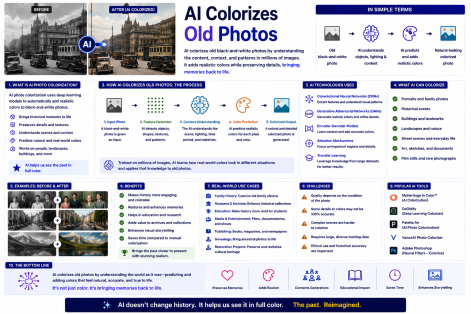
Today, AI-powered photo colorization has transformed this task. Using deep learning and computer vision, AI can analyze black-and-white photographs, recognize the objects within them, and generate realistic color estimates in just seconds. Although AI cannot determine the exact original colors unless historical references are available, it can produce natural-looking colorized versions that make old photographs more engaging and easier to interpret.
AI colorization is now widely used in photo restoration, museums, documentaries, family archives, publishing, education, and digital preservation.
What Is AI Photo Colorization?
AI photo colorization is the process of using artificial intelligence to add color to grayscale or black-and-white photographs.
Instead of applying random colors, AI studies image content such as people, clothing, buildings, landscapes, skies, plants, and objects to estimate realistic colors based on patterns learned from millions of color photographs.
AI colorization can be applied to:
-
Historical photographs
-
Family photo collections
-
Archived newspapers
-
Museum collections
-
Film frames
-
Documentary footage
-
Vintage portraits
-
Cultural heritage projects
How Does AI Colorize Old Photos?
AI-powered photo colorization generally follows these steps.
1. Analyze the Photograph
The AI examines the grayscale image to identify:
-
People
-
Faces
-
Clothing
-
Buildings
-
Vehicles
-
Trees
-
Water
-
Sky
-
Animals
-
Background objects
2. Recognize Image Content
Using computer vision, the system determines what each part of the image likely represents.
3. Predict Appropriate Colors
Deep learning models estimate realistic colors based on patterns learned from large collections of color images.
For example:
-
Blue skies
-
Green vegetation
-
Natural skin tones
-
Brown wood
-
Gray roads
These are statistical predictions, not confirmations of the original colors.
4. Apply Intelligent Colorization
Different colors are assigned to various image regions while preserving shadows, lighting, and texture.
5. Produce the Colorized Image
The final colorized photograph is generated and can often be further refined through manual editing if greater historical accuracy is required.
Key Technologies Behind AI Photo Colorization
1. Computer Vision
Allows AI to recognize objects, people, landscapes, and scene composition.
2. Deep Learning
Neural networks learn relationships between grayscale and color images using extensive training datasets.
3. Convolutional Neural Networks (CNNs)
CNNs identify textures, shapes, and visual patterns that guide realistic color prediction.
4. Image Restoration Models
These models help improve image quality before or during the colorization process.
5. Generative AI
Some advanced systems generate realistic color variations while preserving natural lighting and visual consistency.
Key Characteristics of AI Photo Colorization
1. Content Awareness
AI assigns colors based on the objects and scene rather than applying a single color filter.
2. Fast Processing
Many AI tools can colorize photographs within seconds.
3. Natural-Looking Results
Modern systems produce visually convincing colors while maintaining realistic shading.
4. Scalable Automation
Thousands of archival photographs can be processed efficiently.
5. Supports Manual Refinement
Users can often adjust colors afterward when historical evidence or artistic preferences require changes.
Common Applications of AI Photo Colorization
AI photo colorization is widely used in:
-
Historical photo restoration
-
Family archive preservation
-
Museums
-
Documentary filmmaking
-
Education
-
Genealogy projects
-
Book publishing
-
News archives
-
Cultural heritage preservation
-
Film restoration
-
Digital libraries
-
Graphic design
-
Marketing campaigns
-
Social media content
Benefits of AI Photo Colorization
Brings History to Life
Colorized photographs can make historical scenes feel more immediate and engaging.
Saves Time
AI automates a process that previously required extensive manual work.
Improves Visual Appeal
Colorized images are often easier for modern audiences to interpret and appreciate.
Supports Cultural Preservation
Museums and archives can restore and present historical collections more effectively.
Enhances Creative Projects
Designers, publishers, and filmmakers can use restored historical imagery in new productions.
Challenges of AI Photo Colorization
Original Colors May Be Unknown
AI predicts likely colors based on learned patterns but cannot confirm the true historical colors without reliable reference material.
Ambiguous Scenes
Objects with unusual materials, uniforms, decorations, or lighting conditions may receive inaccurate color estimates.
Historical Accuracy
Researchers, historians, and archivists may need to compare AI-generated colors with historical records before publication.
Image Quality Limitations
Heavily damaged or low-resolution photographs may require restoration before effective colorization.
Human Review Remains Important
For historical, educational, journalistic, or archival use, experts should verify AI-generated colors and make manual adjustments when authenticity is essential.
Traditional Manual Colorization vs AI Photo Colorization
| Feature | Manual Colorization | AI Photo Colorization |
|---|---|---|
| Process | Hand-colored by artists | Automated using AI |
| Speed | Hours or days | Seconds or minutes |
| Required Skill | High | Minimal |
| Scalability | Limited | Can process large collections |
| Best For | Precise historical restoration | Fast, high-quality color enhancement |
Best Practices for Using AI Photo Colorization
Start with a High-Quality Scan
Clearer source images generally produce better colorization results.
Verify Historical Details
Use reference photographs, documents, or expert knowledge when historical accuracy matters.
Restore Before Colorizing
Repair scratches, tears, and noise before applying colorization when possible.
Preserve the Original Image
Always keep an untouched grayscale version alongside the colorized copy.
Combine AI with Human Editing
Use AI for rapid initial colorization and apply manual corrections where necessary.
Future of AI Photo Colorization
AI photo colorization is expected to become increasingly accurate as computer vision, deep learning, and generative AI continue to advance. Future systems will better recognize historical clothing, architecture, vehicles, landscapes, and cultural artifacts, enabling more context-aware color predictions.
Researchers are also combining AI colorization with image restoration, super-resolution, facial enhancement, and damage repair to create comprehensive photo restoration workflows. Museums, archives, and media organizations are expected to use these technologies to preserve and present historical collections with greater efficiency while maintaining high standards of authenticity.
As artificial intelligence evolves, AI photo colorization will continue to make historical images more accessible and engaging, helping new generations connect with the past while supporting responsible digital preservation.
Conclusion
AI photo colorization uses computer vision, deep learning, and image restoration techniques to transform black-and-white photographs into realistic color images. By recognizing objects and estimating likely colors from extensive training data, AI can produce visually compelling results far more quickly than traditional manual methods.
From family photo restoration and documentary production to museum collections and historical archives, AI colorization is helping preserve visual history in new and engaging ways. Although AI-generated colors are informed estimates rather than guaranteed historical facts, they provide a valuable starting point for restoration and storytelling.
As AI technology continues to improve, photo colorization will become even more accurate, efficient, and widely used in preserving cultural heritage and enhancing historical imagery.