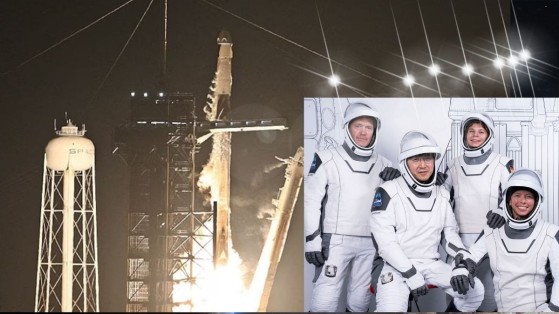
Fram2 Breaks New Ground in Spaceflight with Polar Retrograde Orbit
In a landmark event in the history of human spaceflight, the Fram2 mission has successfully completed the first-ever crewed flight into a polar retrograde orbit. This pioneering achievement opens fresh horizons for scientific research, Earth observation, and the future of space missions.
What is a Polar Retrograde Orbit?
A polar orbit is a trajectory that passes over the Earth’s poles, allowing a satellite or spacecraft to observe nearly every part of the planet as the Earth rotates beneath it. A retrograde orbit means the spacecraft moves in the opposite direction of Earth’s rotation, requiring more energy to achieve but offering unique advantages for certain scientific missions.
Fram2’s flight into this challenging orbit represents a significant technological and operational milestone. It combines the benefits of a polar orbit’s comprehensive coverage with the distinct dynamics of retrograde motion.
About the Fram2 Mission
Fram2 is a crewed space mission developed by an international consortium of space agencies and research institutions. It follows the pioneering Fram1 mission, which focused on uncrewed scientific observations.
This mission carried a crew of astronauts tasked with:
-
Testing human endurance and performance in a retrograde polar orbit.
-
Conducting Earth observation experiments focusing on climate and environmental changes.
-
Demonstrating new spacecraft technologies designed for such demanding orbits.
Challenges of Polar Retrograde Orbits
Launching and sustaining a crewed vehicle in a polar retrograde orbit is complex due to:
-
Higher energy requirements: Flying against Earth’s rotation demands more rocket fuel and precise launch techniques.
-
Thermal and radiation exposure: The spacecraft encounters different space weather conditions compared to equatorial or prograde orbits.
-
Orbital mechanics and navigation: Maneuvering and maintaining the orbit requires advanced guidance and control systems.
Overcoming these challenges, Fram2’s success confirms the feasibility of crewed missions in such orbits, expanding the envelope of human spaceflight capabilities.
Scientific and Practical Advantages
Fram2’s polar retrograde orbit provides several unique benefits:
-
Global Earth Coverage: The orbit allows comprehensive scanning of Earth’s surface, ideal for environmental monitoring, disaster management, and climate science.
-
Enhanced Communication: The orbit’s trajectory supports improved communication relay with polar regions, important for scientific outposts and military applications.
-
Future Exploration: Understanding spacecraft dynamics in retrograde polar orbits aids planning for missions to the Moon, Mars, and other planetary bodies, where varied orbital mechanics come into play.
Crew Experience and Findings
The astronauts aboard Fram2 reported adapting well to the mission’s conditions, with no major health issues despite the unique orbital environment. They performed complex experiments involving:
-
High-resolution imaging of polar ice caps and ocean currents.
-
Testing new radiation shielding materials.
-
Monitoring psychological and physiological effects of this orbit on crew performance.
Their data will be invaluable for designing future long-duration missions in similar orbits.
Global Collaboration and Impact
Fram2 exemplifies international cooperation in space exploration, involving agencies from North America, Europe, and Asia. This collaboration underscores the shared interest in expanding humanity’s presence in space and protecting our planet through enhanced observation.
Looking Forward
With Fram2’s success, space agencies are now evaluating new mission profiles that utilize polar retrograde orbits for:
-
Advanced climate monitoring satellites.
-
Crewed scientific outposts in low Earth orbit with strategic global access.
-
Preparations for crewed lunar and planetary exploration missions.
Conclusion: A New Chapter in Crewed Spaceflight
Fram2’s historic crewed flight into a polar retrograde orbit marks a milestone in human space exploration. By demonstrating the viability of such challenging orbits for humans, it paves the way for expanded scientific research, improved Earth monitoring, and future interplanetary missions.
As humanity pushes further into space, the achievements of Fram2 will serve as a foundation for more ambitious journeys beyond Earth’s atmosphere.