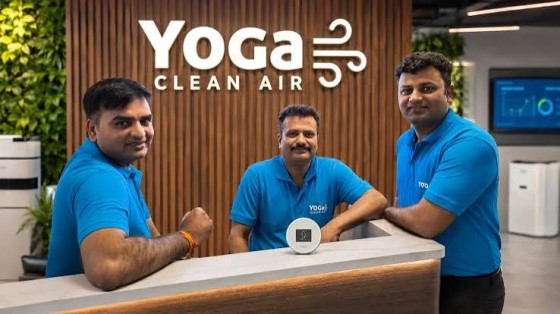
YOGa Clean Air Raises ₹20 Crore From Info Edge Ventures and Other Investors to Scale Indoor-Air Systems
Indian indoor-air-quality startup YOGa Clean Air has raised ₹20 crore in funding led by Info Edge Ventures, with participation from Deepinder Goyal, founder of Eternal, and investment firm Three Words Capital, as the company prepares to expand its engineered clean-air systems across more Indian cities and into new applications such as public transport.
The funding marks the company's first external institutional capital raise, giving YOGa additional resources to deepen operations in existing markets, enter more Tier-I and Tier-II cities, and broaden the use of its air-quality technology beyond homes and conventional commercial buildings.
YOGa currently serves more than 5,000 families and has installations across schools, hospitals, offices and gyms in 11 Indian cities, including Delhi-NCR, Mumbai, Kolkata, Bengaluru and Hyderabad.
The company's core proposition differs from conventional standalone air purifiers.
Instead of filtering air within a limited room after pollutants have entered, YOGa's patented Clean Air Bubble approach is designed to treat the entire indoor environment as a controlled system by filtering incoming air and maintaining slightly higher air pressure indoors than outdoors.
That model positions YOGa not simply as an air-purifier brand but as an indoor-air infrastructure company attempting to manage:
particulate pollution,
air exchange,
and:
carbon-dioxide levels
at the building level.
YOGa Clean Air Raises ₹20 Crore in First Institutional Funding Round

The financing round totals:
₹20 crore.
Info Edge Ventures led the investment.
The round also included:
Deepinder Goyal
and:
Three Words Capital.
The transaction gives YOGa institutional backing at a time when air pollution is increasingly becoming a structural urban-health and building-design issue rather than a seasonal consumer problem.
For the company, the capital provides an opportunity to move from a largely referral-driven growth model toward broader geographic expansion.
Info Edge Ventures Leads the Round
Info Edge Ventures is the lead investor in the financing.
The participation is significant because the investment platform has backed multiple Indian technology and consumer businesses.
For YOGa, institutional venture capital can provide more than funding.
It can also bring:
growth discipline,
recruitment support,
strategic guidance,
and access to broader founder and investor networks.
That becomes increasingly important as the company expands from an engineering-led business into a multi-city operating platform.
Deepinder Goyal Also Participates
The funding round also includes Deepinder Goyal, founder of Eternal.
His participation brings another high-profile entrepreneurial investor onto YOGa's cap table.
Founder-investors can sometimes contribute practical operating insight around:
customer acquisition,
technology,
scaling,
and organisation building.
The exact individual investment amounts were not publicly disclosed.
Three Words Capital Joins the Funding Round
Three Words Capital also participated in the transaction.
The mix of venture, founder and investment-firm capital broadens YOGa's investor base as it enters a more aggressive expansion phase.
The company has not disclosed a valuation for the round.
Capital Will Fund Expansion Across Indian Cities
YOGa plans to use the fresh capital to deepen its presence in markets where it already operates and enter additional:
Tier-I
and:
Tier-II cities.
Expansion into smaller metropolitan markets could significantly increase the addressable opportunity.
Air-quality problems are no longer limited to Delhi-NCR.
Rapid construction, traffic, industrial activity and seasonal pollution affect multiple Indian cities.
That creates demand for building-level air-quality systems across a wider geography.
Public Transport Is a New Target Market
One of the most interesting elements of YOGa's expansion plan is its intention to extend clean-air systems into:
public transportation.
The company has also indicated interest in additional outdoor or semi-outdoor environments.
This could move the business beyond conventional residential and commercial installations.
Potential applications could eventually include:
buses,
rail systems,
transport terminals,
and other high-footfall environments,
subject to engineering feasibility and customer adoption.
YOGa Serves More Than 5,000 Families
The company says its systems already protect more than:
5,000 families.
It also works with:
schools,
hospitals,
offices,
and:
gyms.
This mix is important because indoor-air quality affects very different customer segments.
A household may care about:
children,
elderly family members,
and daily exposure.
A school may need to manage air quality across classrooms.
A hospital may require cleaner and more controlled air environments.
An office may focus on employee comfort, productivity and ventilation.
YOGa Is Present Across 11 Cities
The company currently operates across:
11 Indian cities.
Major markets include:
Delhi-NCR,
Mumbai,
Kolkata,
Bengaluru,
and:
Hyderabad.
That provides YOGa with an existing multi-city base before the new capital is deployed.
The next stage will be testing whether its operating model can scale efficiently beyond its current footprint.
The Company Has Grown Largely Through Referrals
YOGa says much of its growth to date has come from:
customer referrals
and:
word of mouth.
That can be an encouraging signal for a technical service business.
Referral-led growth may indicate strong customer satisfaction and reduce dependence on expensive advertising.
However, entering many new cities will likely require more formal:
sales teams,
channel partnerships,
brand building,
and installation capacity.
Annual Maintenance Renewals Are an Important Revenue Feature
The company has reported a 100% renewal rate on annual maintenance contracts among its installed customers.
For a hardware-and-services business, recurring maintenance revenue can materially improve economics.
Instead of relying only on one-time equipment sales, annual contracts can create:
repeat revenue,
ongoing customer relationships,
and predictable service demand.
Over time, this can make the business model more recurring and less dependent on constant new installations.
YOGa Is Not Positioning Itself as a Conventional Air-Purifier Company
The key technological distinction lies in how YOGa manages indoor air.
Traditional portable air purifiers generally:
pull existing room air through filters,
capture particles,
and release cleaner air back into the same space.
That can lower particulate matter in a room.
But polluted outdoor air may continue entering through:
doors,
windows,
gaps,
or uncontrolled ventilation.
YOGa's system attempts to address the building itself.
Clean Air Bubble Technology Uses Positive Pressure
The company's Clean Air Bubble technology filters outdoor air before introducing it inside.
It then maintains slightly higher indoor pressure relative to outside air.
This positive-pressure effect is designed to reduce the uncontrolled inward movement of polluted outdoor air.
The principle is already used in specialised environments where air quality must be controlled carefully.
Applying it more broadly to:
homes,
schools,
and offices
creates a differentiated consumer and commercial proposition.
The System Also Manages Carbon Dioxide
Particulate pollution is only one indoor-air-quality issue.
A tightly sealed room can reduce incoming pollution but cause:
carbon dioxide levels to rise
when people remain inside.
High CO₂ can indicate inadequate fresh-air exchange.
YOGa therefore combines filtration with controlled ventilation rather than simply sealing a room.
The company says its system is designed to maintain clean air while keeping CO₂ levels under control.
Indoor Air Quality Requires Balancing Two Competing Problems
Buildings in polluted cities face a difficult engineering trade-off.
Opening windows allows ventilation.
But it also allows:
PM2.5,
dust,
and other pollutants
to enter.
Closing the building reduces outside pollution infiltration.
But it can increase:
CO₂,
humidity,
odours,
and indoor contaminants.
A properly engineered air system must solve both problems simultaneously.
That is the technical gap YOGa is attempting to address.
Company Claims Single-Digit Indoor Pollution Levels
YOGa says its systems have reduced indoor particulate readings to:
single-digit levels
even when outdoor pollution exceeded:
900 µg/m³.
The company says this performance has been independently validated by IIT Delhi.
These performance claims are important to the startup's commercial positioning because customers purchasing whole-space air systems need measurable evidence that installations are producing meaningful results.
IIT Delhi Professor Mukesh Khare Is Non-Executive Chairman
YOGa's leadership also includes Professor Mukesh Khare of IIT Delhi as non-executive chairman.
Academic involvement can be particularly relevant for an air-quality engineering company because product performance depends on disciplines including:
environmental engineering,
airflow,
filtration,
pollutant measurement,
and ventilation.
The challenge is translating scientific principles into systems that can be installed economically across thousands of buildings.
YOGa Holds Patented Technology
The company says it holds:
two patents
related to its technology.
Patent records also identify YOGAN Solutions Private Limited as an applicant for technology involving micropore filtration designed to create a clean-air pocket through controlled ventilation.
Intellectual property can provide differentiation if the patented systems produce practical advantages over standard filtration products.
However, long-term competitive strength will also depend on:
installation quality,
service,
cost,
distribution,
and customer trust.
YOGa Was Formally Established as YOGAN Solutions in 2019
The business was founded by Sachin Panwar and formally established as YOGAN Solutions Private Limited in 2019 with co-founders Deepak Raina and Gaurav Nagar.
Some coverage traces the origins of Panwar's work on the concept back to 2010, while the current corporate entity was formalised later.
This distinction is useful because it reflects a long technical-development period before institutional funding.
The Startup Has Been Bootstrapped Until Now
The ₹20 crore raise is YOGa's first external funding round.
That means the company reached thousands of customers and expanded across 11 cities before bringing in institutional capital.
Bootstrapped businesses often develop differently from venture-funded startups.
They typically need to prioritise:
customer revenue,
unit economics,
and cash discipline
earlier in their growth cycle.
Fresh funding can now allow YOGa to accelerate without building the commercial model entirely from internal cash flows.
Scaling an Engineering Business Is Harder Than Scaling Software
YOGa's expansion challenge differs from that of a purely digital company.
Each installation may involve:
site assessment,
airflow design,
equipment,
ducting,
filters,
installation,
testing,
and maintenance.
That means geographic expansion requires physical operating capacity.
The company will likely need to build or partner for:
installation teams,
service technicians,
inventory,
and local logistics.
This makes execution quality critical.
Standardisation Could Determine How Fast YOGa Scales
A highly customised system may produce strong results but can be expensive to scale.
A standardised system can expand faster but may not suit every building.
YOGa therefore needs to strike a balance between:
engineering customisation
and:
repeatable product design.
If the company can create modular systems suitable for multiple building types, its expansion economics could improve significantly.
Schools Represent a Potentially Large Market
Schools are an important indoor-air-quality use case.
Students spend many hours inside classrooms.
In high-pollution cities, schools face pressure to protect children without simply shutting down normal activity during every pollution episode.
Whole-building or classroom-level air-management systems can therefore become part of school infrastructure.
The challenge is affordability.
Education institutions need systems that can operate across multiple rooms without creating excessive capital or maintenance costs.
Hospitals Have More Stringent Air Requirements
Hospitals are another target segment.
Healthcare environments already recognise the importance of:
ventilation,
filtration,
and infection control.
Different hospital areas require different air standards.
A company that can demonstrate reliable engineering and monitoring may find opportunities in:
clinics,
waiting areas,
administrative spaces,
and other controlled environments.
This market also requires rigorous compliance and performance validation.
Offices Are Becoming More Conscious of Air Quality
Corporate offices increasingly monitor workplace conditions beyond temperature.
Employers may consider:
PM2.5,
CO₂,
humidity,
and ventilation
as part of employee-health and building-management programmes.
Large office clients can be particularly attractive because one contract may cover:
multiple floors
or:
multiple locations.
This makes enterprise sales a potentially important growth channel for YOGa.
Gyms Create a Distinct Ventilation Challenge
Gyms have high occupant activity.
People exercising generate more:
heat,
moisture,
and carbon dioxide
than people sitting in a room.
That means filtration without sufficient fresh-air management can become problematic.
YOGa's combination of controlled fresh air and filtration may therefore have a specific use case in fitness environments.
Public Transport Could Significantly Expand the Addressable Market
Moving into public transport would change YOGa's addressable market substantially.
A residential installation serves one household.
A public-transport system can expose:
hundreds or thousands of passengers
to the same air-management infrastructure.
However, transport applications also involve different engineering challenges.
Systems must work under conditions involving:
frequent door opening,
high passenger turnover,
limited space,
vibration,
and high operating hours.
Success in this category would therefore require technology adaptation.
Air Pollution Is Creating a New Building-Technology Category
India's air-quality problem is creating demand for technologies beyond portable purifiers.
The emerging ecosystem includes:
air-quality monitors,
HVAC filtration,
controlled ventilation,
building-management software,
and whole-space purification systems.
This creates an opportunity for companies positioned at the intersection of:
climate technology,
consumer hardware,
and building infrastructure.
YOGa is attempting to occupy that intersection.
Indoor-Air Systems Could Become Similar to Other Building Utilities
In highly polluted cities, clean indoor air may increasingly be treated the way buildings treat:
temperature,
water,
electricity,
and fire safety.
Instead of residents purchasing individual devices after pollution worsens, developers could eventually integrate air-quality systems during construction.
That would represent a major shift from:
consumer appliance
to:
building infrastructure.
If this market develops, it could significantly increase the scale of the opportunity.
Real Estate Developers Could Become Important Customers
Residential developers represent a potentially important B2B channel.
Premium housing projects increasingly differentiate themselves through:
air filtration,
water treatment,
energy efficiency,
and wellness features.
Integrated clean-air systems could become part of:
clubhouses,
common areas,
and eventually individual apartments.
Partnerships with developers would allow YOGa to install systems before occupants move in rather than retrofitting buildings later.
Retrofitting Existing Buildings Remains a Large Opportunity
India also has an enormous installed base of existing:
homes,
schools,
offices,
and hospitals.
Many were not designed for severe outdoor air pollution.
Retrofitting these buildings creates a different engineering challenge but also a much larger immediate market.
YOGa's ability to adapt systems to existing structures will therefore remain central to growth.
Maintenance Economics Will Matter as Installed Base Expands
Filters require replacement.
Fans and ventilation equipment require servicing.
Sensors may need:
calibration
and:
maintenance.
As YOGa's installed base expands, after-sales service becomes increasingly important.
Poor maintenance can reduce system performance even when the original installation was effective.
The company's reported maintenance-contract renewal rate suggests recurring service could become an important part of the business model.
Recurring Service Revenue Can Improve Business Quality
A company earning only from equipment installations must continually find new customers.
A company with recurring maintenance contracts starts each year with an existing revenue base.
As installations accumulate, recurring service revenue can grow alongside new system sales.
That can create:
better revenue visibility,
higher customer lifetime value,
and stronger retention.
For investors, this may make YOGa more attractive than a simple hardware-sales business.
Funding Could Accelerate Product Development
Although geographic expansion is a stated priority, new capital can also strengthen technology development.
Public transport and larger commercial environments will require different system designs from homes.
The company may need to invest in:
more compact hardware,
sensors,
controls,
automation,
and monitoring software.
Better remote monitoring could also reduce service costs as the installed base expands.
Data Could Become an Important Competitive Asset
A network of connected air-quality systems can generate substantial data on:
pollutant levels,
indoor CO₂,
filter life,
occupancy patterns,
and equipment performance.
That data can improve:
maintenance scheduling,
product design,
and system optimisation.
Over time, YOGa could evolve from selling clean-air hardware into managing indoor environmental performance.
That would create a more technology-intensive business model.
Measuring Outcomes Is Critical
Air-quality products face a basic credibility challenge:
customers cannot directly see many pollutants.
They therefore need measurement.
Real-time sensors can make performance visible by showing:
PM2.5,
CO₂,
temperature,
humidity,
and other metrics.
Transparent measurement can increase trust and demonstrate whether a system is actually working.
For YOGa, performance visibility may be an important sales tool.
India’s Indoor-Air Market Is Still Early
Despite high outdoor pollution in several Indian cities, engineered indoor-air systems remain relatively underpenetrated.
Many households still rely on:
portable air purifiers
or:
no dedicated air-treatment system.
Schools and offices also vary widely in their standards.
That creates a large potential market but also means YOGa must educate customers about why whole-space systems differ from portable appliances.
Customer Education Could Be a Major Growth Cost
Selling a conventional purifier is relatively simple.
Consumers understand the product category.
Selling a building-level air-management system requires explaining:
air pressure,
ventilation,
filtration,
CO₂,
and installation design.
This creates a more consultative sales process.
YOGa may therefore need to invest heavily in:
demonstration,
measurement,
and customer education
as it enters new markets.
₹20 Crore Gives YOGa Capital to Test a Larger Growth Model
The funding round is modest compared with large consumer-tech raises.
But for a company that has largely grown without external institutional funding, ₹20 crore can meaningfully increase expansion capacity.
The capital can support:
new-city launches,
team building,
product development,
marketing,
working capital,
and installation infrastructure.
The critical question is how efficiently the company converts this investment into new recurring revenue.
Execution Will Matter More Than the Funding Headline
The fundraise validates investor interest.
It does not guarantee scale.
YOGa must now demonstrate that it can:
expand beyond referral-led demand,
maintain installation quality,
control customer-acquisition costs,
build reliable service operations,
and preserve strong renewal rates.
Hardware-plus-service businesses can grow quickly but become operationally complex.
The quality of expansion will therefore matter as much as speed.
Conclusion
YOGa Clean Air's ₹20 crore funding round led by Info Edge Ventures, with participation from Deepinder Goyal and Three Words Capital, gives the indoor-air-quality company its first significant external capital base for expansion.
The startup already serves more than 5,000 families and a range of schools, hospitals, offices and gyms across 11 Indian cities, while relying heavily on referrals to build its customer base.
Its core differentiation is the patented Clean Air Bubble system, which filters incoming air and maintains positive indoor pressure while managing ventilation and carbon-dioxide levels rather than relying only on room-level recirculating purification.
The new capital will be used to expand across Tier-I and Tier-II markets and explore applications in areas such as public transport, potentially moving YOGa beyond residential and commercial buildings into larger infrastructure environments.
The opportunity is significant because India's air-quality problem is increasingly creating demand for permanent building-level solutions rather than temporary seasonal responses.
The next phase will test whether YOGa can turn a technically differentiated, referral-led business into a scalable national clean-air platform while maintaining the engineering quality and service standards that built its initial customer base.