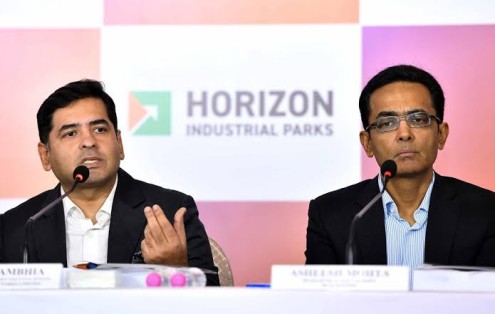
Horizon Industrial Parks Opens ₹2,600 Crore IPO After ₹1,168 Crore Anchor Placement
Blackstone-backed Horizon Industrial Parks has opened its ₹2,600 crore initial public offering for subscription on Monday, August 17, 2026, after raising approximately ₹1,167.75 crore from anchor investors ahead of the public issue. The IPO, priced at ₹57–₹60 per equity share, will remain open until August 19. The offering consists entirely of fresh shares, meaning the proceeds will flow into the company rather than existing shareholders selling their holdings. Horizon plans to use a substantial portion of the capital to reduce debt, potentially strengthening its balance sheet as it expands its industrial and logistics infrastructure portfolio across India.
Horizon Industrial Parks IPO Opens for Subscription

The ₹2,600 crore public offering represents one of the larger IPOs entering India's primary market during the August 17–21 week.
IPO Price Band Fixed at ₹57–₹60 Per Share
Horizon Industrial Parks has fixed the price band for its IPO at ₹57 to ₹60 per equity share.
Investors can bid for a minimum of 250 shares and thereafter in applicable multiples.
At the upper end of the price band, the minimum bid for 250 shares represents an investment of ₹15,000.
The subscription period runs from August 17 through August 19.
The book-built offering will receive bids from qualified institutional buyers, non-institutional investors and eligible retail investors according to the allocation structure specified for the issue.
The final issue price will be determined after the book-building process based on investor demand within the established price band.
Entire ₹2,600 Crore Offering Is a Fresh Issue
One of the important features of the Horizon Industrial Parks IPO is that the ₹2,600 crore offering consists entirely of fresh shares.
There is no offer-for-sale component in the public issue.
This means the IPO proceeds will be received by Horizon Industrial Parks rather than being paid to existing shareholders selling shares.
For investors, this distinction matters because fresh capital can directly strengthen the company's financial position.
Horizon intends to deploy the proceeds primarily toward debt reduction and general corporate purposes.
Reducing borrowings could lower finance costs and provide additional balance-sheet flexibility for future expansion.
Horizon Raises ₹1,167.75 Crore From Anchor Investors
The company completed a substantial institutional placement before opening the IPO to the broader market.
54 Anchor Investors Participate in Placement
Horizon Industrial Parks raised approximately ₹1,167.75 crore from 54 anchor investors.
The company allotted more than 19.46 crore equity shares to anchor investors at ₹60 per share, representing the upper end of the IPO price band.
Anchor placements are conducted before the main IPO subscription period and allow eligible institutional investors to commit capital ahead of the public issue.
The size of Horizon's anchor book represents a significant portion of the overall ₹2,600 crore offering.
Institutional participation can provide an early indication of demand, although it does not guarantee the subsequent performance of the shares after listing.
Anchor Price Matches Upper End of IPO Band
The anchor shares were allotted at ₹60 each.
This is significant because it represents the maximum price within the ₹57–₹60 IPO range.
Institutional investors participating in the anchor allocation therefore accepted the upper-end valuation before the issue opened to other investors.
The final IPO price will still depend on the broader book-building process.
Retail and other investors should independently assess the company's valuation, financial position, business model and risks rather than treating anchor participation as an investment recommendation.
Blackstone Backs Horizon Industrial Parks
Horizon has grown rapidly under the ownership of global alternative asset manager Blackstone.
Blackstone Built Platform Through Industrial Assets
Horizon Industrial Parks has developed into a major owner, developer and operator of industrial and logistics infrastructure in India.
Blackstone began assembling the platform through acquisitions starting in 2020.
The business has subsequently expanded through a combination of acquisitions, development and operational integration.
Horizon operates facilities serving companies requiring modern warehousing, fulfilment and industrial infrastructure.
The platform's scale reflects the rapid institutionalisation of India's logistics real estate market.
Large global and domestic investors have increasingly allocated capital to warehouses and industrial facilities as organised retail, manufacturing and e-commerce expand.
Promoter Will Retain Majority Ownership
Blackstone-linked entities will remain controlling shareholders after the IPO.
Because the offering consists entirely of newly issued shares rather than an offer for sale, the promoter is not using the IPO to directly monetise existing shares.
However, its percentage ownership will decline because the company's overall equity base will expand.
The continued majority ownership keeps Blackstone economically exposed to Horizon's future performance.
For public investors, this creates alignment with an experienced global infrastructure and real-estate investor while also leaving the company with a concentrated promoter structure.
Horizon Operates Large Industrial and Logistics Portfolio
The company has established a significant footprint across India's major industrial and consumption centres.
Portfolio Spans Around 60 Million Square Feet
Horizon has developed a pan-India portfolio of approximately 60 million square feet across completed, under-development and future development assets.
Around 27 million square feet was completed based on its pre-IPO disclosures.
The platform spans dozens of assets across major Indian cities.
Its facilities include fulfilment centres, industrial buildings and in-city logistics infrastructure.
These properties are used by companies requiring strategically located space for manufacturing, inventory management and product distribution.
Scale can provide several advantages in logistics real estate.
Large platforms can serve customers across multiple locations while spreading central operating and technology costs across a broader asset base.
Major Cities Generate Large Share of Revenue
Horizon has meaningful exposure to India's largest industrial and consumption markets.
A substantial proportion of revenue comes from its leading cities, reflecting the concentration of organised logistics demand around major economic centres.
This creates advantages because these locations often have strong infrastructure and deep customer bases.
However, geographic concentration also represents a risk.
Weakness in leasing demand or industrial activity within major markets could affect portfolio performance.
The company will therefore need to balance scale in established logistics hubs with expansion into additional high-growth industrial regions.
Debt Reduction Is Central to IPO Strategy
A major objective of the fresh issue is strengthening Horizon's balance sheet.
Logistics Real Estate Requires Large Capital Investment
Industrial parks are capital-intensive assets.
Developers need land, construction funding, infrastructure and utilities before rental revenue begins.
Expansion can therefore require substantial borrowing.
Debt can accelerate growth, but high leverage also increases finance costs.
This is particularly important when interest rates remain elevated.
Using IPO proceeds to repay borrowings can reduce interest expenses and potentially improve future profitability.
A stronger balance sheet could also provide Horizon with additional capacity to fund new projects when attractive opportunities emerge.
Lower Finance Costs Could Improve Earnings
Horizon has expanded revenue rapidly but has remained loss-making.
Finance expenses are an important consideration for infrastructure and real-estate businesses carrying substantial debt.
If the IPO materially reduces borrowings, lower interest costs could improve the company's path toward profitability.
However, debt repayment alone does not guarantee profits.
Operating performance remains dependent on rental growth, occupancy, asset utilisation, development costs and customer retention.
Investors will therefore need to assess both the balance-sheet improvement and the underlying economics of Horizon's property portfolio.
India's Warehousing Market Supports Long-Term Growth
The Horizon IPO provides investors with exposure to a segment benefiting from structural changes across India's economy.
E-Commerce Has Increased Demand for Modern Warehouses
Online retail requires extensive logistics infrastructure.
Products need to be stored close enough to customers to support rapid delivery.
This has increased demand for large fulfilment centres near major urban areas.
Modern warehouses also need specialised features including higher ceiling heights, efficient loading areas, fire-safety infrastructure and technology-enabled operations.
Institutional logistics developers can provide these facilities at scale.
The continued expansion of e-commerce therefore remains an important long-term demand driver for companies such as Horizon.
Organised Retail Also Requires Larger Supply Networks
The growth of supermarkets, fashion chains, electronics retailers and other organised businesses creates additional logistics demand.
National retailers need regional distribution centres capable of supplying multiple stores efficiently.
Warehousing therefore becomes an important part of their operating infrastructure.
As India's organised retail penetration increases, demand for professionally managed logistics properties could expand.
Large developers can benefit by building facilities that meet institutional customers' technical and compliance requirements.
Manufacturing Expansion Creates Another Demand Driver
India's efforts to increase domestic manufacturing could significantly influence industrial real estate.
Companies Need Ready Industrial Infrastructure
Manufacturers entering a new region do not always want to purchase land and construct facilities independently.
Leasing industrial buildings can reduce upfront capital requirements and shorten the time needed to begin operations.
Industrial park developers can provide ready or built-to-suit facilities.
This model can be particularly attractive to multinational companies establishing operations in India.
Horizon therefore has exposure not only to warehousing but also to India's broader manufacturing investment cycle.
Supply-Chain Diversification Supports India
Global companies have been diversifying manufacturing beyond traditional production centres.
India has attracted increasing investment across electronics, automotive components, renewable energy equipment and other industries.
Government manufacturing incentives have also encouraged domestic capacity expansion.
Each new factory creates additional demand throughout the logistics ecosystem.
Suppliers need industrial facilities.
Finished products require warehouses.
Distribution networks need regional logistics centres.
This multiplier effect can support long-term demand for industrial real estate.
Customer Concentration Remains an Important Risk
Despite the structural growth opportunity, investors need to evaluate concentration within Horizon's portfolio.
Top Customers Account for Significant Revenue
Large logistics platforms frequently serve major corporate tenants that lease substantial areas across multiple locations.
This can create long-term relationships and stable rental income.
It can also create customer concentration.
Horizon generates a meaningful proportion of revenue from its largest tenants.
If one or more major customers reduce space requirements, the company could need time to replace that occupancy.
The financial impact would depend on lease terms, property location and demand from alternative tenants.
Tenant Diversification Can Strengthen Cash Flows
As Horizon expands, increasing the number of customers across sectors could reduce concentration risk.
A diversified tenant base can include e-commerce companies, retailers, manufacturers, logistics providers and other businesses.
Different sectors follow different economic cycles.
Manufacturing demand may remain strong when e-commerce leasing slows, while retail logistics can provide another source of occupancy.
A broader tenant mix can therefore improve the resilience of rental cash flows.
Horizon Has Yet to Establish Consistent Profitability
Rapid revenue growth has not yet translated into bottom-line profits.
Revenue Has Expanded Strongly
Horizon has recorded substantial revenue growth as its industrial and logistics portfolio has expanded.
Revenue increased from roughly ₹245 crore in FY24 to around ₹439 crore in FY25 and approximately ₹768 crore in FY26.
The expansion reflects growth in the underlying asset base and leasing operations.
This trajectory demonstrates that Horizon has been able to scale its business rapidly.
However, revenue growth must eventually translate into sustainable profits and cash flows for public shareholders.
Losses Remain an Investor Consideration
Horizon reported losses across recent financial years even as revenue expanded.
This means investors are effectively evaluating a business still moving toward mature profitability.
The IPO's debt-reduction component could materially improve the earnings structure by reducing interest expenses.
However, investors will need to monitor operating margins, occupancy and future capital expenditure.
A rapidly growing infrastructure platform can continue requiring substantial investment even after listing.
The ability to finance that growth without rebuilding excessive leverage will be important.
IPO Comes During Active Indian Primary Market
Horizon is entering public markets during one of the busiest IPO periods of 2026.
Investors Have Multiple Issues to Evaluate
Several companies are accessing India's primary market during the August 17–21 week.
This creates competition for investor capital.
When numerous IPOs open close together, investors can become more selective.
Companies with attractive valuations, stronger profitability and differentiated business models may receive greater attention.
Horizon stands out because of the size of its issue and exposure to institutional industrial and logistics infrastructure.
Its Blackstone backing also gives it a distinct profile within the week's IPO calendar.
Institutional Liquidity Remains Supportive
India's domestic capital markets continue benefiting from strong institutional participation.
Mutual funds, insurance companies and other investors provide a substantial pool of capital for new listings.
The ₹1,167.75 crore Horizon anchor placement demonstrates the ability of large IPOs to attract significant institutional commitments.
However, post-listing performance will ultimately depend on how investors value the business after trading begins.
Strong IPO demand does not eliminate business or valuation risk.
What Investors Will Watch During Subscription
The next few days will provide a clearer indication of demand across investor categories.
Subscription Across Categories Will Be Important
Investors typically monitor qualified institutional buyer, non-institutional investor and retail subscription levels separately.
Institutional participation is particularly relevant for large issues because professional investors can absorb substantial allocations.
Retail demand provides another indicator of market sentiment.
Subscription levels can change significantly during the final day because many investors wait before submitting bids.
The overall number should therefore be interpreted only after the issue closes.
Post-IPO Debt Position Will Be Closely Watched
Beyond subscription data, Horizon's balance sheet after deployment of the IPO proceeds will be an important financial metric.
Successful debt reduction could materially lower finance costs.
Investors will then focus on whether operating income is sufficient to move the business toward profitability.
Occupancy, rental growth and development pipeline execution will become important post-listing indicators.
The company's ability to grow without returning to excessive leverage will also influence its longer-term valuation.
Conclusion
Horizon Industrial Parks opening its ₹2,600 crore IPO after completing a ₹1,167.75 crore anchor placement marks an important milestone for one of India's largest industrial and logistics infrastructure platforms. The IPO is priced at ₹57–₹60 per share and remains open for subscription from August 17 to August 19, 2026.
The entire offering consists of fresh shares, allowing Horizon to use the proceeds primarily to reduce debt and strengthen its financial position.
Its long-term opportunity is supported by structural growth across e-commerce, organised retail, manufacturing and modern logistics infrastructure. However, investors must weigh those opportunities against existing losses, customer concentration and the capital-intensive nature of the business.
The IPO's success will ultimately be measured beyond subscription numbers. Horizon's ability to use the fresh capital to lower leverage, improve profitability and continue expanding its industrial and logistics portfolio will determine its longer-term performance as a publicly listed company.