





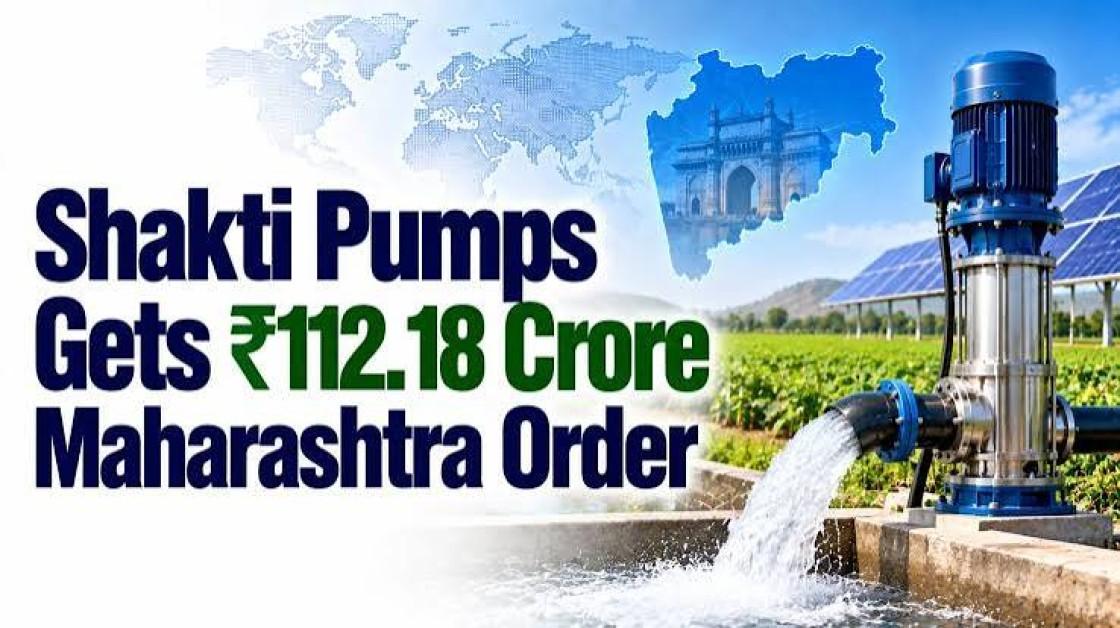
Shakti Pumps Wins ₹112.18 Crore MSEDCL Contract
Shakti Pumps has secured another significant solar-pumping contract from Maharashtra State Electricity Distribution Company Limited, strengthening its order pipeline in the renewable-energy and agricultural infrastructure segment.
The order is valued at approximately ₹112.18 crore, including GST.
Under the contract, Shakti Pumps will supply and install 4,755 off-grid DC solar photovoltaic water pumping systems across Maharashtra.
The project combines solar-power generation with agricultural water pumping, reducing dependence on conventional grid electricity or diesel-powered irrigation systems.
Order Covers 4,755 Solar Water Pumping Systems

The contract involves 4,755 complete off-grid solar pumping installations rather than only the supply of individual pumps.
Shakti Pumps' responsibilities extend across the project lifecycle, including design, manufacturing, supply, transportation, installation, testing and commissioning.
This turnkey approach places responsibility for both equipment and deployment with the company.
Such contracts require coordination across manufacturing operations, logistics networks and field-installation teams because thousands of systems must be deployed across geographically dispersed agricultural locations.
Off-Grid Pumps Can Operate Independently of Electricity Network
Off-grid solar water pumping systems use electricity generated by photovoltaic panels to operate agricultural pumps.
Because the systems do not require continuous access to the conventional electricity grid, they can be particularly useful in agricultural areas where power availability is limited or inconsistent.
Solar pumping also reduces farmers' dependence on diesel generators, which can involve recurring fuel expenses.
Once installed, sunlight becomes the primary energy source for pumping water.
The technology therefore combines agricultural infrastructure with decentralised renewable-energy generation.
Maharashtra Expands Solar Irrigation Infrastructure
Maharashtra has been expanding the deployment of solar-powered agricultural pumps as part of efforts to improve irrigation access while reducing pressure on the electricity distribution system.
Agricultural electricity demand can create operational and financial challenges for distribution companies because irrigation loads are substantial and often subsidised.
Decentralised solar pumps provide an alternative by generating electricity close to where it is consumed.
For farmers, the systems can improve access to daytime power for irrigation.
For electricity distributors, wider adoption can reduce some of the grid demand associated with agricultural pumping.
Contract Strengthens Shakti Pumps’ Solar Portfolio
Shakti Pumps has developed a significant presence in India's solar-pumping market alongside its conventional pumping-system business.
Government-backed agricultural solarisation programmes have created a large addressable market for manufacturers capable of supplying pumps, motors, controllers and related solar equipment.
Winning contracts from state distribution companies allows Shakti Pumps to participate directly in this infrastructure rollout.
The latest MSEDCL order adds 4,755 systems to the company's execution pipeline and provides additional revenue visibility as installations progress.
Government Programmes Support Solar Pump Adoption
India has promoted solar-powered agricultural pumps through initiatives including the PM-KUSUM programme.
The broader policy objective is to increase the use of renewable energy in agriculture while improving energy security for farmers.
Solar pumps can reduce dependence on subsidised grid electricity and fossil fuels while enabling irrigation during daylight hours.
The model also creates demand for domestically manufactured solar equipment, pumps, motors and associated electrical systems.
Companies operating across these product categories can therefore benefit as agricultural solarisation expands.
Solar Pumps Link Renewable Energy With Agriculture
Agricultural solar pumps represent a different renewable-energy model from large utility-scale solar parks.
Instead of generating electricity at a centralised facility and transmitting it through the grid, individual systems generate power close to the agricultural load.
This decentralised structure can reduce transmission requirements for the specific pumping application.
It also allows renewable-energy infrastructure to be deployed directly at farms.
As a result, solar-pumping programmes simultaneously address agricultural productivity, rural energy access and clean-energy adoption.
Turnkey Execution Requires Strong Supply Chain
The scale of the MSEDCL order will require Shakti Pumps to coordinate production and deployment across thousands of individual installations.
Manufacturing capacity must be aligned with the project's delivery schedule, while equipment needs to be transported to multiple locations.
Installation teams must subsequently commission each system and ensure it meets required technical specifications.
Quality control is particularly important because solar pumps are expected to operate in outdoor agricultural environments over extended periods.
Execution capability therefore becomes an important competitive factor in large government-backed solar-pump programmes.
Order Provides Additional Revenue Visibility
Large project orders can provide manufacturers with visibility into future revenues, although financial recognition depends on actual execution.
The ₹112.18 crore contract will contribute to Shakti Pumps' financial performance as systems are supplied, installed and commissioned according to contractual milestones.
The pace of execution will determine how quickly the order translates into reported revenue.
Investors will therefore monitor both new order inflows and the company's ability to convert its existing order book into sales and cash flows.
Domestic Manufacturing Could Benefit From Solarisation
Expansion of agricultural solar infrastructure can support a wider domestic manufacturing ecosystem.
Solar pumping systems require pumps, motors, electronic controllers, photovoltaic modules, mounting structures and other components.
Increasing deployment can therefore generate demand across several industrial supply chains.
India's emphasis on domestic renewable-energy manufacturing provides an additional strategic dimension to these programmes.
Companies capable of integrating multiple components and delivering complete systems may be better positioned to compete for large-scale government orders.
Solar Irrigation Could Reduce Long-Term Energy Costs
Agricultural pumping represents a significant component of electricity consumption in several Indian states.
Traditional agricultural power supply can require substantial subsidies and investment in grid infrastructure.
Solar pumps involve higher upfront capital expenditure but can reduce recurring energy costs over their operating life.
The economic outcome depends on equipment performance, maintenance and utilisation.
At scale, however, decentralised solar irrigation has the potential to change how agricultural electricity demand is supplied.
This makes state-level solar-pump programmes important not only for renewable-energy deployment but also for electricity-distribution reform.
Conclusion
Shakti Pumps' ₹112.18 crore order from Maharashtra State Electricity Distribution Company Limited for 4,755 off-grid solar water pumping systems strengthens the company's position in India's expanding agricultural solarisation market.
The turnkey contract covers the complete process from design and manufacturing to installation, testing and commissioning across Maharashtra.
As governments seek to improve irrigation access while reducing dependence on conventional electricity and diesel, solar pumps are becoming an increasingly important component of rural energy infrastructure.
Successful execution of the MSEDCL project could provide additional revenue visibility for Shakti Pumps while supporting Maharashtra's broader transition toward renewable-powered agricultural irrigation.
 Shakti Pumps Wins ₹112.18 Crore MSEDCL Solar Pump Order FAQs
POST A COMMENT (0)
All Comments (0)
Replies (0)