





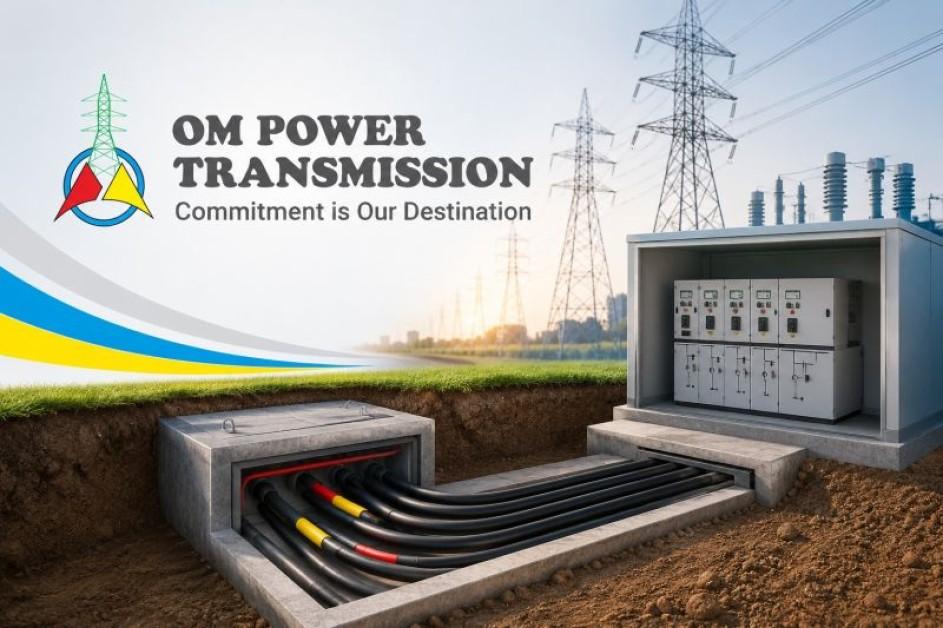
Om Power Transmission Wins Major Underground Power Distribution Order
Om Power Transmission Limited has secured a contract valued at ₹101.56 crore for underground electrical distribution network works in Gujarat, adding a significant assignment to its power infrastructure project portfolio.
The contract involves developing underground electricity distribution infrastructure, an important component of efforts to improve network reliability and modernise urban power supply systems.
Underground distribution networks use insulated cables installed beneath the ground instead of conventional overhead electrical lines.
These systems can reduce exposure to certain weather-related disruptions and improve the management of electricity infrastructure in densely populated areas.
For Om Power Transmission, the latest order provides additional business opportunities in the electrical engineering, procurement and construction segment.
The project's eventual financial contribution will depend on execution progress, procurement costs, contractual milestones and the timely completion of assigned works.
Uttar Gujarat Vij Company Limited Awards Turnkey Contract

Om Power Transmission received a Letter of Acceptance from Uttar Gujarat Vij Company Limited (UGVCL) on October 14, 2026, for converting the existing electrical line network at Ambaji into an underground cable network.
The contract is valued at ₹101.56 crore, including Goods and Services Tax (GST), and covers associated electrical infrastructure activities.
The project is expected to be executed within 12 months following an initial commencement period of 45 days.
UGVCL is a Gujarat electricity distribution utility responsible for supplying electricity across designated areas of the state.
The award adds to Om Power Transmission's existing portfolio of transmission lines, substations, underground cabling and related electrical infrastructure projects.
The company confirmed that the contract was awarded by a domestic entity and does not constitute a related-party transaction.
Key Details of Om Power Transmission's ₹101.56 Crore Contract
|
Particulars |
Details |
|---|---|
|
Company |
Om Power Transmission Limited |
|
Awarding authority |
Uttar Gujarat Vij Company Limited |
|
Project location |
Ambaji, Gujarat |
|
Contract value |
₹101.56 crore |
|
GST treatment |
Included |
|
Project scope |
Conversion of existing electrical lines into underground cable network |
|
Contract type |
Turnkey |
|
Initial commencement period |
45 days |
|
Execution period |
12 months after commencement |
|
Award announcement |
October 14, 2026 |
|
Related-party transaction |
No |
The contract value includes GST, which is important when evaluating the project's financial contribution.
The full announced amount should not automatically be treated as revenue excluding taxes or as profit.
Ambaji Project Focuses on Underground Electrical Network Conversion
The project involves converting the existing electrical line network in Ambaji into an underground cable distribution system.
Underground cabling projects typically require detailed engineering, route planning, excavation, cable laying and electrical installation.
Depending on the contractual scope, such works can also involve cable joints, termination equipment, protective systems and restoration of affected surfaces.
The objective is to establish an electrical distribution network that can operate with reduced exposure to certain external hazards associated with overhead infrastructure.
For Ambaji, the project represents an investment in modernising existing electricity distribution arrangements.
However, the company's disclosure does not specify the total cable length, voltage configuration or number of electricity consumers expected to benefit.
These details would be necessary to assess the project's full technical scale.
Why Underground Power Distribution Infrastructure Matters
Overhead electricity networks are widely used because they are comparatively accessible for installation, inspection and maintenance.
However, they can be exposed to weather-related damage, falling trees, external interference and other physical risks.
Underground cable networks can reduce exposure to several of these hazards.
They can also improve the appearance of streets and reduce conflicts between overhead electrical lines and other urban infrastructure.
Nevertheless, underground systems have their own challenges.
Installation can involve substantial civil works, while identifying and repairing faults may require specialised equipment and excavation.
Underground cabling is therefore not automatically preferable in every location.
The appropriate infrastructure design depends on factors such as population density, land use, cost, technical requirements and local conditions.
Turnkey Contract Places Execution Responsibility on Om Power Transmission
The Ambaji assignment has been awarded on a turnkey basis.
Under this model, the contractor generally assumes responsibility for delivering an integrated project within the agreed technical and commercial framework.
Turnkey electrical infrastructure projects can involve design, engineering, procurement, construction, testing and commissioning.
The exact responsibilities depend on the contract.
For Om Power Transmission, successful execution will require coordination between engineering teams, equipment suppliers, construction personnel and the electricity distribution utility.
The company will also need to manage the logistical challenges associated with underground installation.
These can include excavation permissions, access to work sites, utility coordination and safety requirements.
Timely completion will be important for meeting contractual obligations and recognising project revenue.
Contract Execution Scheduled Over 12 Months
The company has disclosed a 12-month execution period following an initial 45-day commencement period.
The commencement period provides time for preliminary activities before the main execution schedule begins.
These activities may include project mobilisation, engineering preparation, procurement planning and other contractual requirements.
The precise activities are governed by the agreement.
A defined execution period provides a framework for scheduling resources and project milestones.
However, actual progress can be influenced by site conditions, material availability and coordination with the relevant authorities.
The company has not disclosed a detailed milestone schedule or payment structure.
Consequently, the distribution of revenue across reporting periods cannot be determined from the contract announcement alone.
New Contract Strengthens Underground Cabling Business
Underground cabling is one of Om Power Transmission's established business segments.
The company operates across four principal activities: transmission line EPC, substation EPC, underground cabling and operation and maintenance services.
Its underground cabling operations involve the installation and commissioning of electrical cable infrastructure.
These projects require technical expertise in cable selection, route engineering, installation and electrical testing.
The Ambaji assignment provides an opportunity to expand activity within this segment.
The project also reinforces the company's participation in electricity distribution infrastructure, complementing its transmission-focused assignments.
A broader mix of projects can provide additional business opportunities, although it also creates different operational and working capital requirements.
Om Power Transmission Secures Multiple Gujarat Orders in October
The latest contract follows several orders awarded to Om Power Transmission by Gujarat power-sector entities.
Earlier in October, the company announced transmission and substation assignments from Gujarat Energy Transmission Corporation Limited (GETCO).
These included a ₹69.18 crore turnkey contract for the 220 kV double-circuit Prantij–Jantral transmission line project.
The company also secured a ₹60.48 crore contract involving equipment supply, erection, testing and commissioning for the 220 kV Kotda-Sanghani air-insulated substation.
Together, those two assignments were valued at approximately ₹129.66 crore, including GST.
The new ₹101.56 crore Ambaji contract brings the combined announced value of these three October assignments to approximately ₹231.22 crore.
This comparison covers only the specified contracts and should not be interpreted as the company's complete order intake for the month.
Gujarat Transmission and Distribution Orders Have Different Functions
Although transmission and distribution projects form part of the same electricity network, they serve different purposes.
Transmission infrastructure moves electricity over longer distances, often at higher voltages, between generating stations, substations and major network nodes.
Distribution infrastructure delivers electricity through local networks to households, businesses and other consumers.
Om Power Transmission's recent GETCO orders involve transmission lines and substations.
The UGVCL contract, by contrast, concerns the conversion of an existing local electrical network into underground cables.
Participation in both segments allows the company to address different infrastructure requirements.
However, the engineering specifications, execution risks and financial characteristics of these projects can vary.
Earlier Underground Cabling Projects Demonstrate Relevant Experience
Om Power Transmission has previously secured underground cabling assignments in Gujarat.
In July 2026, the company received a contract valued at approximately ₹82.17 crore for converting an existing electrical network into an underground cable system in the Kaliabid subdivision of Bhavnagar.
The assignment involved 11 kV high-tension and low-tension networks, together with a ring main system.
The company has also received orders involving 66 kV underground cable infrastructure.
These projects demonstrate its involvement in underground cabling across different electrical network configurations.
The Ambaji contract adds another assignment to this established line of business.
However, each project has distinct technical requirements and execution conditions.
Gujarat's Electricity Network Modernisation Creates EPC Opportunities
Gujarat has a substantial industrial base and a diverse electricity consumer network.
Industrial activity, commercial development and residential demand create continuing requirements for electricity infrastructure.
Network upgrades can involve new substations, transmission lines, distribution equipment and underground cables.
Modernisation projects are intended to improve system reliability, accommodate changing demand and address ageing infrastructure.
For electrical EPC contractors, these investments create opportunities across engineering, equipment supply and construction.
Om Power Transmission's recent contract awards indicate its participation in this market.
However, future opportunities will depend on utility investment plans, procurement decisions and competitive bidding outcomes.
Underground Cabling Requires Specialised Engineering
Installing electrical cables beneath the ground requires careful planning because the infrastructure must coexist with roads, drainage systems, water pipelines and telecommunications networks.
Project teams must identify suitable cable routes and account for existing underground utilities.
Engineering decisions may involve cable specifications, insulation requirements, thermal conditions and protection systems.
Cable joints and terminations must also be installed and tested correctly.
For projects involving existing electricity networks, contractors may need to coordinate the transition from overhead lines while limiting disruption to consumers.
These requirements make project planning and execution discipline important.
For Om Power Transmission, the ability to manage such activities will influence the successful delivery of the Ambaji assignment.
Contract Value Does Not Equal Revenue or Profit
The ₹101.56 crore contract represents the announced consideration for the assigned works, including GST.
It should not be interpreted as the company's expected profit.
Project profitability will depend on material costs, subcontracting, labour expenses, equipment requirements and other operating costs.
The contract's GST-inclusive value also differs from revenue measured net of applicable indirect taxes.
Accounting recognition will depend on the company's contractual obligations and the progress of execution.
EPC companies may recognise revenue over time when the relevant accounting conditions are satisfied.
Cash receipts can occur on a different schedule from accounting revenue.
Investors should therefore evaluate order wins alongside reported revenue, operating margins, working capital and cash flow.
Working Capital Management Will Be Important
Electrical infrastructure projects can require significant expenditure before customer payments are received.
Contractors may need to purchase cables, electrical equipment and construction materials while also funding labour and site operations.
The timing of customer payments depends on contractual milestones and billing arrangements.
If payments are delayed, working capital requirements can increase.
The Ambaji contract's detailed payment terms have not been publicly disclosed.
As a result, the financial resources required during execution cannot be precisely determined.
For Om Power Transmission, managing procurement and collections will be important as multiple projects progress simultaneously.
Effective working capital management can help support project execution without placing unnecessary pressure on liquidity.
Om Power Transmission Expands Into Renewable Energy
Alongside its established electrical infrastructure activities, Om Power Transmission has begun developing a presence in renewable energy.
On October 5, 2026, the company incorporated OPTL Green Energy Private Limited.
Om Power Transmission holds a 56% equity stake in the subsidiary.
The new entity is intended to undertake activities involving the development, construction, ownership, operation and maintenance of renewable energy projects.
Its proposed areas include solar, wind, hybrid, hydro, biomass and energy storage technologies.
The initiative represents a potential expansion beyond conventional transmission and distribution infrastructure.
However, the formation of a subsidiary does not by itself establish a completed renewable energy project or guaranteed future revenue.
The financial contribution will depend on subsequent investments and commercial developments.
India's Power Infrastructure Investment Supports Industry Demand
India's electricity sector is undergoing expansion as power demand increases and the generation mix changes.
Industrial development, urbanisation, digital infrastructure and electrification contribute to long-term electricity requirements.
At the same time, the expansion of renewable energy creates a need for additional transmission and distribution infrastructure.
Power networks must be capable of transporting electricity from generating locations to demand centres.
Distribution utilities also need to modernise local networks and improve service reliability.
These requirements create opportunities for electrical engineering and construction companies.
However, project demand depends on government and utility investment decisions, financing arrangements and procurement schedules.
Competition and execution costs remain important considerations for contractors.
What Investors Should Monitor
The first important development will be the commencement of work on the Ambaji underground cabling project.
Investors will monitor whether the company progresses through the initial 45-day period and executes the assignment within the subsequent 12-month schedule.
Project costs and operating margins will also be relevant.
The company's recent GETCO orders increase its execution responsibilities across different types of electrical infrastructure.
Investors will therefore assess whether Om Power Transmission can manage multiple projects without significant delays or working capital pressure.
Other important indicators include new order intake, customer payments and the financial performance of the underground cabling segment.
The company's renewable energy expansion may also attract attention, although its commercial contribution remains dependent on future developments.
Conclusion
Om Power Transmission's ₹101.56 crore contract from Uttar Gujarat Vij Company Limited strengthens its position in Gujarat's electrical infrastructure market.
The turnkey assignment involves converting the existing electrical line network at Ambaji into an underground cable system, together with associated works.
The project is scheduled for execution over 12 months following an initial 45-day commencement period.
The award adds to the company's recent Gujarat contracts, including transmission line and substation projects from GETCO.
It also reinforces Om Power Transmission's established underground cabling business.
However, the contract's financial contribution will depend on execution progress, costs, billing arrangements and timely completion.
For Om Power Transmission, the latest order provides additional business visibility while highlighting the importance of maintaining operational efficiency and working capital discipline as its project portfolio expands.
 Om Power Transmission Wins ₹101.56 Crore Gujarat Underground Power Distribution Contract FAQs
POST A COMMENT (0)
All Comments (0)
Replies (0)