





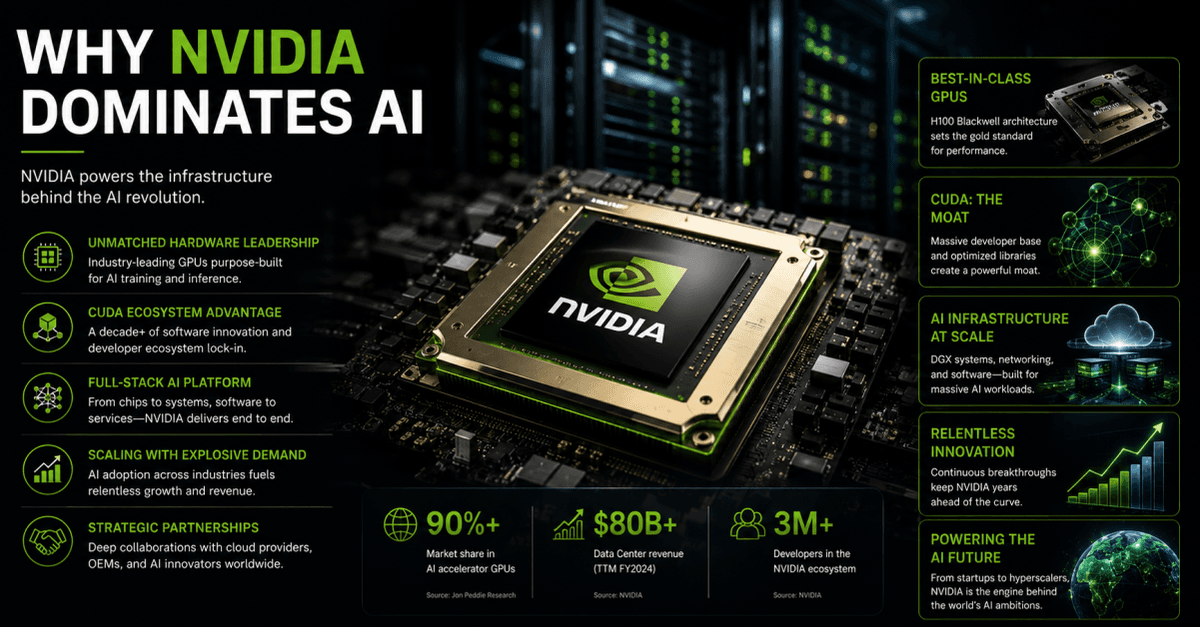
Why Nvidia Dominates AI: The Technology Behind Its Market Leadership
Nvidia has become the dominant force in Artificial Intelligence by building high-performance AI chips, a comprehensive software ecosystem, and powerful computing platforms for training and deploying AI models. From Large Language Models (LLMs) like ChatGPT to autonomous vehicles and robotics, Nvidia's hardware powers many of today's most advanced AI applications. Its leadership extends beyond graphics processors, combining AI accelerators, networking technologies, software frameworks, and developer tools into a complete AI computing platform.
Why Is Nvidia the Leader in AI?

Nvidia dominates AI because it offers an integrated ecosystem of hardware, software, and networking technologies optimized specifically for Artificial Intelligence workloads.
Powerful AI GPUs
Nvidia's GPUs are designed for massive parallel processing, allowing billions of AI calculations to be performed simultaneously. This makes them ideal for training deep learning models and running AI inference at scale.
CUDA Software Platform
CUDA is Nvidia's proprietary parallel computing platform that enables developers to build high-performance AI applications. Its mature software ecosystem has become an industry standard for AI development.
End-to-End AI Infrastructure
Nvidia provides more than AI chips. It offers networking hardware, AI servers, software libraries, developer tools, and cloud platforms that simplify AI deployment across industries.
Key Reasons Nvidia Dominates AI
Several factors have helped Nvidia maintain its leadership position.
Industry-Leading GPUs
Nvidia's AI GPUs deliver exceptional performance for machine learning, Generative AI, scientific computing, and high-performance computing workloads.
Comprehensive Software Ecosystem
Beyond hardware, Nvidia supports developers with CUDA, TensorRT, cuDNN, AI frameworks, SDKs, and optimized libraries that accelerate AI application development.
Strong Developer Community
Millions of developers, researchers, startups, universities, and enterprises use Nvidia's AI tools, creating a large ecosystem that reinforces its market leadership.
Continuous Innovation
Nvidia regularly introduces new GPU architectures, AI accelerators, networking technologies, and AI software platforms to support increasingly complex AI models.
Where Nvidia AI Is Used
Nvidia technology powers AI across many industries.
Data Centers
Cloud providers and AI companies use Nvidia GPUs to train Large Language Models, recommendation systems, and enterprise AI applications.
Autonomous Vehicles
Self-driving vehicle platforms use Nvidia hardware for perception, navigation, object detection, and real-time driving decisions.
Healthcare
Medical researchers use Nvidia-powered AI systems for medical imaging, drug discovery, genomics, and clinical research.
Robotics and Manufacturing
Industrial robots and smart factories rely on Nvidia AI platforms for computer vision, automation, predictive maintenance, and digital twins.
Benefits of Nvidia's AI Ecosystem
Nvidia provides several competitive advantages.
High AI Performance
Its specialized processors dramatically accelerate AI model training and inference compared to traditional computing platforms.
Mature AI Development Platform
Developers benefit from extensive documentation, software libraries, optimized frameworks, and enterprise AI solutions.
Scalable Infrastructure
Nvidia solutions support AI deployments ranging from edge devices to hyperscale cloud data centers.
Challenges to Nvidia's Leadership
Although Nvidia leads the AI market, several challenges remain.
Growing Competition
Companies including AMD, Intel, Google, Amazon, Microsoft, and numerous AI chip startups continue investing heavily in AI hardware.
Supply Constraints
Strong global demand for AI chips has occasionally created shortages and longer delivery times.
High Infrastructure Costs
Advanced AI hardware requires significant investment, making large-scale AI deployments expensive for some organizations.
Future of Nvidia in AI
Nvidia is expected to remain a major force in AI through continued investment in next-generation GPU architectures, AI networking, robotics, autonomous systems, digital twins, and accelerated computing. Future innovations are likely to focus on improving AI performance, reducing energy consumption, enabling trillion-parameter AI models, and expanding AI infrastructure worldwide. As Artificial Intelligence adoption accelerates, Nvidia's integrated hardware and software ecosystem is expected to remain central to enterprise AI development.
Conclusion
Nvidia dominates AI because it combines industry-leading GPUs, a mature software ecosystem, advanced networking technologies, and continuous innovation into a complete AI computing platform. Rather than selling only AI chips, the company provides the infrastructure that powers modern Artificial Intelligence across cloud computing, healthcare, robotics, autonomous vehicles, manufacturing, and scientific research. As AI continues to evolve, Nvidia is well positioned to remain one of the most influential companies shaping the future of intelligent computing.
 Why Nvidia Dominates AI: GPUs, CUDA and AI Leadership Explained FAQs
POST A COMMENT (0)
All Comments (0)
Replies (0)