





What Is Human-AI Collaboration? A Complete Guide
Artificial intelligence has become an essential part of modern workplaces, helping organizations automate repetitive tasks, analyze large amounts of data, and generate insights in seconds. However, AI is not designed to replace human intelligence in every situation. Many business decisions require creativity, ethical judgment, emotional understanding, and domain expertise—areas where people continue to play a critical role.
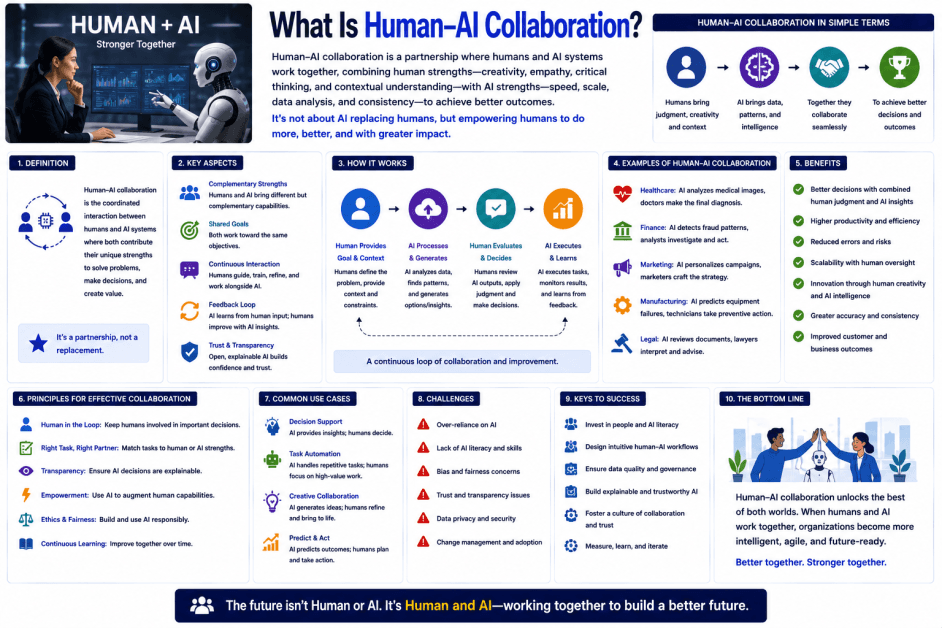
Human-AI Collaboration is the practice of combining human skills with artificial intelligence so that each complements the other's strengths. Instead of competing with people, AI acts as an intelligent assistant that supports employees, while humans provide oversight, critical thinking, and final decision-making.
Today, Human-AI Collaboration is widely used across healthcare, finance, education, manufacturing, software development, customer service, marketing, legal services, research, and enterprise operations.
What Is Human-AI Collaboration?
Human-AI Collaboration is a working model in which people and artificial intelligence cooperate to complete tasks, solve problems, and make better decisions than either could achieve independently.
In this partnership:
-
AI performs repetitive and data-intensive work.
-
Humans provide judgment, creativity, context, ethics, and accountability.
-
Both contribute to achieving better outcomes.
The goal is to improve productivity, decision-making, innovation, and customer experiences while ensuring that important decisions remain under appropriate human oversight.
How Does Human-AI Collaboration Work?
Human-AI collaboration typically follows a structured process.
1. Define the Task
A user or organization identifies a task that can benefit from AI assistance.
Examples include:
-
Writing reports
-
Analyzing financial data
-
Diagnosing medical conditions
-
Drafting legal documents
-
Developing software
-
Responding to customer inquiries
2. AI Processes Information
The AI system analyzes available data, identifies patterns, generates recommendations, or creates draft outputs.
3. Human Reviews the Results
People verify the AI's output, correct mistakes, add context, and apply professional judgment where needed.
4. Make Decisions
The final decision or action is taken by the responsible individual or team, especially for high-impact or regulated activities.
5. Improve Continuously
Feedback from users helps refine AI models, prompts, workflows, and business processes over time.
Key Components of Human-AI Collaboration
1. Artificial Intelligence Systems
Large language models, machine learning models, computer vision systems, and predictive analytics generate insights and automate tasks.
2. Human Expertise
Employees contribute experience, creativity, problem-solving, empathy, and ethical judgment.
3. Business Workflows
AI is integrated into existing processes so that people and technology work together efficiently.
4. Feedback Mechanisms
Human feedback helps improve AI accuracy, relevance, and reliability over time.
5. Governance and Oversight
Policies, security controls, and responsible AI practices ensure collaboration remains safe, transparent, and compliant.
Key Characteristics of Human-AI Collaboration
1. Complementary Strengths
AI excels at processing large amounts of information quickly, while humans contribute reasoning, creativity, and contextual understanding.
2. Human-in-the-Loop
People remain involved in reviewing, approving, or refining AI outputs, particularly for high-impact decisions.
3. Shared Decision Support
AI provides recommendations, while humans evaluate options and determine the final course of action.
4. Continuous Learning
Both AI systems and human users improve through ongoing interaction and feedback.
5. Responsible Use
Collaboration is guided by governance, transparency, privacy, and ethical principles.
Common Applications of Human-AI Collaboration
Human-AI collaboration is widely used in:
-
Healthcare diagnosis support
-
Financial analysis
-
Fraud detection
-
Customer service
-
AI copilots
-
Software development
-
Marketing content creation
-
Human resources
-
Legal document review
-
Manufacturing quality control
-
Scientific research
-
Education and tutoring
-
Cybersecurity
-
Business intelligence
-
Project management
Benefits of Human-AI Collaboration
Improves Productivity
AI automates repetitive work, allowing people to focus on higher-value activities.
Better Decision-Making
Humans combine AI-generated insights with experience and contextual knowledge.
Increases Innovation
AI accelerates idea generation, while people refine concepts into practical solutions.
Reduces Errors
Human review helps identify inaccuracies or inappropriate AI outputs before they affect business operations.
Enhances Customer Experience
Organizations can deliver faster, more personalized services while maintaining human interaction when needed.
Challenges of Human-AI Collaboration
Building Trust
Employees must understand AI capabilities and limitations to use it effectively.
Skill Development
Organizations need to train workers to collaborate productively with AI systems.
Bias and Accuracy
AI-generated outputs may contain errors or reflect biases present in training data, requiring careful review.
Change Management
Successfully integrating AI into existing workflows often involves updating processes, tools, and organizational culture.
Maintaining Human Accountability
Organizations should ensure that humans remain responsible for significant decisions, regulatory compliance, and ethical considerations, even when AI provides recommendations.
Human-AI Collaboration vs Full AI Automation
| Feature | Human-AI Collaboration | Full AI Automation |
|---|---|---|
| Human Involvement | Active participation and oversight | Minimal or no routine involvement |
| Decision-Making | Shared between humans and AI | Primarily automated |
| Flexibility | High, with human judgment | Limited to predefined rules and model capabilities |
| Accountability | Human responsibility remains central | Organization remains responsible for automated outcomes |
| Best For | Complex, high-value, or regulated work | Repetitive, well-defined tasks |
Best Practices for Human-AI Collaboration
Define Clear Roles
Identify which tasks AI performs and which require human expertise.
Keep Humans in the Loop
Require human review for important business, legal, financial, medical, or customer-facing decisions.
Train Employees
Provide education on AI capabilities, limitations, and responsible use.
Monitor AI Performance
Regularly evaluate AI accuracy, fairness, reliability, and business impact.
Establish Strong Governance
Implement policies covering privacy, security, transparency, and ethical AI practices.
Future of Human-AI Collaboration
Human-AI collaboration is expected to become the standard operating model for many organizations as artificial intelligence becomes more deeply integrated into everyday work. Advances in large language models (LLMs), AI agents, multimodal AI, enterprise copilots, and workflow orchestration are enabling AI to assist with increasingly complex tasks while keeping people involved in oversight and strategic decision-making.
Future workplaces are likely to feature AI systems that proactively support employees by summarizing information, automating routine processes, identifying opportunities, and coordinating with specialized AI agents. At the same time, organizations will continue investing in AI literacy, governance, and responsible AI practices to ensure that technology enhances—not replaces—human expertise.
As AI capabilities continue to grow, the greatest value is expected to come from partnerships where people contribute creativity, ethics, empathy, and strategic thinking while AI delivers speed, scale, and data-driven insights. This collaborative approach will help organizations improve productivity, encourage innovation, and make better-informed decisions across industries.
Conclusion
Human-AI Collaboration is a partnership in which people and artificial intelligence work together to achieve better results than either could accomplish alone. AI handles repetitive tasks, analyzes large volumes of information, and generates recommendations, while humans provide judgment, creativity, contextual understanding, and accountability.
From healthcare and finance to education, manufacturing, and enterprise operations, Human-AI Collaboration is helping organizations improve efficiency, support better decisions, and enhance customer experiences. Rather than replacing workers, AI serves as a powerful tool that augments human capabilities.
As artificial intelligence continues to evolve, successful organizations will focus on building collaborative environments where humans and AI complement each other's strengths, enabling responsible innovation and sustainable business growth.
 What Is Human-AI Collaboration? Benefits, Examples & Future Explained FAQs
POST A COMMENT (0)
All Comments (0)
Replies (0)