





What Is Enterprise AI? A Simple Guide
Artificial intelligence is transforming the way organizations operate. Businesses generate massive amounts of data every day from customer interactions, financial transactions, supply chains, employee activities, and business applications. Turning this information into actionable insights is increasingly difficult without intelligent automation.
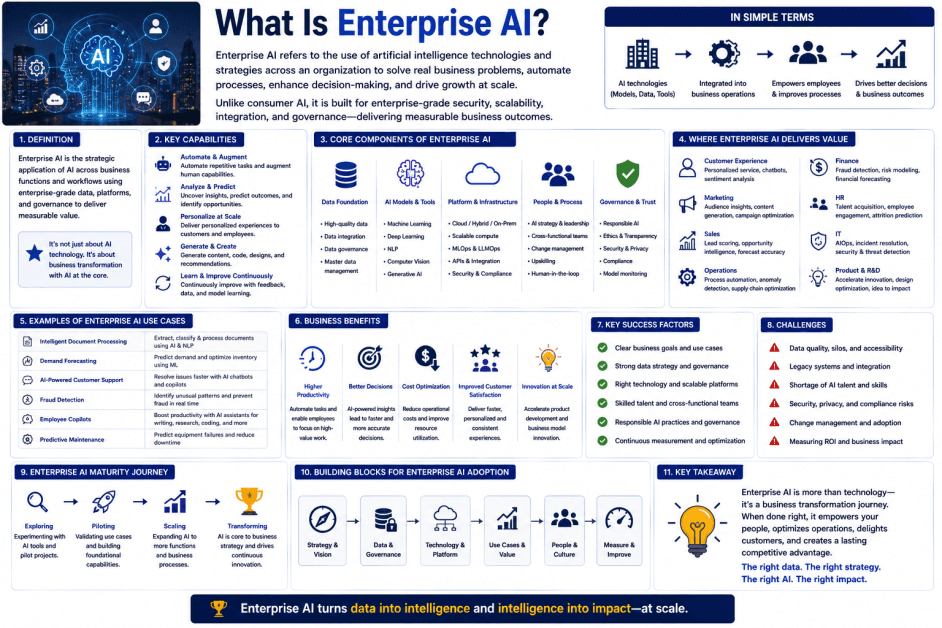
Enterprise AI refers to the use of artificial intelligence technologies across an organization to improve decision-making, automate business processes, enhance customer experiences, and increase operational efficiency. Unlike consumer AI applications, Enterprise AI is designed to integrate with business systems, follow security and compliance requirements, and support large-scale organizational operations.
Today, Enterprise AI is used across industries including healthcare, banking, retail, manufacturing, logistics, education, telecommunications, energy, and government. From AI-powered customer service to predictive analytics and intelligent automation, Enterprise AI is becoming a core part of modern business strategy.
What Is Enterprise AI?
Enterprise AI is the use of artificial intelligence technologies within an organization to automate tasks, analyze data, assist employees, and improve business operations at scale.
Enterprise AI combines technologies such as:
-
Machine learning
-
Large Language Models (LLMs)
-
Natural Language Processing (NLP)
-
Computer Vision
-
Predictive Analytics
-
AI Agents
-
Knowledge Graphs
-
Robotic Process Automation (RPA)
-
Generative AI
Unlike standalone AI tools, Enterprise AI is integrated into business workflows, enterprise software, and organizational knowledge to deliver measurable business value.
How Does Enterprise AI Work?
Enterprise AI typically follows a structured process.
1. Collect Business Data
The system gathers information from various enterprise sources, including:
-
Customer Relationship Management (CRM) systems
-
Enterprise Resource Planning (ERP) platforms
-
Financial systems
-
HR software
-
Email and collaboration tools
-
Business documents
-
Databases
-
IoT devices
2. Prepare and Organize Data
The collected information is cleaned, structured, and secured before being used by AI models.
Many organizations also build enterprise knowledge bases and knowledge graphs to improve AI understanding.
3. Analyze Using AI Models
AI models process the data to:
-
Identify patterns
-
Predict outcomes
-
Generate insights
-
Create content
-
Recommend actions
-
Detect anomalies
4. Integrate with Business Workflows
Enterprise AI connects with existing business applications to automate tasks and assist employees in their daily work.
5. Human Review and Decision-Making
Employees review AI-generated recommendations, validate important outputs, and make final business decisions where appropriate.
Key Components of Enterprise AI
1. Data Infrastructure
Stores and manages enterprise data from multiple business systems.
2. AI Models
Machine learning models, LLMs, predictive models, and other AI technologies perform analysis and generate outputs.
3. Enterprise Knowledge Base
Provides trusted organizational information that AI systems can retrieve and use.
4. Workflow Automation
Coordinates business processes across departments and applications.
5. Security and Governance
Ensures compliance, data protection, access control, auditing, and responsible AI usage.
Key Characteristics of Enterprise AI
1. Organization-Wide Deployment
Enterprise AI supports multiple departments and business functions.
2. Data-Driven Decision-Making
AI analyzes large volumes of business information to support informed decisions.
3. Scalable Automation
Routine and repetitive processes can be automated across the enterprise.
4. Secure and Compliant
Enterprise AI is designed to meet organizational security, privacy, and regulatory requirements.
5. Human-AI Collaboration
AI assists employees while people retain responsibility for oversight, judgment, and accountability.
Common Applications of Enterprise AI
Enterprise AI is widely used in:
-
Customer service automation
-
Sales forecasting
-
Marketing personalization
-
Financial analysis
-
Fraud detection
-
Human resources
-
Supply chain optimization
-
Predictive maintenance
-
Healthcare administration
-
Business intelligence
-
Software development
-
Legal document analysis
-
Cybersecurity
-
Enterprise search
-
AI copilots and virtual assistants
Benefits of Enterprise AI
Improves Productivity
Automates repetitive work and allows employees to focus on higher-value activities.
Better Decision-Making
AI analyzes large datasets to provide actionable insights and recommendations.
Enhances Customer Experience
Supports faster, more personalized customer interactions across multiple channels.
Increases Operational Efficiency
Optimizes workflows, reduces manual effort, and improves resource utilization.
Supports Innovation
Enables organizations to develop new products, services, and business models powered by AI.
Challenges of Enterprise AI
Data Quality
AI systems depend on accurate, complete, and well-managed business data.
Integration Complexity
Connecting AI with existing enterprise systems can require significant planning and investment.
Security and Privacy
Organizations must protect sensitive information and comply with industry regulations.
Change Management
Successful Enterprise AI adoption requires employee training, governance, and organizational support.
Human Oversight Required
Critical decisions should continue to involve human review, especially in legal, financial, healthcare, and customer-facing scenarios where accuracy, ethics, and accountability are essential.
Enterprise AI vs Consumer AI
| Feature | Consumer AI | Enterprise AI |
|---|---|---|
| Primary Users | Individuals | Organizations |
| Data Sources | Public information | Enterprise data and business systems |
| Security | General protections | Enterprise-grade security and compliance |
| Integration | Standalone applications | Integrated with enterprise software |
| Best For | Personal productivity | Business operations and automation |
Best Practices for Implementing Enterprise AI
Build a Strong Data Foundation
Ensure business data is accurate, consistent, and well-governed.
Prioritize High-Value Use Cases
Start with projects that offer measurable business benefits.
Implement Responsible AI Governance
Establish policies for security, privacy, fairness, transparency, and compliance.
Keep Humans in the Loop
Require human oversight for high-impact decisions and sensitive workflows.
Continuously Measure Performance
Monitor AI accuracy, productivity improvements, user adoption, and business outcomes.
Future of Enterprise AI
Enterprise AI is expected to become a fundamental part of business operations as organizations continue integrating artificial intelligence into everyday workflows. Advances in large language models (LLMs), AI agents, retrieval-augmented generation (RAG), multimodal AI, and agent orchestration are enabling AI systems to perform increasingly sophisticated tasks while working alongside employees.
Future Enterprise AI platforms are likely to feature autonomous agents, real-time decision support, predictive business intelligence, advanced workflow automation, and deeper integration with enterprise software ecosystems. Organizations will also place greater emphasis on AI governance, cybersecurity, explainability, and regulatory compliance to ensure responsible deployment.
As artificial intelligence continues to evolve, Enterprise AI will play a central role in improving productivity, accelerating innovation, enhancing customer experiences, and supporting smarter decision-making across industries. Human expertise, strategic oversight, and ethical governance will remain essential for achieving long-term success.
Conclusion
Enterprise AI is the application of artificial intelligence across an organization to improve business performance through automation, intelligent decision support, and enhanced productivity. By combining advanced AI technologies with enterprise data and business systems, organizations can streamline operations and create more efficient workflows.
From customer service and finance to manufacturing and healthcare, Enterprise AI is transforming how businesses operate by enabling faster insights, better decisions, and scalable automation. Its integration with enterprise software makes it a powerful tool for digital transformation.
As AI technology advances, Enterprise AI will continue evolving into a strategic capability that helps organizations remain competitive while ensuring that people stay at the center of critical decisions and responsible AI governance.
 What Is Enterprise AI? How Enterprise Artificial Intelligence Works FAQs
POST A COMMENT (0)
All Comments (0)
Replies (0)