





What Is an AI Knowledge Base? A Simple Guide
Artificial intelligence systems are only as useful as the information they can access and understand. While large language models (LLMs) are trained on vast amounts of public data, organizations often need AI systems that can answer questions using their own documents, policies, manuals, databases, and business knowledge. This is where an AI knowledge basebecomes essential.
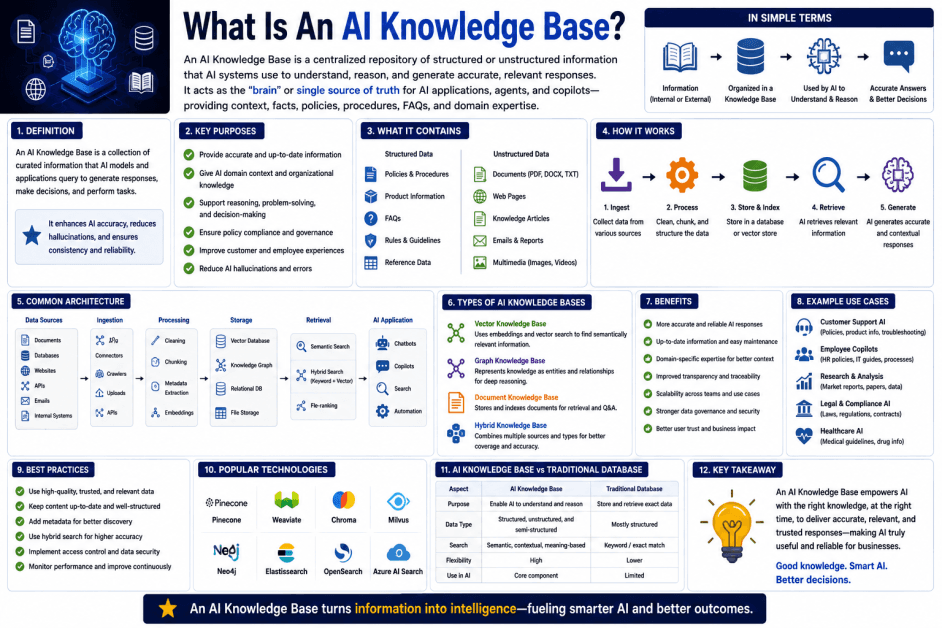
An AI knowledge base is a centralized repository of structured and unstructured information that AI systems use to retrieve facts, answer questions, support reasoning, and automate tasks. Unlike a traditional document library, an AI knowledge base organizes information so that AI applications can quickly find relevant content and provide accurate, context-aware responses.
AI knowledge bases are widely used in enterprise search, customer support, virtual assistants, AI agents, healthcare, finance, education, software development, and business automation. Human experts remain responsible for curating content, validating information, defining access controls, and keeping the knowledge current.
What Is an AI Knowledge Base?
An AI knowledge base is a collection of information that has been organized so artificial intelligence systems can retrieve, understand, and use it to perform tasks or answer questions.
The knowledge base may include:
-
Company documents
-
Policies and procedures
-
Product manuals
-
Frequently asked questions (FAQs)
-
Technical documentation
-
Research papers
-
Databases
-
Wikis
-
Knowledge graphs
-
Structured business data
Instead of relying only on its pre-trained knowledge, an AI system can search the knowledge base and use the retrieved information to generate more accurate and relevant responses.
How Does an AI Knowledge Base Work?
An AI knowledge base typically follows this workflow.
1. Collect Information
Knowledge is gathered from multiple sources such as:
-
Documents
-
PDFs
-
Websites
-
Databases
-
Internal wikis
-
Cloud storage
-
Business applications
2. Organize the Content
The information is cleaned, categorized, indexed, and enriched with metadata to improve retrieval.
Some systems also build relationships between concepts using knowledge graphs or ontologies.
3. Index for AI Search
The content is processed so AI systems can efficiently search it.
Modern AI knowledge bases often use:
-
Semantic search
-
Vector embeddings
-
Keyword indexing
-
Hybrid search techniques
4. Retrieve Relevant Information
When a user asks a question, the system searches the knowledge base to identify the most relevant information.
Many modern AI applications use Retrieval-Augmented Generation (RAG), where retrieved content is supplied to a large language model before it generates a response.
5. Generate an Answer
The AI combines retrieved knowledge with its reasoning capabilities to produce a context-aware response.
Key Components of an AI Knowledge Base
1. Knowledge Repository
Stores structured and unstructured information from multiple sources.
2. Search and Retrieval Engine
Finds relevant information using semantic search, keyword search, or vector search.
3. Metadata and Indexes
Improve search accuracy by organizing documents and relationships.
4. Knowledge Graph or Ontology (Optional)
Represents entities and relationships to support reasoning and discovery.
5. AI Model Integration
Connects the knowledge base with AI models, chatbots, assistants, or intelligent agents.
Key Characteristics of an AI Knowledge Base
1. Centralized Knowledge
Brings information from multiple systems into one searchable repository.
2. Context-Aware Retrieval
Returns information based on meaning rather than exact keyword matches.
3. Continuously Updated
New documents and changes can be added without retraining the AI model.
4. Supports AI Reasoning
Provides reliable context that helps AI systems generate more accurate responses.
5. Secure Access Control
Organizations can define permissions to control who or what can access specific information.
Common Applications of AI Knowledge Bases
AI knowledge bases are widely used in:
-
Enterprise AI assistants
-
Customer support chatbots
-
Employee help desks
-
Technical support
-
Software documentation
-
Healthcare information systems
-
Financial services
-
Legal research
-
Education platforms
-
Sales enablement
-
AI coding assistants
-
Business intelligence
-
AI agent workflows
Benefits of an AI Knowledge Base
Improves AI Accuracy
Providing up-to-date organizational knowledge helps reduce incorrect or outdated responses.
Reduces Information Silos
Brings knowledge from different departments into a unified system.
Faster Information Retrieval
Users can find relevant information quickly without searching multiple systems.
Supports Enterprise Automation
AI assistants and agents can answer questions and complete tasks using trusted information.
Easier Knowledge Management
Organizations can update the knowledge base without retraining their AI models.
Challenges of an AI Knowledge Base
Data Quality
Outdated, duplicate, or inaccurate information can reduce response quality.
Content Maintenance
Knowledge bases require regular updates as business information changes.
Security and Privacy
Sensitive information must be protected through appropriate permissions and governance.
Complex Integration
Connecting multiple business systems and data sources can be technically challenging.
Human Oversight Required
Subject matter experts should review content, validate information, manage permissions, and monitor AI responses to ensure accuracy and compliance.
AI Knowledge Base vs Traditional Knowledge Base
| Feature | Traditional Knowledge Base | AI Knowledge Base |
|---|---|---|
| Search Method | Mostly keyword-based | Semantic and contextual search |
| AI Integration | Limited | Built for AI applications |
| Understanding | Matches keywords | Understands meaning and context |
| Updates | Manual content management | Continuous indexing and retrieval |
| Best For | Human users | Humans and AI assistants |
Best Practices for Building an AI Knowledge Base
Use High-Quality Content
Ensure documents are accurate, current, and authoritative.
Organize Information Clearly
Apply consistent categories, metadata, and document structures.
Enable Semantic Search
Use embeddings, vector search, or hybrid retrieval to improve relevance.
Update Content Regularly
Review and refresh information as products, policies, and regulations evolve.
Implement Strong Governance
Control access, monitor usage, and validate AI-generated responses using trusted knowledge.
Future of AI Knowledge Bases
AI knowledge bases are becoming a critical foundation for enterprise AI as organizations seek more accurate, explainable, and secure intelligent systems. Advances in retrieval-augmented generation (RAG), vector databases, knowledge graphs, semantic search, and large language models are enabling AI applications to retrieve and use trusted information more effectively.
Future AI knowledge bases are expected to support real-time updates, multimodal content such as images and videos, stronger reasoning capabilities, and closer integration with AI agents. They will also incorporate improved governance, automated knowledge extraction, and enhanced security features to manage sensitive organizational information.
As artificial intelligence continues to evolve, AI knowledge bases will remain essential for powering enterprise assistants, customer support systems, intelligent search, and autonomous AI workflows. Combined with human expertise and responsible knowledge management, they will help AI systems deliver more accurate, context-aware, and trustworthy responses.
Conclusion
An AI knowledge base is a centralized repository of information designed to help artificial intelligence systems retrieve, understand, and use trusted knowledge. By organizing documents, data, and relationships in a searchable format, it enables AI applications to provide more accurate, relevant, and explainable responses.
From enterprise assistants and customer support to healthcare and software development, AI knowledge bases are becoming an essential component of modern AI solutions. Their ability to combine structured information with advanced retrieval techniques improves both the quality and reliability of AI-generated outputs.
As organizations increasingly adopt AI, well-managed knowledge bases will play a vital role in ensuring intelligent systems remain accurate, secure, and aligned with current business knowledge.
 What Is an AI Knowledge Base? How AI Knowledge Bases Work Explained FAQs
POST A COMMENT (0)
All Comments (0)
Replies (0)