





What Is a Multi-Agent System? A Simple Guide
As artificial intelligence becomes more advanced, many real-world problems require more than a single AI model working alone. Managing autonomous vehicles, coordinating delivery drones, operating smart factories, or automating business workflows often involves multiple intelligent entities that must communicate, cooperate, and make decisions together. This is where Multi-Agent Systems (MAS) become valuable.
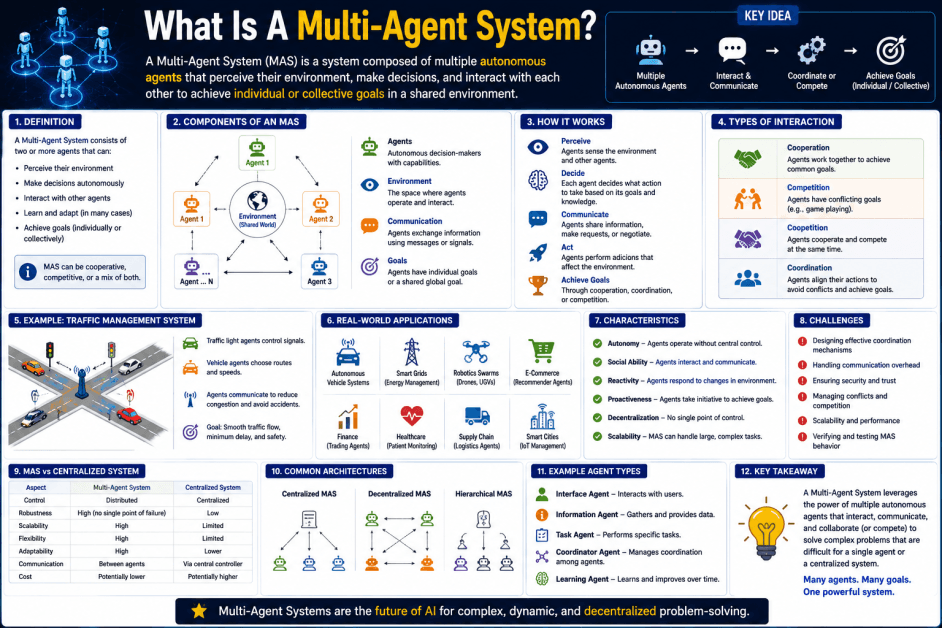
A multi-agent system consists of multiple autonomous AI agents that interact with one another and their environment to achieve individual or shared goals. Each agent can make decisions independently while collaborating or competing with other agents depending on the task.
Today, multi-agent systems are widely used in robotics, logistics, smart cities, finance, telecommunications, cybersecurity, manufacturing, and generative AI workflows. Although these systems automate many complex processes, human oversight remains essential for defining objectives, monitoring performance, resolving conflicts, and ensuring responsible AI deployment.
What Is a Multi-Agent System?
A Multi-Agent System (MAS) is an artificial intelligence framework in which multiple intelligent agents work together—or sometimes compete—to solve problems, complete tasks, or make decisions.
Each agent has its own capabilities, knowledge, and objectives. Agents communicate, exchange information, and coordinate their actions to achieve results that would often be difficult or inefficient for a single agent alone.
For example, in a warehouse:
-
One agent manages inventory.
-
Another plans delivery routes.
-
A third controls warehouse robots.
-
A fourth monitors equipment health.
Together, these agents help optimize the entire operation.
How Does a Multi-Agent System Work?
A multi-agent system follows a collaborative workflow.
1. Create Multiple Agents
The system includes several autonomous agents, each assigned a specific responsibility.
Examples include:
-
Planning agents
-
Scheduling agents
-
Monitoring agents
-
Decision-making agents
-
Robotic agents
-
Customer service agents
2. Observe the Environment
Each agent gathers information from its surroundings using available data, sensors, or connected systems.
3. Communicate and Share Information
Agents exchange relevant information with one another to coordinate actions and improve decision-making.
Communication may occur directly or through a shared environment.
4. Make Independent Decisions
Each agent evaluates available information and performs actions based on its objectives and assigned responsibilities.
5. Coordinate Toward a Goal
Agents continuously adapt, cooperate, negotiate, or compete until the overall objective is achieved.
Key Components of a Multi-Agent System
1. Intelligent Agents
Independent entities capable of sensing, reasoning, and acting.
2. Environment
The physical or digital world in which the agents operate.
3. Communication Mechanism
Allows agents to exchange information and coordinate activities.
4. Coordination Strategy
Defines how agents cooperate, negotiate, or resolve conflicts.
5. Decision-Making Logic
Rules or AI models that guide each agent's actions.
Common Types of Multi-Agent Systems
1. Cooperative Multi-Agent Systems
Agents work together toward a common objective.
Example: Warehouse robots fulfilling customer orders.
2. Competitive Multi-Agent Systems
Agents pursue different goals and may compete for resources.
Example: Automated financial trading systems.
3. Hybrid Multi-Agent Systems
Some agents cooperate while others compete depending on the situation.
4. Hierarchical Multi-Agent Systems
Agents operate under different levels of responsibility, where higher-level agents coordinate lower-level agents.
Key Characteristics of Multi-Agent Systems
1. Autonomous Agents
Each agent can operate independently without continuous human control.
2. Distributed Intelligence
Decision-making is distributed across multiple agents instead of relying on a single controller.
3. Communication
Agents exchange information to improve coordination and efficiency.
4. Adaptability
Agents respond dynamically to changing environments and new information.
5. Scalability
New agents can often be added as system requirements grow.
Common Applications of Multi-Agent Systems
Multi-agent systems are widely used in:
-
Autonomous vehicles
-
Robotics
-
Smart factories
-
Supply chain management
-
Logistics and route optimization
-
Smart cities
-
Energy grid management
-
Financial trading
-
Cybersecurity
-
Telecommunications
-
Healthcare coordination
-
AI-powered virtual assistants
-
Multi-agent generative AI workflows
-
Scientific research
Benefits of Multi-Agent Systems
Solves Complex Problems
Multiple agents divide large problems into manageable tasks.
Improves Scalability
Additional agents can expand system capabilities without redesigning the entire solution.
Increases Reliability
If one agent fails, other agents may continue operating, improving system resilience.
Enables Parallel Processing
Multiple agents can work simultaneously, reducing task completion time.
Supports Flexible Decision-Making
Agents adapt to changing environments while pursuing shared objectives.
Challenges of Multi-Agent Systems
Communication Overhead
Frequent communication between agents can increase complexity and resource usage.
Coordination Challenges
Ensuring agents work together effectively can be difficult in large systems.
Conflict Resolution
Agents with competing objectives may require negotiation or arbitration mechanisms.
Security Risks
Distributed systems may face additional cybersecurity and privacy challenges.
Human Expertise Required
Developers must design communication protocols, coordination strategies, evaluate agent behavior, and ensure reliable and responsible system operation.
Multi-Agent Systems vs Single-Agent Systems
| Feature | Single-Agent System | Multi-Agent System |
|---|---|---|
| Number of Agents | One | Multiple |
| Decision Making | Centralized | Distributed |
| Scalability | Limited | High |
| Collaboration | Not applicable | Agents cooperate or compete |
| Best For | Simple tasks | Complex, distributed problems |
Best Practices for Multi-Agent Systems
Clearly Define Agent Roles
Assign specific responsibilities to each agent to reduce overlap and confusion.
Design Efficient Communication
Use reliable communication methods to share information without unnecessary overhead.
Establish Coordination Rules
Implement strategies for cooperation, negotiation, and conflict resolution.
Monitor System Performance
Evaluate both individual agents and overall system effectiveness.
Combine with Modern AI
Integrate multi-agent systems with machine learning, reinforcement learning, knowledge graphs, and large language models where appropriate.
Future of Multi-Agent Systems
Multi-agent systems are expected to become increasingly important as AI moves toward more collaborative and autonomous applications. Advances in large language models (LLMs), reinforcement learning, robotics, edge computing, and Internet of Things (IoT) technologies are enabling agents to communicate more effectively, coordinate complex workflows, and adapt to dynamic environments.
Researchers are developing multi-agent AI systems capable of collaborative reasoning, distributed planning, and autonomous task execution across industries such as healthcare, logistics, manufacturing, finance, cybersecurity, and scientific research. These systems are also playing a growing role in enterprise automation, where specialized AI agents work together to handle planning, analysis, coding, customer support, and decision-making.
As artificial intelligence continues to evolve, multi-agent systems will remain a key technology for building scalable, resilient, and collaborative AI solutions. Combined with human oversight, responsible governance, and secure communication, they will help power the next generation of intelligent systems.
Conclusion
A multi-agent system is an artificial intelligence framework in which multiple autonomous agents work together—or, in some cases, compete—to solve problems and achieve goals. By distributing intelligence across specialized agents, these systems can handle complex tasks more efficiently than a single AI model.
From robotics and smart cities to enterprise automation and generative AI, multi-agent systems are enabling more scalable, flexible, and resilient intelligent solutions. Their ability to coordinate independent agents makes them well suited for dynamic real-world environments.
As AI technology advances, multi-agent systems will continue to play a central role in building collaborative artificial intelligence capable of tackling increasingly sophisticated challenges across industries.
 What Is a Multi-Agent System? AI Multi-Agent Systems Explained FAQs
POST A COMMENT (0)
All Comments (0)
Replies (0)