





What Is Stable Diffusion? How It Works, Features and Applications
Stable Diffusion is an open-source AI image generation model that creates high-quality images from text prompts. Built using diffusion-based deep learning techniques, it enables users to generate realistic artwork, illustrations, product designs, concept art, and creative visuals within seconds. Unlike many proprietary AI image generators, Stable Diffusion offers developers, researchers, designers, and businesses greater flexibility by allowing the model to run locally, be customized, and integrated into a wide range of applications. Its accessibility and open-source ecosystem have made it one of the most influential tools in Generative AI.
What Is Stable Diffusion?
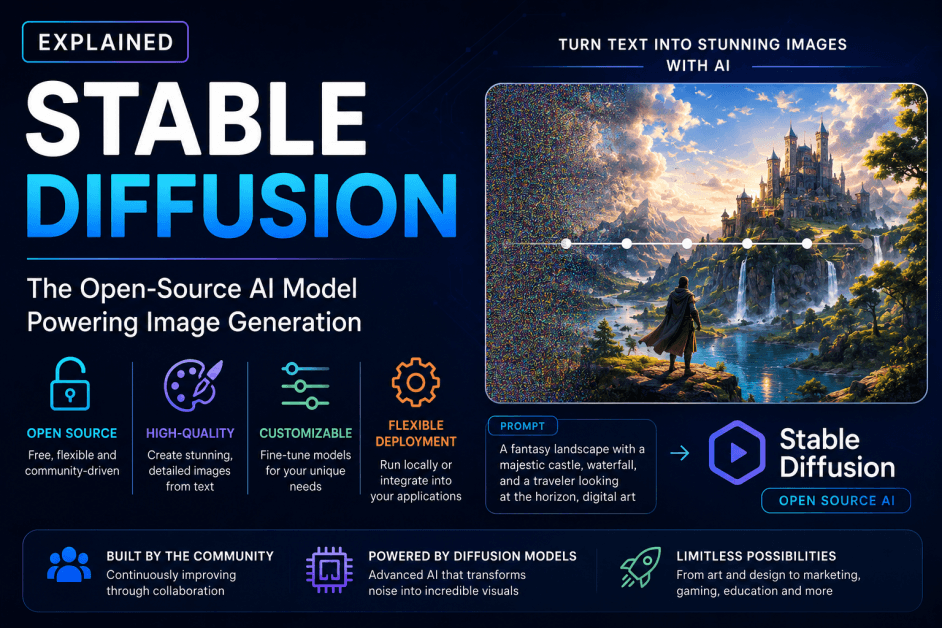
Stable Diffusion is a text-to-image Artificial Intelligence model that converts written descriptions into digital images. It uses diffusion models to gradually transform random noise into detailed visuals that match a user's prompt.
How Stable Diffusion Works
The model begins with random visual noise and repeatedly refines it through multiple processing steps until a complete image is generated. During this process, it interprets the text prompt, understands objects, styles, colors, lighting, and composition to produce realistic or artistic outputs.
Why Stable Diffusion Matters
Stable Diffusion has made advanced AI image generation more accessible by offering an open-source framework that supports customization, local deployment, and community-driven innovation for creative and enterprise applications.
Key Features of Stable Diffusion
Stable Diffusion provides several capabilities that support creators and developers.
Open-Source Architecture
Unlike many proprietary AI image generators, Stable Diffusion allows developers to modify, customize, and integrate the model into their own applications and workflows.
High-Quality Image Generation
The model can generate detailed illustrations, concept art, product mockups, realistic portraits, landscapes, marketing visuals, and digital artwork from simple text prompts.
Customization and Fine-Tuning
Developers can fine-tune Stable Diffusion using specialized datasets, enabling industry-specific image generation for healthcare, fashion, architecture, gaming, and other sectors.
Applications of Stable Diffusion
Stable Diffusion is used across multiple industries for creative and commercial purposes.
Graphic Design
Designers use Stable Diffusion to create marketing materials, branding assets, concept designs, advertising visuals, and social media graphics.
Entertainment and Gaming
Game studios and creative professionals use Stable Diffusion for character design, environment creation, storyboarding, and visual concept development.
Product Design
Businesses generate product prototypes, packaging concepts, interior designs, fashion ideas, and architectural visualizations more efficiently.
Education and Research
Researchers and educators use Stable Diffusion to create visual learning materials, scientific illustrations, and educational content.
Benefits of Stable Diffusion
Stable Diffusion offers several advantages over traditional image creation methods.
Faster Creative Workflows
AI-generated visuals significantly reduce the time required to create concepts, illustrations, and design assets.
Flexible Deployment
Organizations can run Stable Diffusion locally or integrate it into enterprise systems, offering greater control over data and customization.
Cost-Effective Content Creation
Businesses can rapidly generate visual concepts without relying entirely on traditional design processes during early development stages.
Challenges of Stable Diffusion
Despite its capabilities, Stable Diffusion also presents several challenges.
Prompt Quality
Image quality depends heavily on the clarity and detail of user prompts. Well-crafted prompts generally produce better results.
Hardware Requirements
Running advanced versions of Stable Diffusion locally often requires modern GPUs and sufficient computing resources.
Responsible AI Use
Organizations should consider copyright, intellectual property, bias, and ethical guidelines when creating or distributing AI-generated images.
Future of Stable Diffusion
Stable Diffusion is expected to continue evolving through improvements in image quality, editing capabilities, multimodal AI, and model efficiency. As open-source AI development expands, Stable Diffusion is likely to remain a major platform for innovation across design, entertainment, advertising, education, healthcare, and enterprise applications.
Conclusion
Stable Diffusion has transformed AI-powered image generation by making advanced text-to-image technology more accessible through its open-source approach. Its flexibility, customization options, and ability to generate high-quality visuals have made it a preferred solution for developers, designers, researchers, and businesses. As Generative AI continues to advance, Stable Diffusion is expected to remain a leading platform driving innovation in digital creativity and visual content generation.
 What Is Stable Diffusion? How It Works and Key Features Explained FAQs
POST A COMMENT (0)
All Comments (0)
Replies (0)