





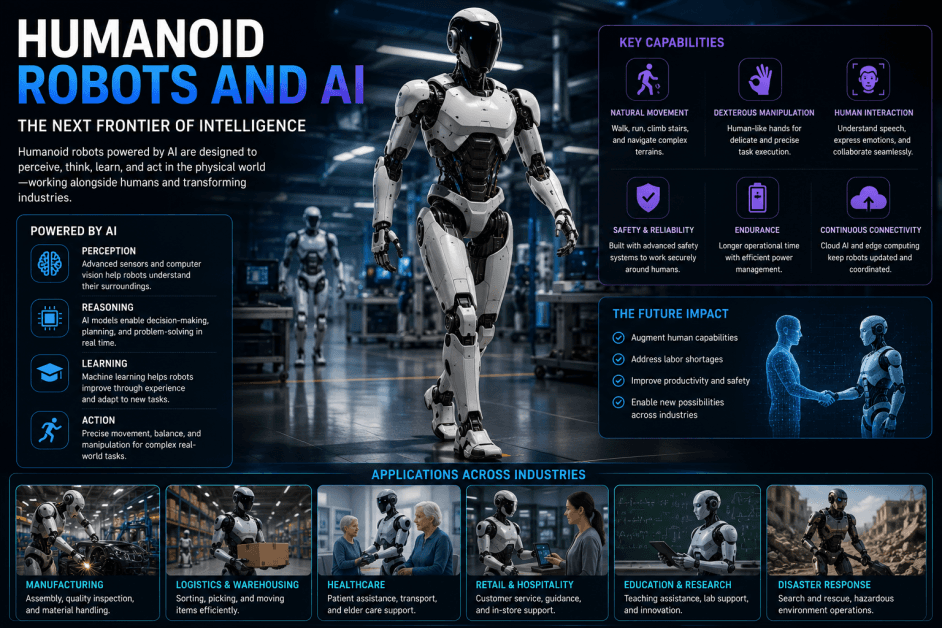
Humanoid Robots and AI: How Artificial Intelligence Is Creating Human-Like Machines
Humanoid robots are among the most exciting applications of Artificial Intelligence (AI). Designed to resemble and interact with humans, these robots combine AI, robotics, computer vision, speech recognition, and advanced sensors to perform tasks that traditionally require human intelligence. From assisting in factories and hospitals to providing customer service and conducting research, AI-powered humanoid robots are rapidly evolving and could transform the future of work and daily life.
What Are Humanoid Robots?

Humanoid robots are robots designed with a human-like appearance and movement. They often have a head, torso, arms, and legs, allowing them to operate in environments built for people.
How AI Powers Humanoid Robots
Artificial Intelligence serves as the "brain" of humanoid robots. AI processes data from cameras, microphones, sensors, and other inputs to recognize objects, understand speech, plan movements, make decisions, and interact naturally with people. Machine learning enables robots to improve their performance over time through experience.
Why AI Is Essential for Humanoid Robots
Without AI, humanoid robots would only perform fixed, pre-programmed actions. AI gives them the ability to adapt to changing environments, recognize people, understand instructions, solve problems, and perform increasingly complex tasks.
Key Technologies Behind Humanoid Robots
Several AI technologies work together to make humanoid robots intelligent.
Computer Vision
AI allows robots to identify people, recognize objects, interpret surroundings, and safely navigate through complex environments using cameras and visual sensors.
Natural Language Processing (NLP)
Humanoid robots use NLP to understand spoken language, answer questions, follow verbal instructions, and engage in natural conversations.
Machine Learning
Machine learning enables robots to learn from experience, improve task performance, recognize patterns, and adapt to new situations without constant reprogramming.
Motion Planning and Control
AI algorithms coordinate balance, walking, grasping, and body movements so humanoid robots can interact safely and efficiently with their environment.
Applications of Humanoid Robots
AI-powered humanoid robots are expanding into numerous industries.
Manufacturing
Factories use humanoid robots to perform repetitive assembly, inspection, material handling, and warehouse operations while working alongside human employees.
Healthcare
Hospitals and care facilities use humanoid robots to assist patients, deliver medications, provide companionship, support rehabilitation, and perform routine tasks.
Retail and Customer Service
Businesses deploy humanoid robots to greet customers, answer questions, guide visitors, provide product information, and improve customer experiences.
Education and Research
Schools, universities, and research institutions use humanoid robots to teach robotics, AI, programming, and human-robot interaction.
Space Exploration
Humanoid robots assist astronauts by performing maintenance, inspections, and hazardous operations in environments that are difficult or dangerous for humans.
Benefits of AI-Powered Humanoid Robots
Humanoid robots offer several important advantages.
Greater Automation
Humanoid robots can perform repetitive, physically demanding, and hazardous tasks with high efficiency.
Human-Like Interaction
AI enables robots to communicate naturally, recognize emotions, understand speech, and collaborate effectively with people.
Increased Productivity
Organizations can improve operational efficiency by using humanoid robots to support manufacturing, logistics, healthcare, and service industries.
Workplace Safety
Humanoid robots can work in hazardous environments, reducing the risk of injuries for human workers.
Challenges of Humanoid Robots
Despite rapid progress, several challenges remain.
High Development Costs
Designing humanoid robots requires advanced AI software, precision hardware, sensors, batteries, and sophisticated engineering.
Energy Consumption
Walking, balancing, lifting, and running advanced AI models require significant computing power and battery capacity.
Ethical and Social Concerns
The growing use of humanoid robots raises important questions about employment, privacy, security, safety, and responsible AI governance.
Future of Humanoid Robots and AI
Humanoid robots are expected to become increasingly capable through advances in AI reasoning, multimodal AI, robotics hardware, Edge AI, and battery technology. Future robots will better understand human intentions, perform more complex physical tasks, learn continuously, and collaborate safely with people in homes, hospitals, factories, offices, and public spaces. As Artificial Intelligence continues to advance, humanoid robots could become common assistants across many aspects of everyday life.
Conclusion
Artificial Intelligence is transforming humanoid robots from simple programmable machines into intelligent systems capable of learning, communicating, and working alongside humans. By combining AI with advanced robotics, computer vision, and natural language understanding, these robots are opening new possibilities across healthcare, manufacturing, retail, education, and beyond. As AI technology continues to evolve, humanoid robots are expected to become one of the most significant innovations in the future of intelligent automation.
 Humanoid Robots and AI: How Intelligent Robots Are Evolving FAQs
POST A COMMENT (0)
All Comments (0)
Replies (0)