





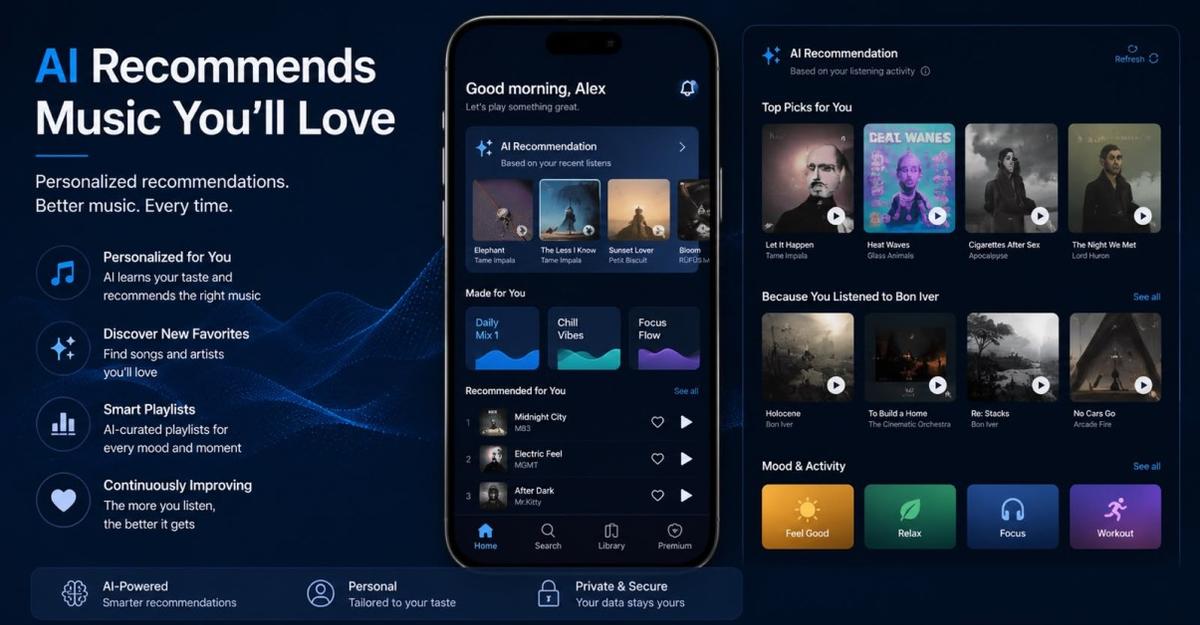
How AI Recommends Music: A Complete Guide
Music streaming services have transformed the way people discover and enjoy songs. Instead of manually searching through millions of tracks, users now receive personalized playlists, recommended albums, and song suggestions tailored to their tastes. Behind these features is artificial intelligence.
AI-powered music recommendation analyzes listening habits, song characteristics, and user preferences to predict which tracks someone is most likely to enjoy. Rather than recommending only the most popular songs, AI continuously learns from user interactions to deliver highly personalized music experiences.
Today, AI music recommendation is widely used by music streaming platforms, online radio services, social media apps, smart speakers, connected vehicles, and entertainment platforms.
What Is AI Music Recommendation?
AI music recommendation is the use of artificial intelligence to suggest songs, albums, artists, or playlists that match a user's listening preferences.
Instead of relying solely on manually curated playlists, AI analyzes large amounts of data to identify patterns and predict what users may want to hear next.
Recommendations may be based on:
-
Listening history
-
Favorite artists
-
Frequently skipped songs
-
Saved playlists
-
Music genres
-
Tempo and mood
-
Time of day
-
Recently played tracks
-
Similar user preferences
How Does AI Recommend Music?
AI-powered music recommendation generally follows these steps.
1. Collect User Activity
The system gathers information such as:
-
Songs played
-
Listening duration
-
Likes and favorites
-
Skipped tracks
-
Search history
-
Playlist activity
-
Repeat listening
2. Analyze Music Characteristics
AI studies features including:
-
Genre
-
Tempo
-
Rhythm
-
Instrumentation
-
Vocals
-
Mood
-
Energy level
-
Acoustic properties
3. Find Similar Patterns
Machine learning identifies relationships between:
-
Similar songs
-
Similar artists
-
Similar listeners
-
Listening habits
-
Musical styles
4. Predict User Preferences
The AI estimates which songs or playlists are most likely to interest the listener based on historical behavior and learned patterns.
5. Deliver Personalized Recommendations
The platform generates customized playlists, suggested albums, artist recommendations, and "discover" collections that update as user preferences evolve.
Key Technologies Behind AI Music Recommendation
1. Machine Learning
Learns user preferences and improves recommendation accuracy over time.
2. Recommendation Algorithms
Identify similarities between users, songs, artists, and listening behavior to generate personalized suggestions.
3. Natural Language Processing (NLP)
Analyzes artist descriptions, reviews, lyrics, and metadata to improve music discovery.
4. Audio Feature Analysis
AI examines musical characteristics such as tempo, rhythm, harmony, pitch, and energy to compare songs.
5. Large Language Models (LLMs)
Modern AI systems can better understand conversational music requests, explain recommendations, and enhance music discovery experiences.
Key Characteristics of AI Music Recommendation
1. Personalization
Recommendations adapt to each user's listening habits and preferences.
2. Continuous Learning
The system improves as users listen, like, skip, or save music.
3. Real-Time Updates
Recommendations can change immediately based on recent listening activity.
4. Large-Scale Analysis
AI can analyze millions of songs and user interactions efficiently.
5. Context Awareness
Some systems consider factors such as activity, location, time of day, or device type to deliver more relevant recommendations.
Common Applications of AI Music Recommendation
AI music recommendation is widely used in:
-
Music streaming platforms
-
Online radio services
-
Smart speakers
-
Mobile music apps
-
Connected vehicles
-
Social media platforms
-
Podcast recommendation systems
-
Fitness applications
-
Gaming platforms
-
Entertainment services
-
Retail and hospitality music systems
-
Enterprise media platforms
Benefits of AI Music Recommendation
Personalized Listening
Users receive recommendations tailored to their interests.
Music Discovery
AI helps listeners find new artists, genres, and songs they may not have discovered otherwise.
Saves Time
Users spend less time searching and more time enjoying music.
Increases User Engagement
Personalized playlists encourage longer listening sessions.
Supports Artists
Recommendation systems can introduce emerging artists to audiences with similar musical interests.
Challenges of AI Music Recommendation
Limited Diversity
Recommendations may become repetitive if the system focuses too heavily on past listening habits.
Cold Start Problem
New users or newly released songs may have limited data available for accurate recommendations.
Bias in Recommendations
Popular artists may receive more visibility than independent or niche musicians if recommendation systems are not carefully balanced.
Privacy Considerations
Listening history and preference data should be handled securely and transparently.
Human Choice Remains Important
AI recommendations are designed to assist discovery, but users may still prefer exploring music independently or through editorial playlists.
Traditional Playlists vs AI Music Recommendation
| Feature | Traditional Playlists | AI Music Recommendation |
|---|---|---|
| Creation | Manually curated | AI-generated and personalized |
| Personalization | Limited | Highly personalized |
| Updates | Periodic | Continuously updated |
| Learning Capability | Static | Learns from user behavior |
| Best For | Editorial collections | Personalized music discovery |
Best Practices for Using AI Music Recommendation
Interact with Recommendations
Like, save, or skip songs to help the AI better understand your preferences.
Explore New Genres
Occasionally listen to unfamiliar artists to encourage more diverse recommendations.
Review Privacy Settings
Understand how your listening data is collected and used by the platform.
Combine AI with Editorial Playlists
Use both personalized recommendations and curated playlists for a broader listening experience.
Monitor Recommendation Quality
Streaming platforms should regularly evaluate recommendation accuracy, diversity, and user satisfaction.
Future of AI Music Recommendation
AI music recommendation is expected to become even more personalized as machine learning, multimodal AI, and large language models continue to advance. Future systems will better understand mood, activity, listening context, and conversational requests, enabling more natural and relevant music discovery.
Emerging AI technologies will also integrate music recommendations with wearable devices, smart homes, connected vehicles, and voice assistants. By combining audio analysis with contextual information, AI may recommend music that matches workouts, travel, relaxation, study sessions, or social events more accurately than ever before.
As artificial intelligence evolves, AI-powered music recommendation will continue to enhance digital entertainment by helping listeners discover new music while providing artists with more opportunities to reach interested audiences.
Conclusion
AI music recommendation combines machine learning, recommendation algorithms, audio analysis, and user behavior modeling to deliver personalized song and playlist suggestions. By understanding listening habits and musical characteristics, AI helps users discover relevant content while making music streaming more engaging and efficient.
From streaming platforms and smart speakers to connected vehicles and fitness applications, AI-powered recommendations have become a core part of modern digital entertainment. Although AI provides highly personalized suggestions, user preferences, exploration, and editorial curation remain valuable for creating a diverse listening experience.
As AI technology continues to advance, music recommendation systems will become more intelligent, context-aware, and capable of delivering increasingly personalized experiences across every listening platform.
 How AI Recommends Music: The Technology Behind AI Music Recommendations FAQs
POST A COMMENT (0)
All Comments (0)
Replies (0)