





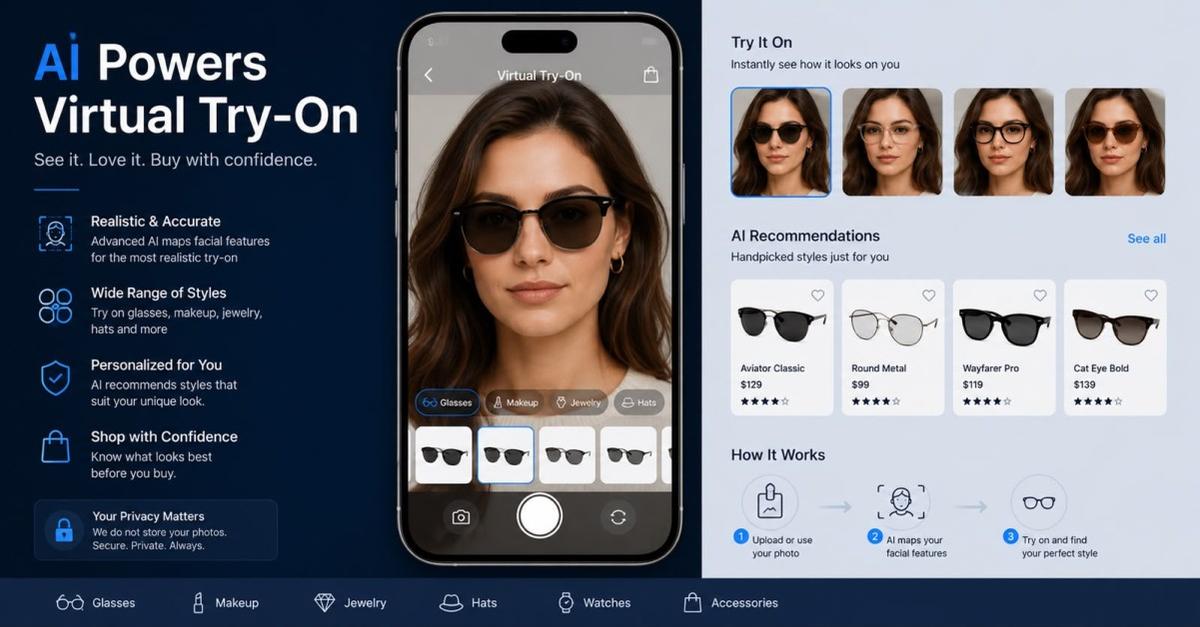
How AI Powers Virtual Try-On: A Complete Guide
Online shopping offers convenience, but one of its biggest challenges is knowing how a product will look before making a purchase. Whether buying clothes, glasses, shoes, makeup, or jewellery, customers often hesitate because they cannot try items on in person.
Artificial intelligence is changing this experience through AI-powered virtual try-on technology. By combining computer vision, augmented reality (AR), machine learning, and 3D modelling, AI allows shoppers to see how products may appear on themselves using a smartphone, tablet, or computer.
Today, AI virtual try-on is widely used in fashion, beauty, eyewear, footwear, jewellery, furniture, and e-commerce platforms to improve customer confidence and reduce product returns.
What Is AI Virtual Try-On?
AI virtual try-on is the use of artificial intelligence to digitally place products onto a person's image or live camera view, allowing users to preview how an item may look before purchasing.
Instead of physically trying on products, AI creates a realistic digital visualization by analyzing body features, facial landmarks, dimensions, and product characteristics.
Virtual try-on solutions can be used for:
-
Clothing
-
Shoes
-
Glasses
-
Sunglasses
-
Makeup
-
Jewellery
-
Watches
-
Hats
-
Hairstyles
-
Accessories
Some advanced systems also provide approximate size recommendations based on user-provided measurements or sizing data, though results may vary by brand and product.
How Does AI Power Virtual Try-On?
AI-powered virtual try-on generally follows these steps.
1. Capture the User's Image
The system receives input through:
-
Smartphone camera
-
Webcam
-
Uploaded photo
-
Live video
2. Detect Facial or Body Features
Computer vision identifies important landmarks such as:
-
Face shape
-
Eyes
-
Nose
-
Lips
-
Shoulders
-
Arms
-
Waist
-
Legs
-
Overall body proportions
3. Build a Digital Model
AI creates a digital representation of the user and aligns it with the selected product.
4. Overlay the Product
Using augmented reality and image processing, the system positions the product realistically while considering angle, scale, and movement.
5. Display the Virtual Preview
Users can often rotate, move, or change products to compare different colors, styles, and designs before making a purchase.
Key Technologies Behind AI Virtual Try-On
1. Computer Vision
Detects facial landmarks, body features, and user movements to accurately position virtual products.
2. Augmented Reality (AR)
Displays digital products within the user's real-world environment through a camera view.
3. Machine Learning
Improves product alignment, body recognition, and fitting accuracy over time.
4. 3D Modelling
Creates realistic product representations and supports accurate scaling and visualization.
5. Deep Learning
Enhances image understanding, pose estimation, and rendering quality for more natural-looking virtual try-on experiences.
Key Characteristics of AI Virtual Try-On
1. Real-Time Visualization
Users can preview products instantly through a live camera or uploaded image.
2. Interactive Experience
Customers can switch between products, colors, and styles with minimal effort.
3. Personalized Preview
AI adapts product placement based on each user's facial features or body proportions.
4. Cross-Device Accessibility
Virtual try-on is available on smartphones, tablets, desktop computers, and smart mirrors.
5. Scalable Retail Integration
Retailers can offer virtual try-on experiences to millions of online shoppers simultaneously.
Common Applications of AI Virtual Try-On
AI virtual try-on is widely used in:
-
Fashion retail
-
E-commerce websites
-
Beauty and cosmetics
-
Eyewear retailers
-
Jewelry stores
-
Footwear brands
-
Luxury goods
-
Department stores
-
Mobile shopping apps
-
Smart mirrors
-
Social commerce platforms
-
Digital marketing campaigns
Benefits of AI Virtual Try-On
Better Shopping Experience
Customers can visualize products before purchasing.
Higher Purchase Confidence
Virtual previews reduce uncertainty when shopping online.
Reduced Product Returns
Better visualization can help reduce returns caused by appearance or style expectations.
Increased Customer Engagement
Interactive shopping experiences encourage users to spend more time exploring products.
Supports Retail Innovation
Businesses can improve online shopping experiences while showcasing larger product catalogs.
Challenges of AI Virtual Try-On
Fit Accuracy
A virtual preview may not perfectly represent how every product will fit or feel due to differences in materials, sizing, or body shapes.
Lighting and Camera Quality
Poor lighting or low-quality cameras can affect the realism and accuracy of the experience.
Product Representation
Highly reflective materials, complex fabrics, or intricate textures may be more difficult to render accurately.
Privacy Considerations
Images, videos, and body-related data should be processed securely, with transparent privacy practices and appropriate user controls.
Human Judgment Remains Important
Virtual try-on is a helpful shopping aid, but customers may still benefit from reviewing sizing information, product descriptions, and return policies before making a purchase.
Traditional Online Shopping vs AI Virtual Try-On
| Feature | Traditional Online Shopping | AI Virtual Try-On |
|---|---|---|
| Product Preview | Static images | Interactive virtual visualization |
| Personalization | Limited | Personalized based on user appearance |
| Customer Confidence | Moderate | Higher through realistic previews |
| Shopping Experience | Passive | Interactive and engaging |
| Best For | Standard online browsing | Visualizing products before purchase |
Best Practices for Using AI Virtual Try-On
Use Good Lighting
A well-lit environment helps AI detect facial and body features more accurately.
Follow Camera Instructions
Position yourself as recommended by the application for better alignment.
Review Size Guides
Use virtual try-on alongside official sizing charts for clothing and footwear.
Protect Personal Data
Use trusted platforms that clearly explain how images and personal data are handled.
Compare Multiple Products
Try different colors, styles, and designs before making a purchasing decision.
Future of AI Virtual Try-On
AI virtual try-on is expected to become increasingly realistic as computer vision, augmented reality, generative AI, and 3D rendering technologies continue to advance. Future systems will better simulate fabric movement, lighting conditions, body shapes, and facial expressions, creating more accurate digital fitting experiences.
Integration with smart mirrors, wearable devices, virtual reality, and immersive online stores is also expected to expand. AI may provide personalized styling advice, recommend complementary products, and suggest sizes based on previous purchases, body measurements, or brand-specific sizing information.
As artificial intelligence continues to evolve, virtual try-on will play an increasingly important role in digital retail by making online shopping more interactive, personalized, and convenient for both consumers and businesses.
Conclusion
AI virtual try-on combines computer vision, augmented reality, machine learning, deep learning, and 3D modeling to help shoppers preview products before making a purchase. By creating realistic digital visualizations, AI improves confidence, enhances customer engagement, and supports better online shopping experiences.
From fashion and beauty to eyewear and jewelry, AI-powered virtual try-on has become a valuable tool for modern retailers and consumers alike. While virtual previews can provide helpful guidance, customers should also consider sizing information, product details, and personal preferences when making purchasing decisions.
As AI technology advances, virtual try-on systems will become more accurate, immersive, and personalized, helping shape the future of digital commerce.
 How AI Powers Virtual Try-On: The Technology Behind AI Digital Fitting FAQs
POST A COMMENT (0)
All Comments (0)
Replies (0)