





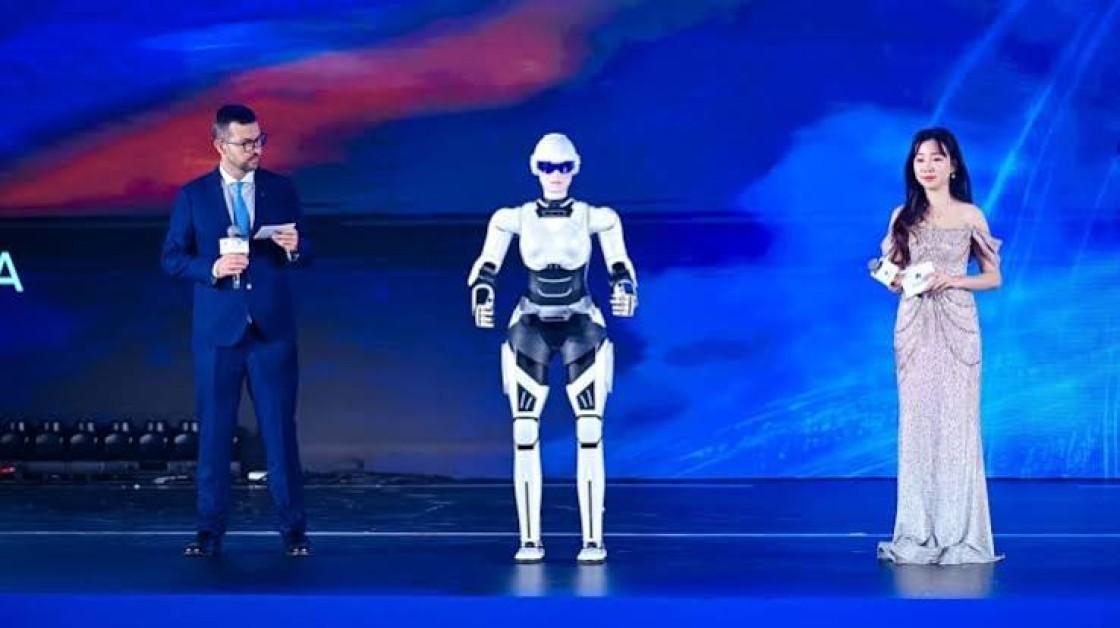
Chery Robotics Unit Prepares IPO While Targeting Overseas Demand for Police Robots
Chery Automobile-backed AiMOGA Robotics is preparing for an initial public offering as the Chinese robotics company accelerates international expansion and targets growing overseas demand for humanoid police robots, service robots and quadruped machines.
AiMOGA is in discussions with several potential listing venues, although the company has not yet disclosed where or when it plans to go public. The proposed IPO is intended to provide additional capital for technology investment and international expansion while also strengthening governance and transparency. (Reuters)
The company has already delivered more than 3,000 robots globally, including around 2,000 units outside China, and now operates across more than 60 countries and regions. It is targeting approximately 10,000 global deliveries next year as it attempts to establish itself among the world's leading robotics companies. (Reuters)
Police and public-safety applications are emerging as one of AiMOGA's most visible growth areas.
AiMOGA Is Exploring Multiple IPO Venues

AiMOGA is currently preparing for a stock-market listing and discussing several possible locations.
Zhang Guibing, head of the robotics business and president of Chery International, said the company is undertaking the relevant IPO preparations but has not disclosed a timetable or preferred exchange. (Reuters)
That means the listing remains at an early preparatory stage rather than a formally launched offering.
IPO Would Fund Technology and Expansion
Robotics remains a highly capital-intensive industry.
Companies need continuing investment across:
motors,
sensors,
AI software,
batteries,
manufacturing,
and mechanical engineering.
An IPO could provide AiMOGA with additional capital to accelerate development while reducing dependence on its automotive parent for future funding.
Public Listing Could Also Strengthen Governance
Management has said a listing would not simply provide money.
Operating as a publicly traded company could also strengthen transparency, governance and operational standards.
That becomes increasingly important as AiMOGA sells into international markets and works with governments or large enterprise customers.
Chery Incubated AiMOGA in 2025
AiMOGA was incubated by Chery in January 2025, making it a relatively young company within China's rapidly expanding robotics sector. (Reuters)
Its development illustrates how Chinese automakers are increasingly applying their manufacturing, supply-chain and AI expertise outside conventional vehicles.
Chery is already China's largest automobile exporter, giving AiMOGA access to an unusually broad international commercial network.
Auto Manufacturing Skills Transfer Naturally to Robotics
Cars and humanoid robots share several technological foundations.
Both require:
electric motors,
battery systems,
sensors,
control software,
and sophisticated manufacturing.
An automaker therefore already possesses many capabilities relevant to robot production.
This helps explain why Chinese automotive companies are entering robotics so aggressively.
AiMOGA Has Delivered More Than 3,000 Robots
Despite its short history, the company says it has delivered more than 3,000 robots globally.
Approximately 2,000 of those units have gone to overseas markets. (Reuters)
That means international sales already represent a substantial portion of its commercial footprint.
Operations Span More Than 60 Countries and Regions
AiMOGA's products and services are now present across more than 60 countries and regions.
This gives the company a broader global distribution base than many early-stage humanoid robotics companies.
Management wants to use that footprint to accelerate future overseas sales.
Company Targets 10,000 Deliveries Next Year
AiMOGA plans to increase global robot deliveries to approximately 10,000 units next year. (Reuters)
Reaching that target would require a major increase in manufacturing scale.
The challenge will be maintaining:
quality,
reliability,
and service support
while production expands quickly.
Police Robots Are Key Growth Category
One of AiMOGA's most distinctive applications is humanoid policing.
The company unveiled police robots earlier this year and says around 110 units are already being used across several Chinese cities. (Reuters)
Their roles include:
traffic management,
crowd guidance,
and public-safety awareness.
Robots Are Not Replacing Police Authority
The machines should not be confused with autonomous law-enforcement officers.
Current deployments are primarily designed to automate repetitive or physically demanding duties.
Separate robotic traffic-police pilots in China similarly use machines for warnings and guidance rather than giving them arrest powers. (Reuters)
Human officers remain responsible for legal authority and complex judgment.
Traffic Management Is Natural Early Application
Traffic policing involves many predictable repetitive tasks.
Officers may spend long periods:
directing vehicles,
giving warnings,
and guiding pedestrians.
These tasks can potentially be partially automated.
Robots can also carry cameras and sensors that improve situational awareness.
Extreme Weather Strengthens Business Case
AiMOGA believes overseas demand could be particularly strong in regions where traffic officers work under difficult environmental conditions.
Management has highlighted the Middle East and Southeast Asia as potentially attractive markets because of extreme heat and heavy rainfall. (Reuters)
Robots can operate in conditions that are uncomfortable or hazardous for humans.
Middle East Could Become Important Market
Several Middle Eastern countries are investing heavily in:
AI,
smart cities,
automation,
and public infrastructure.
That makes the region a natural potential market for service and public-safety robots.
Government customers may also be willing to test emerging technology more quickly than ordinary consumer markets.
Southeast Asia Offers Different Opportunity
Southeast Asian cities often combine:
high population density,
heavy traffic,
and tropical weather.
Traffic management can therefore be labour intensive.
Robotic systems able to provide guidance and monitoring could have practical applications.
However, every market will require adaptation to local laws and infrastructure.
Regulation Will Be Major Export Challenge
AiMOGA acknowledges that international expansion will require compliance with different regulatory regimes.
A police or public-safety robot interacts with potentially sensitive areas including:
video recording,
personal data,
and government infrastructure.
Countries may impose different rules on how such data can be collected or processed.
Data Protection Could Slow Adoption
Robots used in public spaces can contain cameras, microphones and other sensors.
That creates privacy concerns.
Governments may require:
local data storage,
restricted facial recognition,
or independent security certification.
These requirements can make exporting public-safety robots substantially more complicated than exporting ordinary consumer electronics.
Integration With Police Systems Is Another Barrier
A robot used by a police department cannot operate completely independently from the organisation's existing systems.
It may need integration with:
traffic databases,
communications networks,
and emergency systems.
That creates country-specific engineering work.
The more customised each deployment becomes, the harder it can be to scale globally.
Service Robots Lead Overseas Expansion
Police robots are attracting attention, but AiMOGA's international push is broader.
The company is initially expanding overseas through service robots and companion robots. (Reuters)
These applications may face fewer regulatory barriers than law-enforcement use cases.
Service Robots Can Work in Commercial Environments
Potential applications include:
showrooms,
hotels,
events,
and customer service.
These settings provide relatively controlled environments.
That makes them easier places to deploy robots than crowded streets or unpredictable homes.
Companion Robots Could Become Consumer Category
AiMOGA is also developing robots aimed at individual customers.
Consumer robotics remains a much less mature market.
The central challenge is usefulness.
A robot may attract attention initially, but buyers need recurring practical value to justify a high purchase price.
AiMOGA Already Sells Robots Online
The company began selling directly to Chinese consumers through JD.com in April.
Its humanoid robot was priced at approximately 285,800 yuan, or around $42,100, while its quadruped robot dog was priced at 15,800 yuan. (CnEVPost)
Those prices illustrate how different the two product categories currently are economically.
Humanoid Robots Remain Expensive
A roughly $42,000 humanoid remains far too expensive for mass consumer adoption.
Near-term buyers are therefore more likely to be:
businesses,
government agencies,
research institutions,
or affluent technology enthusiasts.
Costs need to decline substantially before humanoids become commonplace in ordinary households.
Manufacturing Scale Could Reduce Costs
China has already demonstrated its ability to drive down costs across:
electric vehicles,
solar panels,
and batteries.
Robotics companies hope a similar pattern will develop.
Larger manufacturing volumes can reduce component costs and improve production efficiency.
Chery's automotive manufacturing expertise could therefore become an important advantage.
Chinese Robotics Competition Is Intensifying
AiMOGA enters an increasingly crowded domestic market.
More than 300 exhibitors participated in the 2026 World Robot Conference in Beijing, showcasing everything from industrial robots to humanoid companions. (Reuters)
Major companies include:
Unitree,
UBTECH,
Deep Robotics,
Leju Robotics,
and Fourier Intelligence.
Competition is spreading across both technology and price.
Unitree’s Listing Raises Investor Interest
China's humanoid robotics market has also begun entering public markets.
Unitree, one of the country's best-known humanoid and quadruped manufacturers, recently made a dramatic stock-market debut, with its shares initially surging nearly six-fold. (The Business Standard)
That event could strengthen investor interest in other robotics listings.
AiMOGA's IPO preparation comes during this increasingly favourable capital-market environment.
Deep Robotics Is Also Pursuing a Listing
Other Chinese robotics businesses are moving toward public markets as well.
Deep Robotics, known for quadruped machines used in applications such as inspection and search-and-rescue, has applied for a Shanghai STAR Market listing. (Reuters)
A wave of listings could provide Chinese robotics companies with significant new capital.
Robotics Is Following China’s EV Playbook
AiMOGA management has compared the current robotics industry with China's electric-vehicle sector several years ago.
The comparison is instructive.
The EV industry initially attracted large numbers of companies.
Competition intensified.
Prices fell.
Eventually, stronger manufacturers gained scale while weaker businesses disappeared.
AiMOGA expects robotics to undergo a similar consolidation process. (CnEVPost)
Cost Competition Could Be Severe
Zhang has warned that competition, particularly around costs, is likely to become fierce.
That creates both opportunity and risk.
Lower prices can accelerate adoption.
But rapid price reductions can also compress margins.
Robotics companies need enough technological differentiation to avoid becoming commodity manufacturers.
Humanoid Robots May Take a Decade to Mature
AiMOGA's management has cautioned that humanoid robots may require roughly a decade before reaching truly rapid mass adoption. (CnEVPost)
That is an important counterweight to current market excitement.
Humanoid robotics is progressing quickly, but technical and economic limitations remain substantial.
Reliability Is Still Major Challenge
A robot working in public spaces needs to operate reliably for many hours.
Failures could create:
safety problems,
service disruptions,
or reputational damage.
Unlike a software application, physical robots cannot simply restart without consequences.
Hardware reliability therefore remains one of the industry's biggest barriers.
Battery Life Limits Working Hours
Humanoid robots consume significant energy.
Walking, balancing, computing and sensor processing all require power.
Current battery technology can restrict operating duration.
For commercial customers, frequent charging reduces productivity.
Longer battery life will therefore be important for large-scale adoption.
Dexterity Remains Difficult
Humans perform apparently simple tasks using extraordinary fine motor control.
Robots still struggle with unpredictable physical environments.
Handling objects of different:
sizes,
weights,
and textures
remains technically challenging.
This limits how many real-world jobs humanoids can perform economically.
AI Models Are Improving Robot Intelligence
Recent advances in artificial intelligence are making robots more adaptable.
Vision-language-action models can help machines interpret visual information and translate instructions into movement.
Instead of programming every task manually, robots may increasingly learn through:
demonstration,
simulation,
and video.
This could significantly expand their capabilities.
Physical AI Is Becoming Major Investment Theme
The robotics sector is increasingly described as physical AI.
Generative AI demonstrated that software can interpret language and images.
Physical AI attempts to apply similar intelligence to machines operating in the real world.
That opportunity is attracting capital from:
technology companies,
automakers,
and venture investors.
Chery Sees Robotics as Strategic Adjacency
For Chery, robotics offers a way to extend capabilities developed through automobiles into a new technology market.
The company already understands:
mass manufacturing,
supply-chain management,
and global distribution.
Those capabilities can reduce some of the obstacles facing standalone robotics startups.
Chery’s Global Dealer Network Could Help
Chery exports automobiles widely.
That means it already has commercial relationships across numerous countries.
AiMOGA could potentially use portions of this network for:
market entry,
customer support,
and logistics.
This gives the robotics unit a distribution advantage that many startups lack.
Automotive Showrooms Can Be Robot Test Sites
Service robots can also be deployed inside Chery's own commercial ecosystem.
Dealerships and events provide controlled environments where robots can:
greet customers,
explain products,
and demonstrate technology.
Internal deployment gives the company real-world usage data before pursuing external customers.
IPO Could Create Independent Valuation
Listing AiMOGA separately would allow investors to value the robotics business independently from Chery's automotive operations.
This can be strategically useful when a fast-growing technology unit operates inside a much larger industrial group.
A separate stock-market valuation can also make acquisitions and employee compensation easier.
Chery Has Used Separate Listings Before
Separate listings of Chery-related businesses are not unprecedented.
Automotive component supplier Bethel Automotive listed in Shanghai in 2018, while robotics and automation company Efort listed on the STAR Market in 2020. (CnEVPost)
This provides an established precedent for independent capital-market structures within the wider Chery ecosystem.
Public Markets Could Fund Acquisitions
Robotics remains fragmented.
If consolidation accelerates, listed companies may use both cash and shares to acquire competitors or specialist technology.
An IPO could therefore give AiMOGA strategic flexibility beyond merely financing organic expansion.
Talent Competition Is Intense
Robotics requires expertise across:
AI,
mechanical engineering,
electronics,
and control systems.
Experienced engineers are scarce.
Public-company equity incentives can help attract and retain employees.
This could become another motivation for a listing.
Overseas Revenue Can Reduce China Dependence
China offers enormous robotics demand, but competition is exceptionally intense.
Expanding overseas gives AiMOGA access to markets with fewer domestic competitors.
It can also diversify revenue.
This becomes especially important if price competition in China compresses margins.
But Geopolitical Risk Could Limit Expansion
Chinese technology companies increasingly face regulatory scrutiny abroad.
Robots containing cameras, sensors and AI systems may attract particular concern because they collect information from physical environments.
Some governments could impose restrictions on Chinese robotics equipment in sensitive sectors.
Police applications would likely receive especially close scrutiny.
US Market Could Be Difficult
AiMOGA says its ambition is to serve global markets, including potentially the United States when conditions are appropriate. (Reuters)
But US-China technology tensions could make entry challenging.
Security reviews, tariffs or procurement restrictions could all affect commercial prospects.
Middle East May Offer Faster Route to International Scale
Given those barriers, the Middle East may provide a more immediate overseas growth opportunity.
Several governments in the region actively promote:
robotics,
AI,
and smart-city infrastructure.
They may also value robots capable of operating in extreme temperatures.
This combination makes the region commercially attractive.
Police Robots Could Save Labour in Dangerous Conditions
Traffic officers can face substantial occupational risks.
They work near moving vehicles and may be exposed to:
pollution,
heat,
and accidents.
Robots can potentially take over some repetitive roadside duties.
This does not eliminate human police jobs but can change how officers allocate their time.
Human Officers Can Focus on Higher-Value Tasks
If robots handle routine:
warnings,
directions,
and information,
human officers can spend more time on situations requiring judgment.
That includes:
accidents,
conflict,
and enforcement decisions.
The strongest business case may therefore be augmentation rather than replacement.
Public Acceptance Will Matter
Robotic police machines can attract curiosity.
Long-term adoption requires public trust.
Citizens need confidence that robots:
behave predictably,
protect privacy,
and remain under human control.
A technically capable robot can still fail commercially if the public rejects its presence.
Governments Will Need Clear Accountability
If a robot makes an error, responsibility must remain clear.
Public agencies need rules defining:
who controls the machine,
what it is permitted to do,
and who is responsible for failures.
This becomes especially important in law-enforcement environments.
IPO Investors Will Need to Assess Revenue Quality
Robotics companies can generate attention through demonstrations.
Public-market investors will focus more heavily on financial fundamentals.
They will want to understand:
commercial revenue,
unit margins,
order visibility,
and recurring service income.
AiMOGA will eventually need to show that growing shipments translate into sustainable profitability.
10,000-Unit Target Will Test Economics
The planned increase to 10,000 annual deliveries represents a meaningful commercial benchmark.
If AiMOGA can reach that scale while maintaining product quality and acceptable margins, it would demonstrate that the business is moving beyond experimental deployments.
If deliveries require heavy subsidies or discounts, the economics would look less attractive.
Service Revenue Could Improve Business Model
Robots can generate revenue beyond the initial hardware sale.
Potential recurring income includes:
software subscriptions,
maintenance,
and fleet management.
These revenue streams can carry better margins than hardware manufacturing.
Developing them could improve long-term economics.
Robot Fleets Need Continuous Support
Government and enterprise customers purchasing dozens of robots need reliable service.
Machines require:
repairs,
software updates,
and spare parts.
A strong international service network may therefore be as important as the robots themselves.
Chery's global operations could again provide an advantage.
Conclusion
Chery-backed AiMOGA Robotics is preparing for an IPO as it attempts to turn rapid growth in humanoid and service robots into a larger international business.
The company is discussing several possible listing venues but has not yet announced a timetable or final exchange. An IPO would provide additional capital for technology development and expansion while strengthening corporate governance. (Reuters)
AiMOGA has already delivered more than 3,000 robots worldwide, including approximately 2,000 overseas, and operates across more than 60 countries and regions. It aims to increase global deliveries to 10,000 units next year. (Reuters)
Police robots are emerging as one of its most unusual commercial opportunities. Around 110 units are already operating in Chinese cities for traffic management, crowd guidance and public-safety awareness, while management sees potential demand in the Middle East and Southeast Asia where difficult weather conditions can make traffic-policing work especially demanding. (Reuters)
The opportunity is considerable, but so are the challenges.
Humanoid robots remain expensive, technically immature and difficult to deploy reliably in uncontrolled environments. International police applications also raise complex questions around data protection, regulation and integration with public-safety systems.
AiMOGA's proposed listing will therefore test more than investor enthusiasm for robotics.
It will test whether Chery can use its automotive manufacturing scale, international distribution network and engineering expertise to turn physical AI from an experimental technology into a commercially scalable global business.
 Chery’s AiMOGA Robotics Prepares IPO as Overseas Police-Robot Demand Grows FAQs
POST A COMMENT (0)
All Comments (0)
Replies (0)