





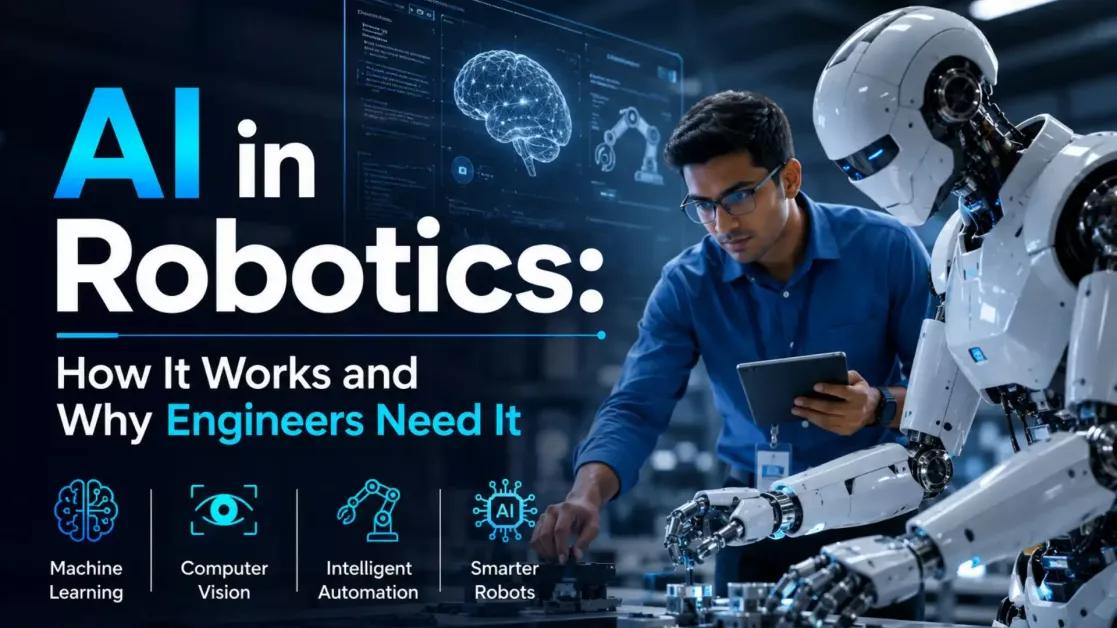
AI in Robotics: How Artificial Intelligence Is Powering Intelligent Robots
Artificial Intelligence (AI) is transforming robotics by enabling machines to perceive their surroundings, make decisions, learn from experience, and perform complex tasks with minimal human intervention. Unlike traditional robots that follow pre-programmed instructions, AI-powered robots can adapt to changing environments, recognize objects, navigate autonomously, and interact more naturally with humans. From manufacturing and healthcare to logistics and space exploration, AI is making robots smarter, more capable, and increasingly valuable across industries.
What Is AI in Robotics?

AI in robotics refers to the integration of Artificial Intelligence technologies into robotic systems, allowing robots to analyze data, understand their environment, make decisions, and continuously improve their performance.
How AI in Robotics Works
AI-powered robots combine machine learning, computer vision, Natural Language Processing (NLP), sensor fusion, and reinforcement learning with cameras, sensors, and robotic hardware. These technologies help robots recognize objects, avoid obstacles, plan movements, understand voice commands, and perform intelligent actions in real time.
Why AI in Robotics Matters
AI enables robots to move beyond repetitive automation by giving them the ability to adapt, solve problems, improve efficiency, and safely collaborate with humans in dynamic environments.
Key Applications of AI in Robotics
AI is driving innovation across many types of robotic systems.
Industrial Robotics
Manufacturing companies use AI-powered robots for assembly, welding, packaging, quality inspection, predictive maintenance, and material handling to improve productivity and precision.
Healthcare Robotics
Hospitals use intelligent robots for surgical assistance, rehabilitation, patient monitoring, hospital logistics, and medication delivery, helping improve patient care and operational efficiency.
Warehouse and Logistics
AI-powered robots automate inventory management, order picking, package sorting, and warehouse transportation, enabling faster and more accurate fulfillment.
Autonomous Robots
Delivery robots, agricultural robots, drones, and self-driving machines use AI to navigate independently, avoid obstacles, and perform tasks without constant human control.
Service Robots
Businesses use AI-powered service robots in hotels, restaurants, retail stores, airports, and customer service environments to assist customers and automate routine tasks.
Benefits of AI in Robotics
AI-powered robotics offers several significant advantages.
Greater Automation
AI enables robots to perform increasingly complex tasks with minimal supervision, improving productivity across industries.
Improved Accuracy
Computer vision and machine learning allow robots to complete tasks with high precision while reducing human error.
Enhanced Safety
Robots can perform hazardous tasks in dangerous environments, reducing workplace risks for human workers.
Continuous Learning
Machine learning enables robots to improve their performance over time by learning from data and real-world experiences.
Challenges of AI in Robotics
Despite its advantages, AI-powered robotics faces several challenges.
High Development Costs
Building intelligent robotic systems requires significant investment in hardware, software, AI models, and sensor technologies.
Complex Decision-Making
Robots operating in unpredictable environments must process large amounts of information and make safe decisions in real time.
Ethical and Regulatory Issues
The increasing use of autonomous robots raises important questions about safety, accountability, privacy, and responsible AI deployment.
Future of AI in Robotics
AI-powered robotics is expected to advance rapidly through multimodal AI, humanoid robots, edge AI, collaborative robots (cobots), and autonomous learning systems. Future robots will better understand human intentions, work safely alongside people, perform increasingly sophisticated tasks, and operate across industries ranging from healthcare and manufacturing to agriculture, logistics, and space exploration. As Artificial Intelligence continues to evolve, intelligent robotics will become an essential part of everyday life and industrial automation.
Conclusion
Artificial Intelligence is revolutionizing robotics by enabling machines to perceive, learn, reason, and act with increasing autonomy. From industrial automation and healthcare to logistics and autonomous vehicles, AI-powered robots are improving productivity, safety, and operational efficiency across countless industries. As AI technology continues to advance, robotics will become even more intelligent, adaptable, and capable of solving complex real-world challenges.
 AI in Robotics: Benefits, Applications and Future Trends FAQs
POST A COMMENT (0)
All Comments (0)
Replies (0)