





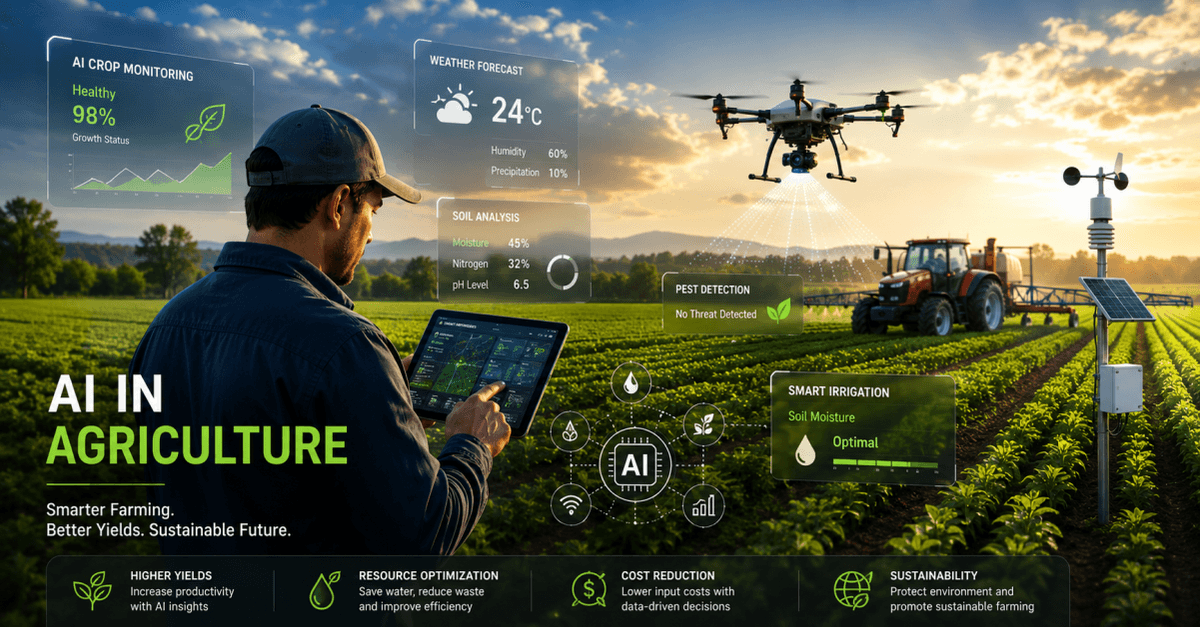
AI in Agriculture: How Artificial Intelligence Is Transforming Modern Farming
Artificial Intelligence (AI) is transforming agriculture by helping farmers increase crop yields, optimize resource usage, reduce operational costs, and make data-driven farming decisions. From precision agriculture and smart irrigation to crop monitoring and autonomous farming equipment, AI enables more efficient and sustainable agricultural practices. As the global demand for food continues to grow, AI has become a vital technology for improving productivity while addressing challenges such as climate change, labor shortages, and resource management.
What Is AI in Agriculture?

AI in agriculture refers to the use of Artificial Intelligence technologies to improve farming operations, monitor crops, automate agricultural processes, and optimize decision-making across the agricultural value chain.
How AI in Agriculture Works
AI combines machine learning, computer vision, predictive analytics, satellite imagery, Internet of Things (IoT) sensors, drones, and Generative AI to collect and analyze agricultural data, detect crop issues, forecast yields, and automate farming activities.
Why AI in Agriculture Matters
AI helps farmers make informed decisions, improve crop health, conserve water, reduce waste, optimize fertilizer usage, and increase overall farm productivity while promoting sustainable agriculture.
Key Applications of AI in Agriculture
AI is transforming farming from planting to harvesting.
Precision Farming
AI analyzes soil conditions, weather patterns, and crop data to recommend the best planting schedules, irrigation strategies, and fertilizer applications for maximum productivity.
Crop Monitoring
Drones, cameras, and satellite imagery powered by AI monitor crop health, identify diseases, detect pest infestations, and assess nutrient deficiencies in real time.
Smart Irrigation
AI-powered irrigation systems optimize water usage by analyzing soil moisture, weather forecasts, and crop requirements, helping farmers conserve water while maintaining healthy crops.
Autonomous Farming Equipment
AI enables tractors, harvesters, drones, and agricultural robots to perform planting, spraying, harvesting, and field monitoring with greater efficiency and precision.
Benefits of AI in Agriculture
AI provides significant advantages for farmers and agricultural businesses.
Higher Crop Yields
AI helps optimize farming practices, leading to healthier crops and improved agricultural productivity.
Reduced Resource Waste
Smart irrigation, precision fertilizer application, and targeted pest control minimize water, chemical, and energy consumption.
Better Decision-Making
AI analyzes real-time agricultural data to support faster, more accurate decisions related to crop management, harvesting, and resource allocation.
Challenges of AI in Agriculture
Despite its benefits, AI adoption presents several challenges.
High Initial Costs
Implementing AI-powered sensors, drones, robotics, and smart farming technologies can require significant investment.
Connectivity and Infrastructure
Reliable internet connectivity and digital infrastructure are essential for many AI-powered agricultural systems, particularly in rural areas.
Farmer Training
Successful adoption requires farmers and agricultural workers to develop the skills needed to operate AI-powered tools and interpret data effectively.
Future of AI in Agriculture
AI is expected to play an even greater role in agriculture through autonomous farming, robotic harvesting, climate-resilient crop management, digital twins, and predictive farming systems. Future AI platforms will integrate weather forecasting, satellite monitoring, and real-time field analytics to help farmers maximize productivity while reducing environmental impact. As Artificial Intelligence continues to evolve, AI-driven agriculture will become smarter, more sustainable, and increasingly resilient to global food production challenges.
Conclusion
Artificial Intelligence is revolutionizing agriculture by enabling precision farming, automating field operations, improving crop monitoring, and optimizing resource management. From smart irrigation and predictive analytics to autonomous farming equipment and AI-powered crop health monitoring, AI is helping farmers increase productivity while promoting sustainable farming practices. As technology advances, AI in Agriculture will continue to play a crucial role in ensuring food security and improving the future of global farming.
 AI in Agriculture: Benefits, Use Cases and Future Trends FAQs
POST A COMMENT (0)
All Comments (0)
Replies (0)