





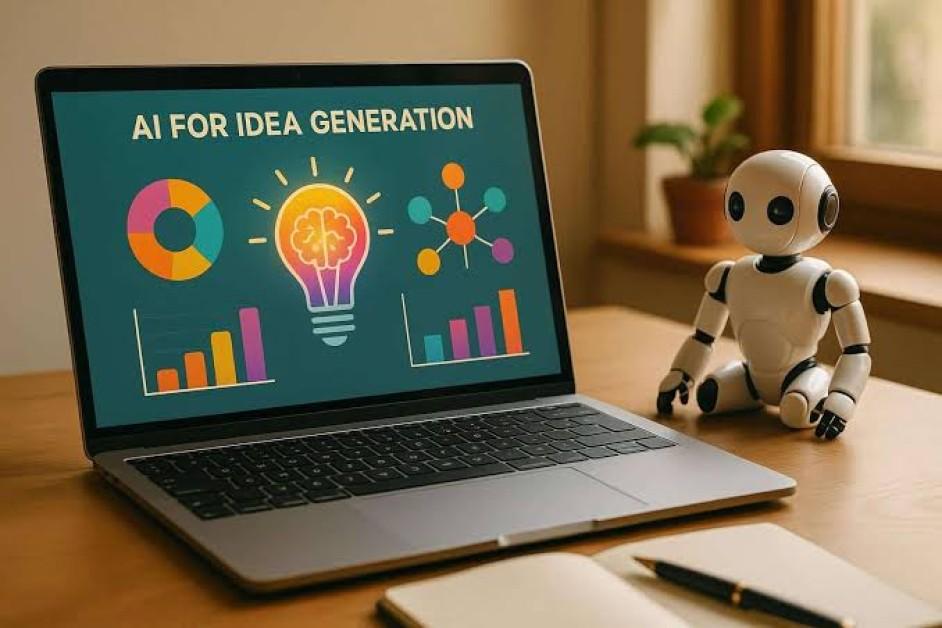
AI for Idea Generation: How Artificial Intelligence Is Transforming Creativity and Innovation
Artificial Intelligence (AI) is transforming idea generation by helping businesses, entrepreneurs, students, marketers, designers, writers, and professionals develop creative solutions more efficiently. From brainstorming business concepts and marketing campaigns to generating product ideas and solving complex problems, AI-powered tools support innovation while reducing the time required to develop new ideas.
Rather than replacing human creativity, AI serves as an intelligent brainstorming assistant that provides inspiration, explores possibilities, and helps refine concepts through data-driven suggestions.
What Is AI for Idea Generation?

AI for idea generation refers to the use of artificial intelligence technologies to assist in brainstorming, exploring, organizing, and refining ideas for creative, educational, business, and professional purposes.
AI-powered idea generation tools use natural language processing (NLP), machine learning, generative AI, and pattern recognition to analyze prompts, identify trends, and generate relevant ideas tailored to specific goals or industries.
How AI Helps with Idea Generation
AI supports creativity and innovation throughout the brainstorming process.
1. Brainstorming New Ideas
AI helps generate ideas for:
- Business opportunities
- Marketing campaigns
- Blog topics
- Product development
- Social media content
- Creative projects
These suggestions help users overcome creative blocks and explore new directions.
2. Content Inspiration
AI assists content creators by suggesting ideas for:
- Articles
- Videos
- Podcasts
- Newsletters
- Presentations
- Educational materials
This enables creators to maintain a consistent content pipeline.
3. Product Innovation
AI supports product development by identifying opportunities related to:
- Customer needs
- Feature improvements
- Market trends
- User feedback
- Industry developments
- Competitive differentiation
These insights help businesses innovate more effectively.
4. Problem Solving
AI helps users explore multiple solutions by:
- Suggesting alternative approaches
- Organizing ideas
- Evaluating possible strategies
- Identifying risks
- Highlighting opportunities
- Encouraging creative thinking
Final decisions should always incorporate human judgment and expertise.
5. Trend Analysis
AI analyzes large volumes of information to identify:
- Emerging technologies
- Consumer interests
- Industry trends
- Market opportunities
- Seasonal patterns
- Popular topics
These insights support informed brainstorming.
6. Idea Expansion
AI helps refine basic concepts into more detailed plans by suggesting:
- Features
- Improvements
- Variations
- Target audiences
- Use cases
- Implementation ideas
This transforms simple ideas into actionable concepts.
7. Collaboration Support
AI can facilitate collaborative brainstorming by:
- Organizing team ideas
- Grouping similar concepts
- Summarizing discussions
- Prioritizing suggestions
- Identifying recurring themes
- Tracking creative sessions
This supports more productive teamwork.
8. Workflow Automation
AI automates repetitive brainstorming tasks such as:
- Idea categorization
- Note organization
- Topic clustering
- Outline creation
- Summary generation
- Session documentation
Automation allows users to spend more time developing ideas.
Benefits of AI for Idea Generation
AI provides several important advantages.
Faster Brainstorming
AI generates numerous ideas within seconds, accelerating creative processes.
Increased Creativity
AI introduces fresh perspectives and alternative approaches that may not have been considered initially.
Improved Productivity
Users can develop concepts more efficiently while reducing time spent overcoming creative blocks.
Better Organization
AI structures ideas into logical categories, making them easier to evaluate and refine.
Continuous Inspiration
AI provides ongoing suggestions that help maintain creative momentum.
Challenges of AI for Idea Generation
Despite its benefits, AI also presents important challenges.
Originality
AI-generated ideas may require human refinement to become truly unique and innovative.
Context
AI may not fully understand organizational goals, cultural nuances, or specialized industry requirements.
Quality
Not every AI-generated idea will be practical, relevant, or feasible.
Human Creativity
Innovation, intuition, strategic thinking, and emotional understanding remain uniquely human strengths.
Best Practices for Using AI for Idea Generation
Individuals and organizations should follow these recommendations.
Use AI as a Brainstorming Partner
Allow AI to inspire ideas while making final creative decisions independently.
Refine Every Suggestion
Evaluate AI-generated concepts based on practicality, originality, and business or project goals.
Combine Multiple Perspectives
Use AI suggestions alongside team discussions, customer feedback, and expert insights.
Validate Ideas
Research and test promising ideas before implementation.
Encourage Human Creativity
Use AI to support—not replace—creative thinking, experimentation, and innovation.
Common Applications of AI for Idea Generation
AI is increasingly used for:
- Business ideas
- Product innovation
- Marketing campaigns
- Content creation
- Brand development
- Research brainstorming
- Educational projects
- Startup planning
- Creative writing
- Team workshops
- Strategic planning
- Workflow automation
Future of AI for Idea Generation
Artificial Intelligence is expected to become even more advanced through personalized brainstorming assistants, predictive trend analysis, collaborative innovation platforms, real-time market insights, industry-specific creativity tools, and deeper integration with productivity and project management software. As AI technologies continue to evolve, individuals and organizations will increasingly rely on intelligent idea-generation assistants while continuing to depend on human creativity, strategic thinking, and experience to transform ideas into meaningful outcomes.
Conclusion
Artificial Intelligence is transforming idea generation by helping users brainstorm concepts, explore creative possibilities, analyze trends, organize thoughts, and automate repetitive planning tasks. Rather than replacing human imagination, AI serves as a valuable brainstorming assistant that enhances productivity and supports innovation. When combined with human creativity, critical thinking, and practical experience, AI enables businesses, creators, and professionals to generate stronger ideas and develop more effective solutions.
 AI for Idea Generation: Benefits, Brainstorming Applications, Challenges, and Future Explained FAQs
POST A COMMENT (0)
All Comments (0)
Replies (0)