





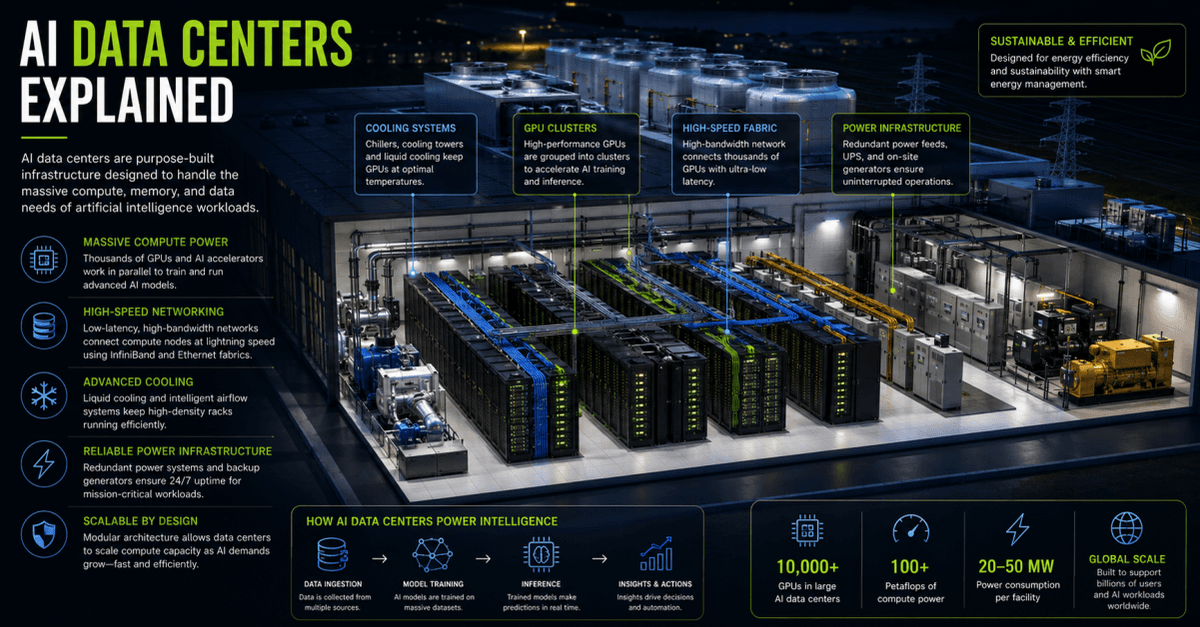
AI Data Centers Explained: How They Power Modern Artificial Intelligence
AI data centers are specialized computing facilities built to train, deploy, and operate Artificial Intelligence (AI) models at massive scale. Unlike traditional data centers that primarily support websites, databases, and enterprise applications, AI data centers are optimized for high-performance computing using thousands of AI chips, advanced networking, and massive storage systems. They provide the infrastructure behind Large Language Models (LLMs), Generative AI applications, cloud AI services, autonomous systems, and scientific research.
What Are AI Data Centers?

AI data centers are facilities designed specifically to support Artificial Intelligence workloads by combining powerful AI processors, high-speed networking, advanced cooling systems, and large-scale storage infrastructure.
How AI Data Centers Work
AI data centers connect thousands of GPUs or AI accelerators through ultra-fast networking, allowing them to work together as a single computing system. These facilities process enormous datasets to train AI models and deliver real-time AI inference for millions of users worldwide.
Why AI Data Centers Matter
Modern AI models require enormous computing resources. AI data centers provide the performance, scalability, and reliability needed to train increasingly complex AI systems while delivering fast and efficient AI services.
Key Components of an AI Data Center
Several technologies work together to power AI infrastructure.
AI GPUs and Accelerators
High-performance GPUs and specialized AI chips perform the parallel computations required for machine learning, deep learning, and Generative AI workloads.
High-Speed Networking
Advanced networking technologies connect thousands of servers with extremely low latency, enabling distributed AI training across large computing clusters.
Massive Storage Systems
AI models require access to vast amounts of structured and unstructured data. High-speed storage systems provide rapid access to training datasets and model checkpoints.
Advanced Cooling Systems
AI servers generate significant heat during operation. Liquid cooling and advanced thermal management systems help maintain optimal performance while improving energy efficiency.
Applications of AI Data Centers
AI data centers support a wide range of AI services and industries.
Training Large Language Models
Technology companies use AI data centers to train foundation models and Large Language Models that power chatbots, search engines, and enterprise AI applications.
AI Cloud Services
Cloud providers deliver AI infrastructure, model hosting, inference services, and AI development platforms through dedicated AI data centers.
Scientific Research
Researchers use AI computing infrastructure for climate modeling, genomics, pharmaceutical research, materials science, and complex simulations.
Enterprise AI
Businesses deploy AI applications for customer service, predictive analytics, cybersecurity, finance, healthcare, manufacturing, and business automation using AI cloud infrastructure.
Benefits of AI Data Centers
AI data centers provide several important advantages.
Massive Computing Power
Thousands of AI processors work together to handle demanding AI workloads far beyond the capabilities of traditional servers.
Faster AI Training
Distributed computing significantly reduces the time required to train large machine learning and deep learning models.
Scalable Infrastructure
Organizations can expand AI workloads by adding additional computing resources without redesigning their applications.
Challenges of AI Data Centers
Despite their advantages, AI data centers face several challenges.
High Energy Consumption
Large AI clusters consume substantial amounts of electricity, increasing demand for efficient hardware, renewable energy, and advanced cooling technologies.
Infrastructure Costs
Building AI data centers requires major investments in AI chips, networking equipment, storage systems, power distribution, and facility construction.
Chip Availability
Strong global demand for AI processors has created supply chain constraints and increased competition for advanced semiconductor manufacturing capacity.
Future of AI Data Centers
AI data centers are expected to become larger, more efficient, and increasingly specialized through advances in next-generation AI chips, liquid cooling, optical networking, modular infrastructure, and renewable energy integration. Future facilities will support trillion-parameter AI models, autonomous AI agents, scientific breakthroughs, and enterprise-scale AI deployments while improving energy efficiency and sustainability. As Artificial Intelligence continues to evolve, AI data centers will remain the backbone of global AI innovation.
Conclusion
AI data centers are the foundation of modern Artificial Intelligence, providing the specialized infrastructure required to train and deploy today's most advanced AI models. By combining powerful AI chips, high-speed networking, massive storage, and efficient cooling technologies, these facilities enable breakthroughs in Generative AI, cloud computing, scientific research, and enterprise automation. As AI adoption accelerates worldwide, AI data centers will continue to play a central role in powering the next generation of intelligent technologies.
 AI Data Centers Explained: Infrastructure, GPUs and How They Work FAQs
POST A COMMENT (0)
All Comments (0)
Replies (0)