





What Are AI Context Windows? How They Work, Size and Importance
AI context windows define the amount of information an Artificial Intelligence (AI) model can process and remember during a single interaction. In Large Language Models (LLMs), the context window determines how much text, code, or other input the model can consider before generating a response. Larger context windows allow AI systems to understand longer conversations, analyze lengthy documents, and perform more complex reasoning tasks. As AI technology advances, context window size has become one of the most important factors influencing model performance, accuracy, and usability.
What Are AI Context Windows?

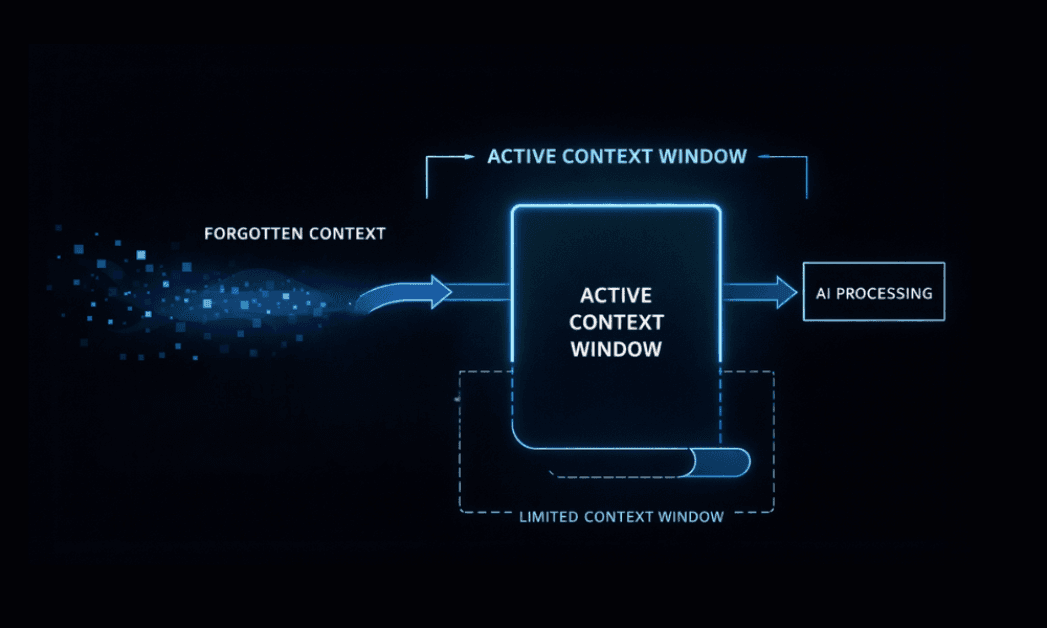
An AI context window is the maximum amount of information an AI model can process at one time. It includes the user's prompt, previous conversation, uploaded content, and the model's own generated responses within a single interaction.
How AI Context Windows Work
AI models process information as tokens rather than individual words. Every prompt and response consumes tokens, and once the maximum context window is reached, older information may no longer be considered when generating new responses.
Why AI Context Windows Matter
Larger context windows enable AI to maintain better conversational continuity, understand complex instructions, summarize long documents, analyze extensive codebases, and perform more sophisticated reasoning.
How Context Window Size Affects AI Performance
The size of a context window directly impacts the capabilities of AI models.
Better Long-Form Understanding
Large context windows allow AI to process lengthy reports, books, research papers, contracts, and technical documentation without losing important information.
Improved Conversation Memory
AI can maintain context across longer discussions, resulting in more consistent, relevant, and personalized responses.
Enhanced Reasoning
Access to more information enables AI to identify relationships between different sections of content and generate more accurate conclusions.
Applications of AI Context Windows
Context windows play an important role across many AI use cases.
Document Analysis
Businesses use AI to review contracts, financial reports, legal documents, research papers, and policy manuals without splitting them into smaller sections.
Software Development
Developers benefit from larger context windows when analyzing large codebases, debugging applications, reviewing documentation, and generating software solutions.
Enterprise Productivity
Organizations use AI to summarize meetings, analyze knowledge bases, automate workflows, and improve customer support across complex business environments.
Education and Research
Students and researchers use AI to understand lengthy academic materials, compare multiple sources, and generate detailed summaries.
Benefits of Larger Context Windows
Larger context windows provide several significant advantages.
More Accurate Responses
AI produces better answers by considering more relevant information before generating a response.
Greater Productivity
Users can work with larger datasets, longer conversations, and more detailed documents without repeatedly providing the same context.
Better User Experience
Longer context windows reduce interruptions and improve conversational continuity across extended interactions.
Challenges of AI Context Windows
Despite their advantages, larger context windows also introduce challenges.
Higher Computing Costs
Processing larger amounts of information requires greater computational resources, memory, and processing power.
Increased Latency
Very large context windows may increase response times depending on model architecture and hardware.
Information Management
AI models must efficiently prioritize relevant information within large context windows to maintain response quality and avoid unnecessary processing.
Future of AI Context Windows
AI context windows are expected to continue expanding as advances in model architecture, memory optimization, and computing infrastructure improve efficiency. Future AI systems will likely process significantly larger amounts of text, code, images, audio, and video within a single interaction. These improvements will support more advanced reasoning, enterprise knowledge management, software development, scientific research, and multimodal AI applications.
Conclusion
AI context windows play a fundamental role in determining how much information an AI model can understand and remember during a conversation or task. Larger context windows improve long-form reasoning, document analysis, coding assistance, and conversational continuity while enabling more capable AI applications. As Artificial Intelligence continues to evolve, advances in context window technology will help create smarter, more efficient, and more reliable AI systems.
 What Are AI Context Windows? Complete Guide Explained FAQs
POST A COMMENT (0)
All Comments (0)
Replies (0)