





What Is Agentic AI? How It Works, Benefits and Applications
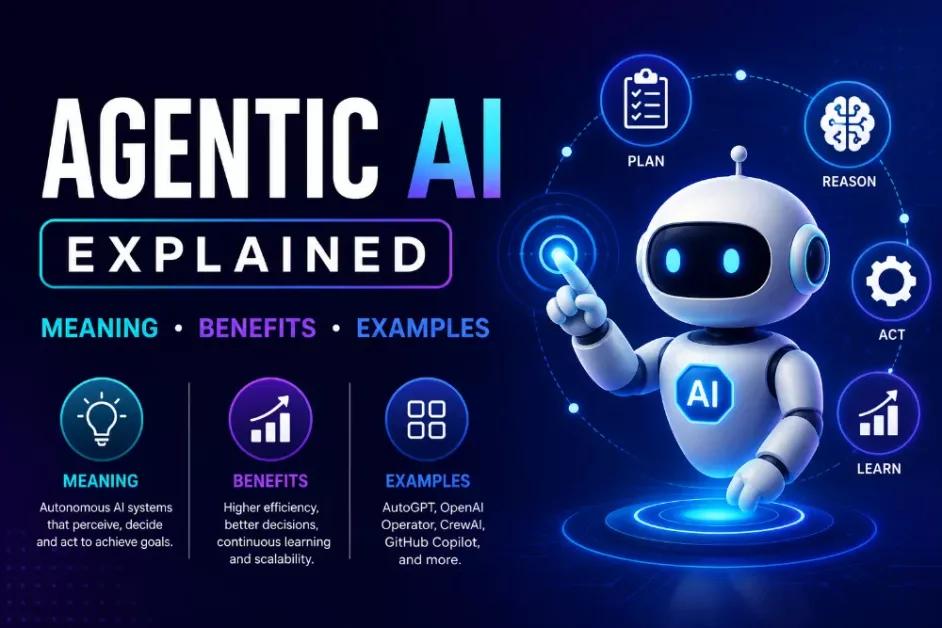
Agentic AI is an advanced form of Artificial Intelligence (AI) that enables intelligent systems to plan, reason, make decisions, and complete complex tasks with minimal human intervention. Unlike traditional AI systems that primarily respond to user prompts, Agentic AI can pursue goals, use external tools, adapt to changing conditions, and execute multi-step workflows autonomously. As businesses increasingly adopt intelligent automation, Agentic AI is emerging as a key technology driving enterprise productivity, digital transformation, and next-generation AI applications.
What Is Agentic AI?
.webp)
Agentic AI refers to AI systems that can independently plan actions, solve problems, and achieve objectives rather than simply generating responses. These systems combine reasoning, memory, planning, and execution capabilities to perform tasks across multiple environments.
How Agentic AI Works
Agentic AI integrates Large Language Models, reasoning engines, memory, planning algorithms, external tools, APIs, and workflow automation. It analyzes objectives, develops execution plans, performs actions, evaluates outcomes, and adjusts its strategy based on new information.
Why Agentic AI Matters
Agentic AI expands the role of Artificial Intelligence from information generation to intelligent decision-making and autonomous task execution, enabling organizations to automate increasingly complex business processes.
Key Features of Agentic AI
Agentic AI introduces several advanced capabilities beyond conventional AI assistants.
Autonomous Decision-Making
Agentic AI can evaluate multiple options, determine the most effective course of action, and execute decisions without requiring constant user guidance.
Planning and Reasoning
These systems break large objectives into smaller tasks, prioritize activities, monitor progress, and adapt their plans as conditions change.
Tool and System Integration
Agentic AI can interact with enterprise software, databases, APIs, cloud platforms, and digital tools to complete real-world workflows automatically.
Applications of Agentic AI
Agentic AI is transforming operations across multiple industries.
Enterprise Automation
Organizations use Agentic AI to automate document processing, workflow management, customer service, compliance monitoring, and business operations.
Software Development
Developers use Agentic AI for code generation, debugging, software testing, deployment automation, and project management assistance.
Healthcare
Healthcare providers apply Agentic AI to clinical workflow automation, medical research support, documentation, and operational efficiency.
Financial Services
Financial institutions use Agentic AI for risk analysis, fraud detection, regulatory compliance, investment research, and intelligent process automation.
Benefits of Agentic AI
Agentic AI provides several advantages for businesses and organizations.
Increased Productivity
By automating complex workflows, Agentic AI allows employees to focus on strategic, creative, and high-value activities.
Smarter Decision-Making
Agentic AI analyzes information, reasons through problems, and continuously adjusts its actions to achieve better outcomes.
Scalable Automation
Organizations can automate sophisticated business processes across multiple departments while improving operational efficiency.
Challenges of Agentic AI
Despite its capabilities, Agentic AI also presents several challenges.
Governance and Oversight
Organizations must establish appropriate policies, monitoring systems, and human oversight to ensure responsible AI deployment.
Security and Privacy
Agentic AI often interacts with enterprise systems and sensitive information, making cybersecurity and data protection essential.
Reliability
Autonomous systems must consistently produce accurate results while minimizing errors and unintended actions in complex environments.
Future of Agentic AI
Agentic AI is expected to become one of the most significant developments in Artificial Intelligence over the coming years. Future systems will feature stronger reasoning, longer memory, multimodal understanding, and deeper integration with enterprise software and digital infrastructure. As AI technologies mature, Agentic AI is likely to power intelligent assistants capable of independently managing projects, coordinating teams, optimizing workflows, and supporting decision-making across industries.
Conclusion
Agentic AI represents a major advancement in Artificial Intelligence by enabling systems to reason, plan, and execute complex tasks autonomously. Its ability to combine decision-making, memory, tool usage, and intelligent automation makes it valuable across enterprise operations, software development, healthcare, finance, and customer service. As organizations continue adopting AI-driven automation, Agentic AI is expected to become a cornerstone of the next generation of intelligent digital systems.
 What Is Agentic AI? Complete Guide to Autonomous AI Systems FAQs
POST A COMMENT (0)
All Comments (0)
Replies (0)