





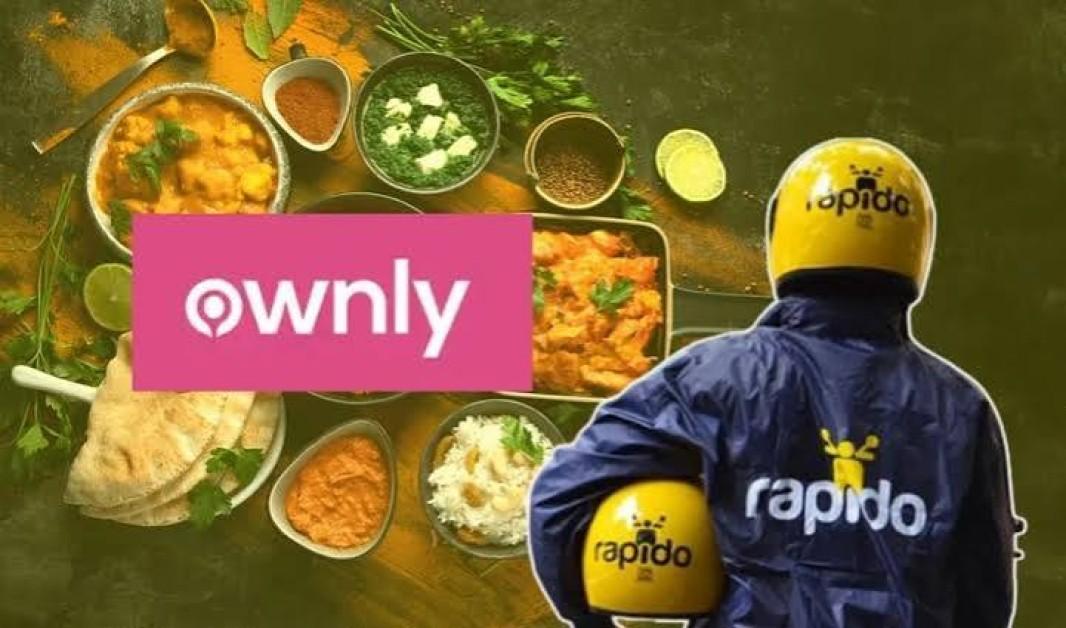
Rapido Launches Ownly Food Delivery Inside Main App With Zero Restaurant Commission Model
Rapido has integrated its food-delivery platform Ownly directly into the main Rapido app, giving users in Bengaluru access to restaurant ordering alongside bike-taxi, auto-rickshaw and cab bookings. The move significantly broadens Ownly's visibility by exposing the service to Rapido's existing mobility user base while strengthening the company's challenge to India's established food-delivery platforms. (Moneycontrol)
Ownly is differentiated by a zero-commission model for restaurant partners. Instead of taking a percentage commission from restaurant orders, the platform is designed to allow restaurants to retain the order value while using alternative monetisation mechanisms. The model is intended to address long-running concerns among restaurants about commissions and platform-related costs in online food delivery. (NewsBytes)
Ownly Moves Inside Rapido's Main Consumer App

The most important development is not the initial launch of Ownly itself, but its integration into Rapido's primary consumer platform.
Ownly previously operated as a standalone food-delivery service in Bengaluru. By placing it inside the main Rapido app, the company can potentially introduce food ordering to users who already rely on Rapido for transportation. (Tech in Asia)
The strategy could reduce one of the biggest challenges facing a new digital marketplace: customer acquisition.
Instead of building an entirely new user base from the beginning, Rapido can use its existing app traffic to promote food delivery.
Zero Commission Targets Restaurant Economics
Ownly's central proposition is its zero-commission structure for restaurants.
Traditional food-delivery marketplaces often generate revenue partly through commissions charged to restaurant partners. Ownly is attempting to change that relationship by eliminating percentage-based restaurant commissions.
The model allows participating restaurants to retain a greater share of the value generated by each order. (Business Today)
Potential advantages for restaurants include:
-
Higher retained revenue per order
-
Reduced dependence on percentage commissions
-
Greater flexibility in menu pricing
-
Lower platform-related costs
-
Improved unit economics
-
Access to digital customers
-
Greater control over online sales
-
Additional distribution reach
Whether the economics remain sustainable at scale will be one of the most important questions surrounding the model.
Rapido Builds on a Large Restaurant Network
Ownly's expansion gives Rapido access to a substantial restaurant ecosystem in Bengaluru.
Reports surrounding the integration indicate that the service has built a network of around 20,000 restaurants, providing users with a broad selection across the city. (Business Today)
Scale on the restaurant side is important because food-delivery marketplaces become more attractive to consumers when they offer sufficient variety, geographic coverage and price options.
A broader selection can also increase order frequency by making the platform relevant across breakfast, lunch, dinner, snacks and convenience occasions.
Unified App Could Lower Customer Acquisition Costs
Integrating Ownly into Rapido's main app creates strategic advantages beyond convenience.
Rapido already has consumers using its platform for mobility services. Those users can now potentially be converted into food-delivery customers without requiring them to download and regularly open a separate application.
This cross-selling strategy could help Rapido lower customer acquisition costs compared with building a standalone food marketplace entirely through advertising and discounts.
The same app can potentially support several consumer use cases:
-
Bike taxis
-
Auto-rickshaw bookings
-
Cab rides
-
Food delivery
-
Local commerce
-
Last-mile services
A broader consumer platform could increase engagement and transaction frequency.
Competition With Swiggy and Zomato Intensifies
Rapido's expansion places it more directly against established food-delivery leaders such as Swiggy and Zomato.
India's online food-delivery market has historically been dominated by these large platforms, which benefit from established restaurant relationships, extensive delivery fleets, consumer loyalty programmes and significant technology infrastructure.
Ownly is attempting to differentiate itself primarily through restaurant economics and transparent pricing rather than simply competing through scale.
The move comes as established players are also experimenting with new offerings and pricing structures amid growing competition for value-conscious consumers. (The Times of India)
Rapido's Mobility Network Could Provide an Advantage
Rapido enters food delivery with an asset that many new competitors lack: an established network of drivers and a large mobility business.
That infrastructure may create opportunities to improve delivery utilisation by matching demand across different services and periods of the day.
For example, driver capacity that is not being used for passenger rides could potentially support other delivery-related activity, subject to operational design and economics.
This creates the possibility of greater fleet utilisation across the broader Rapido ecosystem.
Restaurant Relationships Could Become a Major Differentiator
Restaurant economics have become increasingly important in the food-delivery industry.
Restaurants often balance the benefits of digital customer acquisition against commissions, advertising expenses, promotional discounts and other platform costs.
A zero-commission model could therefore become attractive to restaurants seeking to protect margins.
If Ownly can build strong restaurant relationships, the platform may gain advantages in:
-
Restaurant participation
-
Menu pricing
-
Exclusive offers
-
Product availability
-
Local restaurant discovery
-
Merchant retention
-
Customer pricing
-
Geographic expansion
However, restaurant adoption alone will not guarantee consumer scale.
Consumer Pricing Will Be Closely Watched
Ownly's proposition also depends on whether lower restaurant-side costs translate into attractive consumer prices.
The platform has promoted transparent pricing and an approach designed to avoid the menu mark-ups often associated with commission-heavy marketplace models. Reports indicate that Ownly does not charge conventional restaurant commissions and has sought to offer consumers clearer pricing. (NewsBytes)
Consumers will ultimately compare the total checkout amount across platforms, including:
-
Menu prices
-
Delivery charges
-
Platform fees
-
Taxes
-
Discounts
-
Membership benefits
-
Promotional offers
This means perceived affordability will remain an important competitive factor.
Profitability Remains the Bigger Test
Zero commission may attract restaurants, but Rapido must still build a sustainable economic model.
Food delivery carries substantial operating costs, including:
-
Delivery partner payments
-
Technology infrastructure
-
Customer support
-
Payment processing
-
Marketing
-
Discounts
-
Restaurant onboarding
-
Logistics management
Rapido therefore needs alternative revenue streams capable of covering those expenses.
Potential monetisation opportunities could include subscriptions, advertising, logistics charges and other restaurant or consumer services.
The effectiveness of this revenue model will determine whether Ownly can scale without eventually adopting higher merchant charges.
Bengaluru Serves as the Key Test Market
Ownly's current focus on Bengaluru gives Rapido an opportunity to refine the model before pursuing broader geographic expansion.
Bengaluru is one of India's largest technology and online-commerce markets, with high digital adoption and significant demand for app-based convenience services.
Success in the city could provide evidence that the model can be expanded to other major urban markets.
However, city-by-city food-delivery economics differ substantially based on restaurant density, consumer behaviour, logistics costs and competitive intensity.
Risks to Monitor
Several risks could influence Ownly's expansion:
-
High delivery costs
-
Customer acquisition expenses
-
Competitive discounting
-
Restaurant retention
-
Low order density
-
Platform monetisation challenges
-
Driver availability
-
Service reliability
-
Geographic expansion costs
-
Strong responses from established competitors
A zero-commission model may strengthen restaurant relationships, but the company must still demonstrate that it can build a profitable marketplace.
What Investors and the Industry Should Watch
The next phase of Ownly's expansion will be judged by whether integration into Rapido's main app materially increases consumer adoption.
Important indicators include:
-
Order growth
-
Active food-delivery users
-
Restaurant additions
-
Repeat-order frequency
-
Average order value
-
Delivery costs
-
Customer acquisition costs
-
Restaurant retention
-
Geographic expansion
-
Monetisation per order
The industry's response will also be important.
If Ownly gains meaningful scale, established food-delivery companies may face greater pressure to reconsider restaurant commissions, consumer fees and pricing strategies.
Outlook
Rapido's integration of Ownly into its main app marks a significant escalation of its ambitions in India's food-delivery market.
The strategy combines Rapido's existing consumer base and mobility infrastructure with a restaurant-friendly zero-commission proposition. This gives Ownly a differentiated position in a sector dominated by established platforms.
The critical question is whether Rapido can convert this differentiation into sustainable order volumes while building enough alternative revenue to cover the economics of delivery.
If the model succeeds in Bengaluru, Ownly could become a more significant challenger within India's online food-delivery market.
Conclusion
Rapido's decision to bring Ownly directly into its main app transforms the food-delivery service from a standalone experiment into a more integrated part of the company's consumer platform strategy.
The zero-commission model gives restaurants a potentially attractive alternative to conventional aggregator economics, while Rapido gains the ability to cross-sell food ordering to its existing mobility customers.
The opportunity is substantial, but so is the execution challenge. Ownly must build consumer frequency, maintain restaurant participation and prove that zero restaurant commissions can coexist with sustainable platform economics.
Its performance in Bengaluru will therefore be closely watched as a test of whether India's food-delivery market can support a fundamentally different marketplace model.
 Rapido Adds Ownly Food Delivery to Main App With Zero Commission FAQs
POST A COMMENT (0)
All Comments (0)
Replies (0)