





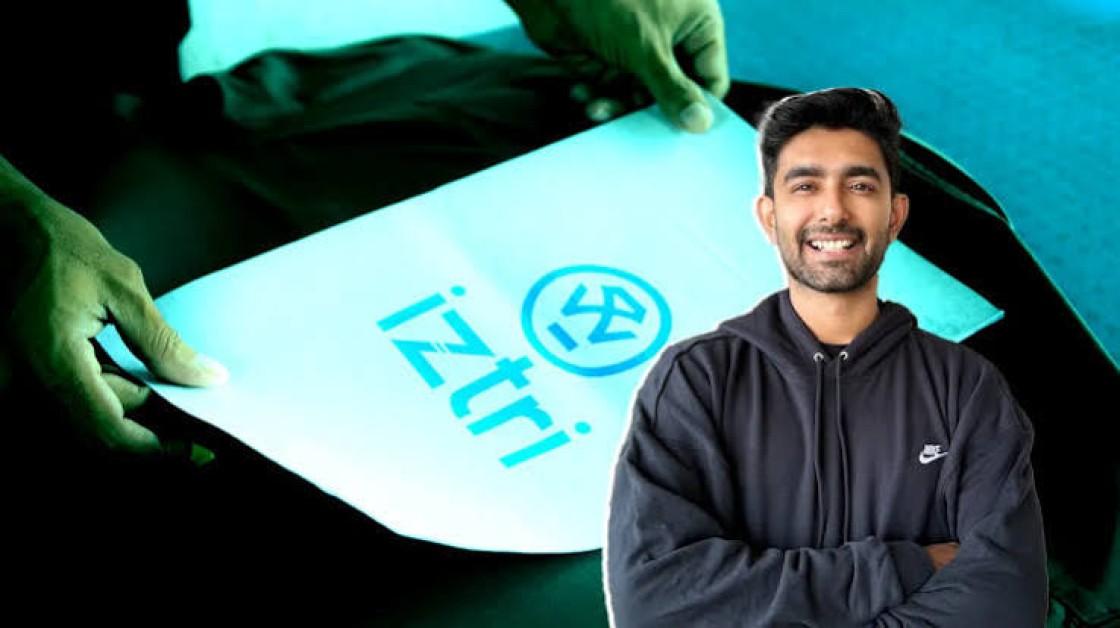
On-Demand Fabric-Care Startup Iztri Raises ₹10 Crore to Expand Operations
Bengaluru-based on-demand fabric-care startup Iztri has raised ₹10 crore in fresh funding as it looks to expand its neighbourhood hub network, add services including dry cleaning and shoe care, strengthen technology infrastructure and sharply increase its customer base.
The funding round was led by:
All In Capital
and:
Suashish Group.
It also included participation from existing and new investors, including PedalStart, the JK Tyre family office, Shadowfax co-founders Abhishek Bansal and Vaibhav Khandelwal, and several angel investors.
The latest round takes Iztri's total funding raised so far to approximately:
₹12 crore.
Founded in 2024, Iztri is attempting to organise a highly fragmented urban service category by building a managed network for everyday fabric care rather than functioning only as a marketplace connecting customers with independent providers.
The company's initial focus has been:
ironing services.
It now plans to expand into broader categories such as:
dry cleaning,
shoe care,
and other recurring fabric-care requirements.
Iztri Raises ₹10 Crore in Fresh Funding

Iztri's latest ₹10 crore funding round provides the startup with additional capital to scale a business built around frequent household service requirements.
The round was co-led by All In Capital and Suashish Group.
Participation also came from angel and strategic investors including entrepreneurs and founders from India's technology and consumer ecosystem.
The funding is relatively modest compared with large consumer-tech rounds, but the capital is significant for Iztri's current stage because the company is still focused on building density within a single city before expanding geographically.
That approach can help the company establish operating discipline before attempting rapid national expansion.
All In Capital and Suashish Group Lead the Round
All In Capital and Suashish Group emerged as the primary institutional investors in the transaction.
The investor participation reflects growing interest in businesses attempting to organise fragmented, high-frequency consumer-service categories.
Fabric care is structurally different from occasional home services.
Customers may require ironing or garment care several times each month, creating the potential for:
high repeat usage,
recurring customer relationships,
and predictable neighbourhood-level demand.
The challenge is delivering the service consistently enough for consumers to move away from informal local providers.
Angel Investors Also Participate
The round attracted participation from several prominent individual investors.
These included:
Anupam Mittal,
Kunal Shah,
Tanmay Bhat,
Gaurav Munjal,
and others.
Existing backer PedalStart also participated.
The JK Tyre family office and Shadowfax co-founders Abhishek Bansal and Vaibhav Khandelwal were among the other investors.
The mix gives Iztri access not only to financial capital but potentially to experience across:
consumer internet,
logistics,
marketplaces,
brand-building,
and startup scaling.
Those capabilities are relevant because fabric care is fundamentally an operations-heavy consumer business.
Iztri Has Now Raised About ₹12 Crore
Including the latest transaction, Iztri has raised approximately:
₹12 crore
since inception.
That indicates the company had previously raised roughly ₹2 crore before the new round.
For an early-stage service business, capital must generally be deployed carefully because growth can require continuous investment in:
hubs,
workforce,
pickup and delivery systems,
technology,
customer acquisition,
and quality control.
Iztri's model appears to be focused on creating operational density rather than simply spending aggressively to expand across many cities at once.
Startup Was Founded in 2024
Iztri was founded in:
2024
by:
Rohit Ramesh
and:
Ankit Choudhary.
Ramesh previously worked at Unilever, while Choudhary has experience at logistics company Shadowfax.
Their backgrounds bring together expertise across:
consumer businesses
and:
logistics operations.
That combination is particularly relevant for a fabric-care startup because success depends on more than garment processing alone.
The company must also manage:
collection,
sorting,
processing,
tracking,
delivery,
customer communication,
and turnaround times.
Iztri Operates an Apartment-Hub Model
Iztri has differentiated itself through an:
apartment-hub model.
Instead of relying purely on centralised facilities located far from customers, the company builds neighbourhood-level hubs close to residential demand.
These hubs can support:
garment collection,
processing coordination,
ironing,
customer handover,
and other service activities.
A dense local network can reduce travel distances and improve turnaround times.
It can also help the company serve apartment communities where a large number of potential customers are concentrated within a small geographic radius.
Bengaluru Is Currently Iztri's Only Market
Iztri is currently operational only in:
Bengaluru.
The company has deliberately concentrated on building density in its home market before entering other cities.
This can be strategically important in local-service businesses.
Expanding too early can create a fragmented network with:
low utilisation,
high logistics costs,
inconsistent service quality,
and weak unit economics.
By increasing the number of customers around existing hubs, Iztri can potentially spread fixed operating costs across a larger transaction base.
More Than 200 Workers Support the Network
Iztri currently employs more than:
200 workers
across its Bengaluru operations.
The workforce supports the company's neighbourhood hub network and service execution.
Labour management is one of the central challenges in organised fabric care.
Traditional ironing and laundry services often rely on highly decentralised workers operating independently.
An organised platform must introduce more standardised systems for:
training,
quality,
productivity,
turnaround time,
and customer service.
Iztri's model therefore requires significant operational discipline alongside technology.
Company Wants to Quadruple Customer Base
One of Iztri's most ambitious near-term goals is to increase its customer base substantially.
The startup currently serves approximately:
25,000 customers.
It is targeting more than:
100,000 customers within six months.
That would represent an increase of at least four times from its current base.
Achieving this target will require both:
new customer acquisition
and:
strong repeat usage.
For a high-frequency service business, repeat behaviour is particularly important because customer acquisition becomes expensive if users try the service once but don't return.
Existing Hubs Will Be Deepened Before Wider Expansion
A significant portion of the new funding will be used to:
deepen Iztri's existing hub network.
That means increasing density and capacity in neighbourhoods where it already operates rather than focusing exclusively on entering new cities.
Hub density can improve economics in several ways.
More customers per hub can increase:
worker productivity,
capacity utilisation,
route efficiency,
and local brand recognition.
It can also reduce the average distance required to collect or return garments.
These factors can have a meaningful impact on margins.
Technology Infrastructure Will Be Strengthened
Iztri also plans to invest in:
technology infrastructure.
Although fabric care is a physical service, technology plays an important role in creating a consistent customer experience.
A digital operating system can manage:
orders,
pickup schedules,
garment tracking,
payments,
customer communication,
workforce allocation,
turnaround times,
and hub performance.
Technology can also help identify operational bottlenecks and measure service quality across locations.
The larger Iztri's network becomes, the more important these systems will be.
Standardised Turnaround Time Is a Key Part of the Model
The startup uses backend technology to standardise:
turnaround times
and:
service execution.
This addresses one of the most common limitations of informal fabric-care services.
Customers may face uncertainty around:
when garments will be ready,
whether items will be collected on time,
how quality will vary,
or whether service standards will remain consistent.
Organised platforms can potentially differentiate themselves by making the experience more predictable.
For Iztri, predictability appears to be one of the core elements of its positioning.
Iztri Started With Ironing Services
The company's initial focus has been:
ironing.
This is a high-frequency but largely fragmented service category in urban India.
Many households still depend on local ironing providers operating without:
digital ordering,
standardised pricing,
formal tracking,
or structured customer support.
Iztri sees an opportunity to organise this segment through managed local infrastructure.
Starting with a relatively simple, frequent service can also help the company build customer relationships before introducing additional categories.
Dry Cleaning Will Expand the Service Basket
The startup now plans to expand further into:
dry cleaning.
Dry cleaning has a different customer use case from regular ironing.
It is generally used for:
formal wear,
delicate fabrics,
premium garments,
winter clothing,
and clothing requiring specialised treatment.
Adding dry cleaning can increase average revenue per customer because the service typically has a higher transaction value than basic ironing.
It can also allow Iztri to retain customers who currently use separate providers for different garment-care needs.
Shoe Care Is Another Planned Category
Iztri will also expand into:
shoe care.
This broadens the company's positioning from garment ironing toward a wider personal-item maintenance platform.
Shoe-care services can include:
cleaning,
restoration,
polishing,
stain removal,
and minor repairs.
Premium sneakers and footwear have become increasingly important consumer categories in urban India.
As customers spend more on footwear, professional maintenance services can become more relevant.
The move also helps Iztri increase the number of services that can be delivered through its existing customer relationships.
Broader Fabric Care Could Increase Customer Lifetime Value
Expanding the service basket can improve:
customer lifetime value.
A customer who uses Iztri only for ironing may generate a relatively small ticket size per transaction.
The same customer could potentially also purchase:
dry cleaning,
shoe cleaning,
repairs,
and other specialised services.
This increases revenue without requiring the company to acquire an entirely new customer.
Cross-selling can therefore become an important part of Iztri's economics.
Fabric Care Is a High-Frequency Urban Service
Iztri is targeting a category characterised by unusually frequent demand.
Urban households continuously generate clothing that needs:
washing,
ironing,
dry cleaning,
repair,
or specialised care.
Unlike discretionary services used only occasionally, garment care forms part of recurring household expenditure.
That can create attractive business economics if the service provider develops:
trust
and:
habit.
A customer who becomes comfortable with a fabric-care service may continue using it for years.
The Category Remains Highly Unorganised
Despite its frequency, fabric care remains fragmented across India.
Services are provided through:
independent ironing workers,
local laundries,
neighbourhood dry cleaners,
domestic staff,
and small unorganised businesses.
This structure gives consumers considerable choice but can also result in inconsistent:
pricing,
service quality,
delivery times,
and complaint resolution.
Iztri's opportunity lies in introducing more standardisation without allowing costs to become too high compared with informal alternatives.
Iztri Is Building Infrastructure Rather Than Just Aggregating Providers
A key part of Iztri's model is that it isn't positioning itself purely as a technology marketplace.
Instead of simply listing existing fabric-care vendors and passing customer orders to them, the company is building:
its own operating infrastructure.
That includes:
managed neighbourhood hubs,
trained staff,
technology systems,
and standardised processes.
This gives Iztri more control over customer experience.
It also makes the business more operationally complex.
A marketplace may scale more quickly, but a managed model can potentially offer greater consistency if executed well.
Operational Control Could Improve Quality
Quality consistency is particularly important in garment care because mistakes can permanently damage customer property.
Problems can include:
burn marks,
stains,
colour damage,
missing garments,
incorrect folding,
or delayed delivery.
A managed network gives Iztri greater ability to establish:
training,
quality checks,
process standards,
and accountability.
That control could help build trust.
However, maintaining consistent quality becomes harder as the network expands.
Expansion Across Southern India Is Planned
Over the next:
two to three years,
Iztri plans to expand across:
southern India.
The company hasn't indicated an immediate nationwide rollout.
A regional strategy can make operational expansion easier because nearby cities may share:
consumer behaviour,
supply-chain links,
management resources,
and geographic proximity.
Possible future southern markets could include large urban centres where apartment living and professional household services are increasingly common.
The company has not yet publicly detailed a city-by-city rollout schedule.
Top Metro Cities Could Follow Later
After establishing a wider southern India footprint, Iztri plans to expand into:
major metropolitan markets.
Large metros offer substantial demand but also introduce higher:
customer acquisition costs,
wages,
rent,
competition,
and operating complexity.
A stronger base in Bengaluru and southern India could allow Iztri to enter those markets with a more mature operating playbook.
The company can test and refine its systems before attempting a broader national expansion.
Apartment Communities Provide Concentrated Demand
Iztri's hub model is particularly suited to large apartment communities.
A single residential development can contain:
hundreds
or even:
thousands of households.
This concentration can improve unit economics.
Instead of collecting garments from customers spread across a wide geographic area, the company can serve many households within the same location or neighbourhood.
That reduces:
travel time,
logistics cost,
and operating complexity.
Density is therefore one of the most important variables in the business.
Convenience Could Drive Adoption
Urban consumers increasingly pay for services that reduce household workload.
This has supported businesses across:
food delivery,
home cleaning,
beauty services,
repairs,
and quick commerce.
Fabric care fits into the same broader shift.
For working households, the value proposition isn't necessarily only lower pricing.
It can also include:
convenience,
predictability,
digital payments,
doorstep service,
and transparent tracking.
If Iztri can deliver these consistently, consumers may be willing to move away from informal alternatives.
Pricing Will Remain a Major Competitive Challenge
The largest structural challenge is likely to be:
price sensitivity.
Traditional ironing and laundry services can be inexpensive because they operate with:
low overheads,
minimal technology costs,
and informal labour structures.
An organised startup has additional expenses including:
technology,
management,
customer support,
marketing,
quality assurance,
and investor expectations.
Iztri must therefore create enough additional convenience and reliability to justify its cost structure without pricing itself too far above local alternatives.
Unit Economics Will Determine Long-Term Scalability
Customer growth alone won't determine whether Iztri becomes a sustainable business.
The more important measures will include:
revenue per customer,
repeat rate,
orders per hub,
worker productivity,
logistics costs,
customer acquisition cost,
and contribution margin.
A neighbourhood hub becomes more attractive economically as more customers use it frequently.
Low-density hubs, however, can become expensive.
This is why the company's decision to deepen its Bengaluru network before expanding aggressively could prove important.
Workforce Productivity Is Critical
The fabric-care business also has a substantial human component.
Automation can manage:
ordering,
tracking,
routing,
and communication,
but physical garment processing still requires workers.
Iztri therefore needs to improve productivity without compromising:
quality.
Training and standardised operating procedures can help workers process more orders consistently.
As the company scales, workforce retention and supervision could become major operational considerations.
Funding Reflects Investor Interest in Offline-Heavy Consumer Startups
Iztri's funding also reflects a broader change in India's startup ecosystem.
Not every emerging consumer startup is based purely on:
software
or:
online marketplaces.
Investors are increasingly evaluating businesses that combine technology with:
physical infrastructure,
local operations,
and recurring services.
These models can be harder to scale than pure software businesses but can also build defensibility through:
local networks,
operational expertise,
and customer trust.
Iztri fits within this category.
Home Services Are Becoming More Organised
India's home-services economy has gradually moved toward organised platforms.
Consumers now commonly use digital services for:
beauty treatments,
home repairs,
cleaning,
appliance servicing,
and other household needs.
Fabric care remains less organised than many of these categories.
That creates an opportunity, but it also raises the question of whether consumer behaviour can be changed at scale.
Users already have established relationships with local providers.
Iztri will need to offer a sufficiently better experience to encourage switching.
Success Depends on Creating Habit
The company's strongest potential advantage would be becoming part of a customer's recurring household routine.
If a user repeatedly sends clothes to the same Iztri hub every week, the service can become:
habitual.
Habit reduces the need for repeated marketing expenditure.
It also improves revenue predictability.
This is why frequent-use categories can become attractive despite relatively modest ticket sizes.
High repeat rates can compensate for lower revenue per transaction.
Latest Funding Will Test Iztri's Ability to Scale Density
The ₹10 crore round gives Iztri enough capital to test whether its Bengaluru model can scale significantly.
The immediate objective of moving from:
25,000 customers
to more than:
100,000
within six months will provide an important measure of demand.
If the company can increase customer density while maintaining service quality and improving hub utilisation, it will strengthen the case for expansion into new cities.
If operations become more difficult as volumes increase, management may need to refine the model before moving beyond Bengaluru.
Conclusion
Iztri's ₹10 crore funding round marks an important step in the Bengaluru startup's effort to organise India's fragmented fabric-care market through a managed, neighbourhood-based service network.
The round, led by All In Capital and Suashish Group, takes Iztri's total funding to approximately ₹12 crore and will be used to deepen its hub network, strengthen technology and operations and expand into services including dry cleaning and shoe care.
The company currently employs more than 200 workers in Bengaluru and serves approximately 25,000 customers, with a target of exceeding 100,000 customers within the next six months.
Over the longer term, Iztri plans to expand across southern India before entering major metro markets.
Its opportunity lies in transforming a frequent but highly unorganised household service into a more predictable, technology-enabled experience. The central challenge will be maintaining quality, affordability and efficient unit economics as the company moves from a dense Bengaluru network toward a much larger regional operation.
 Related News
POST A COMMENT (0)
All Comments (0)
Replies (0)