





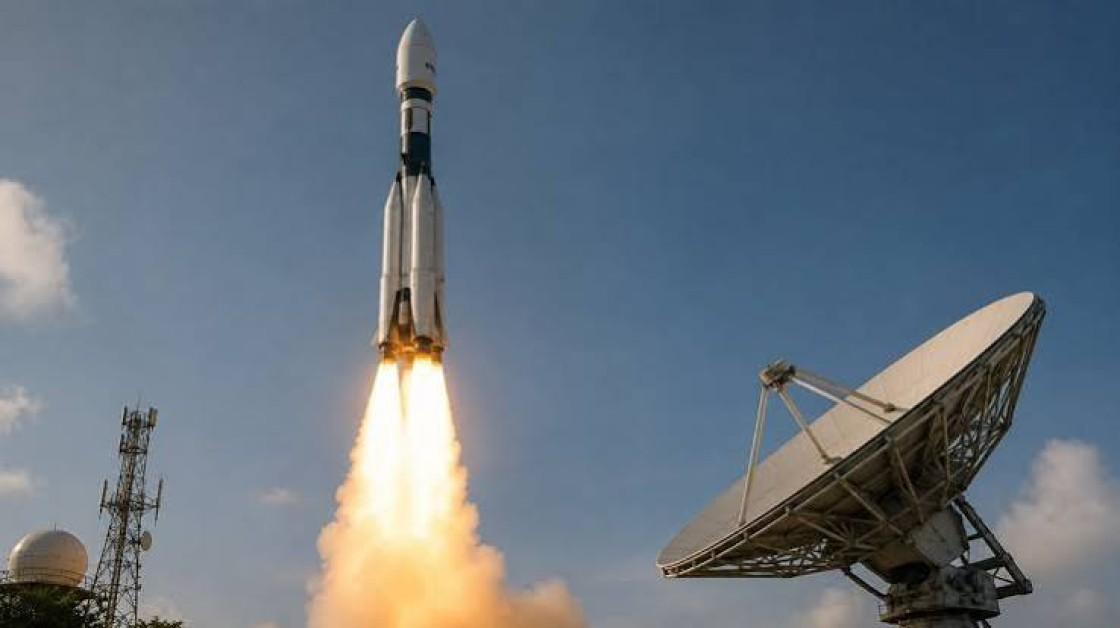
India’s Space Startup Count Reaches Around 440 as Private Investment Climbs Six-Fold to $618 Million
India's private space ecosystem has expanded dramatically following reforms that opened the industry to greater commercial participation, with the number of space startups now reaching roughly 440 and cumulative private investment crossing $618.5 million by March 31, 2026. Private funding has increased nearly six-fold from $100.5 million in 2021-22, while investment of about $187 million has been reported during 2026 alone. The growth highlights India's transition from a predominantly government-led space programme toward a broader commercial ecosystem involving startups, established companies, investors and public institutions.
India’s Space Startup Ecosystem Expands Rapidly

The growth in startup numbers represents one of the clearest outcomes of India's efforts to develop a private commercial space industry.
Startup Count Rises to Around 440
India now has roughly 440 startups operating across different areas of the space economy, compared with only a handful of private ventures before the sector was opened more extensively to commercial participation.
These companies operate across satellite manufacturing, launch systems, propulsion, geospatial intelligence, earth observation, communications, space components and downstream data services.
The diversity of businesses is important.
A sustainable space economy cannot depend entirely on rocket manufacturers or satellite operators.
It requires suppliers producing specialised components, software companies processing satellite information, ground infrastructure providers and businesses converting space-derived data into commercial services.
The expanding startup base indicates that this wider ecosystem is beginning to develop.
Reforms Created Space for Private Companies
India's 2020 space-sector reforms marked an important structural change.
Private companies gained a clearer pathway to participate in activities that had historically been dominated by government institutions.
The establishment of the Indian National Space Promotion and Authorization Centre, or IN-SPACe, created a dedicated interface for regulating and facilitating private-sector space activities.
The Indian Space Policy 2023 subsequently provided greater clarity regarding the roles of government agencies and private companies.
These reforms have given entrepreneurs and investors greater confidence to build businesses around space technologies.
Private Space Investment Crosses $618 Million
Capital flowing into the sector has increased alongside startup activity.
Investment Climbs Nearly Six-Fold
Cumulative private investment in India's space sector reached approximately $618.5 million by March 31, 2026.
That compares with around $100.5 million in 2021-22.
Investment had already increased to approximately $348.5 million by 2023-24 before continuing higher.
The expansion represents nearly a six-fold increase within a relatively short period.
Around $187 million of private investment has also been reported during 2026, demonstrating continued investor appetite for Indian space businesses.
The figures are significant because space technology is generally capital intensive and can require long development periods before generating substantial commercial revenue.
Investors Are Funding Different Space Businesses
Capital is flowing into companies operating at different layers of the space value chain.
Launch startups need financing to develop rocket engines, test infrastructure and manufacturing systems.
Satellite companies require capital for spacecraft design and production.
Earth-observation businesses need satellite infrastructure as well as data-processing platforms.
Component manufacturers need specialised factories and testing equipment.
This diversity can help create a more resilient industry because investment is not concentrated entirely in one technological category.
IN-SPACe Becomes Central to Private Space Expansion
Regulatory infrastructure is becoming increasingly important as the number of companies grows.
More Than 100 Authorisations Granted
IN-SPACe had granted 105 authorisations to non-government entities as of July 14, 2026.
These approvals cover different categories of private space activity.
The authorisation framework provides companies with a formal mechanism for undertaking activities involving satellites, launch systems and other space operations.
This is particularly important because space is not an ordinary commercial industry.
Launches, orbital operations, spectrum, remote sensing and national-security considerations require regulatory oversight.
A predictable approval framework allows companies to plan investments while ensuring strategic interests remain protected.
National Security Remains Important
Rapid commercialisation creates new regulatory responsibilities.
Space infrastructure can have both civilian and strategic applications.
High-resolution earth-observation satellites, for example, can provide valuable information for agriculture and disaster management while also producing sensitive geographic data.
The government is consequently strengthening safety and security guidelines for private space activities.
The objective is to support commercial expansion without compromising national-security requirements.
This balance will become increasingly important as private companies operate more advanced satellites and launch systems.
ISRO Remains Foundation of India’s Space Ecosystem
Private-sector growth does not diminish the importance of India's national space agency.
Decades of ISRO Investment Created Technical Base
India's commercial space opportunity has been built on decades of scientific and engineering capability developed through the Indian Space Research Organisation.
ISRO established expertise in rockets, satellites, remote sensing, navigation and deep-space missions.
It also created specialised testing facilities and a large network of suppliers.
Private companies can build upon this foundation.
Engineers trained within India's space ecosystem can move into entrepreneurial roles.
Suppliers that historically served government programmes can expand toward commercial customers.
Infrastructure developed for national missions can also support private projects under appropriate frameworks.
Private Companies Can Commercialise Technologies
ISRO's primary responsibilities extend beyond commercial markets.
It undertakes scientific missions, strategic programmes and national-development projects that private companies may not pursue independently.
Startups can concentrate more directly on commercial opportunities.
This creates a complementary structure.
Government institutions can focus on frontier research and national capabilities while private companies develop products and services for domestic and international customers.
Over time, this division could allow India's overall space activity to expand without requiring government budgets to finance every commercial project.
Launch Startups Become Visible Part of SpaceTech Growth
Rocket companies have attracted considerable attention within India's private space ecosystem.
Private Launch Vehicles Target Small Satellites
The rapid growth of small satellites has created demand for dedicated launch services.
Traditional rockets often carry many satellites simultaneously.
Smaller launch vehicles can potentially provide customers with greater control over launch schedules and orbital destinations.
Indian startups are developing vehicles specifically for this market.
Companies such as Skyroot Aerospace and Agnikul Cosmos have emerged as prominent participants in India's private launch industry.
Their progress demonstrates that Indian startups are attempting to build technologies once developed almost exclusively by national space agencies.
Launch Economics Remain Challenging
Building rockets is extremely capital intensive.
Companies need propulsion systems, manufacturing facilities, testing infrastructure and specialised engineering teams.
Failures can destroy expensive hardware.
Commercial launch businesses therefore require significant financing before reaching sustainable scale.
Indian startups must also compete internationally with established launch providers.
Cost, reliability and launch frequency will ultimately determine whether domestic companies can capture meaningful global market share.
Satellite Manufacturing Creates Another Major Opportunity
Not every space company needs to build rockets.
Smaller Satellites Lower Entry Barriers
Traditional satellites could weigh several tonnes and cost hundreds of millions of dollars.
Advances in electronics and miniaturisation have enabled much smaller spacecraft to perform commercially valuable missions.
Startups can therefore build satellites with significantly lower capital requirements.
Small satellites can provide earth observation, communications and scientific services.
Constellations consisting of many spacecraft can also provide frequent coverage of specific locations.
This creates opportunities for Indian manufacturers to serve both domestic and international customers.
Commercial Earth Observation Gains Momentum
India is also moving toward privately operated earth-observation infrastructure.
Private companies can use satellite imagery to provide information to agriculture, insurance, infrastructure, mining, logistics and environmental-monitoring customers.
Instead of selling satellite images alone, companies increasingly convert raw data into business intelligence.
A farmer may want information about crop health.
An insurer may need flood-damage assessment.
An infrastructure company may want to monitor construction progress.
These applications can create recurring commercial revenue from space-based assets.
Satellite Data Could Become Bigger Business Than Hardware
The economic value of space technology increasingly extends downstream.
Geospatial Intelligence Serves Multiple Industries
Satellites continuously generate enormous quantities of information about the Earth.
The commercial challenge is converting that data into useful decisions.
Artificial intelligence and cloud computing can analyse imagery at scale.
Software can identify changes in vegetation, buildings, roads or industrial activity.
This creates opportunities for companies combining space data with analytics.
Such businesses can potentially achieve higher margins than pure hardware manufacturing because software can be sold repeatedly without manufacturing a new satellite for every customer.
Agriculture Could Become Major Indian Use Case
India's enormous agricultural economy creates a particularly relevant domestic market.
Satellite imagery can help monitor crop conditions.
Governments can estimate acreage.
Insurance companies can assess weather-related damage.
Agricultural businesses can monitor supply conditions.
These applications demonstrate why the commercial space economy is not limited to aerospace companies.
Space infrastructure can become an information layer supporting traditional industries.
Space Components Could Become Manufacturing Opportunity
India's manufacturing capabilities could help the country participate in global space supply chains.
Satellites Require Specialised Components
Spacecraft need sensors, electronics, propulsion systems, solar panels, structures and communications equipment.
These components must operate reliably under extreme conditions.
Radiation, vacuum and large temperature variations make space hardware considerably more demanding than ordinary electronics.
Companies capable of meeting these standards can become suppliers to satellite manufacturers globally.
India's established engineering base provides a foundation for developing such capabilities.
Electronics Manufacturing Can Support Space Sector
India is simultaneously expanding domestic semiconductor and electronics manufacturing.
A stronger electronics ecosystem can support space companies by improving access to components and manufacturing expertise.
However, space-grade hardware requires much higher reliability than consumer electronics.
Specialised testing and certification capabilities will therefore need to grow alongside production.
Building these capabilities could allow India to capture more value from each satellite rather than importing critical components.
Foreign Investment Policy Supports Capital Formation
Space-sector expansion requires large amounts of long-term financing.
FDI Rules Have Been Liberalised
India has relaxed foreign direct investment rules for different segments of the space industry.
The framework permits varying levels of foreign investment under the automatic route depending on the activity.
Satellite manufacturing and operations, components and launch-related activities are treated according to their strategic sensitivity.
The objective is to attract international capital and technology while maintaining appropriate oversight.
For startups, access to global investors can be particularly important because India's domestic venture-capital market for deep technology remains relatively young.
Global Capital Can Accelerate Scale
International investors can provide more than financing.
They can connect startups with overseas customers.
Strategic investors can provide manufacturing knowledge and technology partnerships.
Global venture funds can help companies prepare for international expansion.
However, space remains strategically sensitive.
India therefore needs to balance openness to capital with safeguards covering ownership, technology and data.
The increasing level of investment suggests investors are becoming more comfortable with the emerging regulatory structure.
Commercial Revenue Is the Next Major Test
Startup numbers and funding demonstrate ecosystem growth, but sustainable businesses ultimately need paying customers.
Funding Cannot Replace Commercial Demand
Space companies can spend years developing technology before generating significant revenue.
During this period, venture capital finances research, testing and employee costs.
Eventually, companies need commercial contracts.
Customers may include governments, telecommunications operators, agricultural companies, defence organisations and international satellite businesses.
Startups capable of converting technology demonstrations into repeatable commercial revenue will be more likely to survive.
The next stage of India's space startup ecosystem will therefore be measured increasingly by sales rather than startup registrations.
Government Can Serve as Anchor Customer
Governments are major customers for space services globally.
Defence, weather forecasting, navigation, disaster management and earth observation all require satellite infrastructure.
Indian government agencies can potentially provide anchor contracts to domestic startups.
Such contracts give companies revenue while helping them establish performance records.
Once a technology has demonstrated reliability with a government customer, winning international commercial contracts can become easier.
Procurement reform could therefore be as important as venture funding for the industry's long-term development.
India Wants Larger Share of Global Space Economy
The expansion of private companies forms part of a broader national economic objective.
Global Space Market Continues to Expand
The commercial space economy includes satellite communications, navigation, earth observation, launch services, manufacturing and downstream applications.
Demand is expanding as satellites become integrated into everyday economic infrastructure.
Navigation supports transportation and smartphones.
Weather satellites support agriculture and disaster management.
Communications satellites connect remote areas.
Earth-observation systems provide data to governments and companies.
Capturing even a modestly larger share of these markets could create substantial opportunities for Indian companies.
Cost Advantage Could Support International Expansion
India has historically demonstrated an ability to execute complex space missions at comparatively competitive costs.
Private companies hope to extend this advantage into commercial markets.
Engineering salaries and manufacturing costs can be lower than in several established space economies.
However, low cost alone will not be sufficient.
International customers require reliability, insurance compatibility and consistent delivery.
Indian companies will need to demonstrate that cost advantages do not compromise mission success.
Space Startups Can Create High-Skill Employment
The industry's expansion has implications beyond investment and revenue.
Engineering Talent Finds New Opportunities
Historically, Indian engineers interested in space had relatively limited domestic career options outside government institutions and established aerospace companies.
Private startups have changed this landscape.
Engineers can now work on propulsion, satellite design, robotics, geospatial analytics and space software within entrepreneurial companies.
This can help retain specialised talent in India.
It can also encourage students to pursue aerospace and related engineering disciplines.
Startup Ecosystem Encourages Entrepreneurship
Engineers with experience in established institutions can increasingly create their own businesses.
Successful exits or public listings could eventually recycle capital and talent into newer startups.
This process has helped build technology ecosystems in industries such as software and e-commerce.
India's space sector remains much younger, but the growing startup count suggests the foundations of a similar entrepreneurial cycle are developing.
Funding Growth Also Creates Valuation Risks
Rapid investment can generate challenges alongside opportunities.
Capital-Intensive Startups Face Founder Dilution
Space businesses frequently need multiple funding rounds before reaching commercial scale.
Each equity financing can reduce founders' ownership percentages.
Recent analysis of India's most-funded space technology startups indicates that founder ownership has already become significantly diluted at several companies.
This reflects the capital-intensive nature of the industry.
Founders need enough financing to complete expensive development programmes while retaining sufficient incentives and strategic influence.
Investors Need Longer Time Horizons
Space technology generally cannot be evaluated like consumer internet startups.
Rocket engines and satellites require years of engineering.
Testing cycles are long.
Regulatory approvals can take time.
Commercial customers demand extensive reliability evidence.
Investors therefore need patience.
Funds expecting rapid exits may be poorly matched with the sector.
Specialised deep-tech capital and strategic investors could become increasingly important as companies move from prototypes toward full commercial deployment.
Regulation Will Become More Complex as Industry Grows
Hundreds of companies operating in space create regulatory challenges that did not exist when the sector was dominated by government agencies.
Orbital Safety Requires Coordination
More satellites increase the risk of congestion and collisions.
Operators need systems for tracking spacecraft.
End-of-life disposal becomes important.
Companies also need procedures for responding to potential conjunctions with other satellites.
India will need regulatory frameworks aligned with international space-sustainability practices as domestic constellations grow.
Security and Commercial Growth Need Balance
Some space technologies have dual-use applications.
High-resolution imaging can support commercial agriculture while also revealing strategically sensitive information.
Satellite communications can serve civilian users but also have security implications.
Regulators therefore need to enable commercial innovation without weakening national safeguards.
IN-SPACe's evolving safety and security framework will become increasingly important as private activity scales.
India Could Develop SpaceTech Unicorns
The increase in investment creates the possibility of much larger private companies emerging from the ecosystem.
Global Markets Provide Scale
India alone may not provide enough demand to support every space startup.
International customers therefore become essential.
Launch companies can serve foreign satellite operators.
Component manufacturers can join global supply chains.
Geospatial businesses can sell analytics internationally.
Companies capable of winning global customers can expand far beyond the limits of the domestic market.
This creates the potential for Indian space startups to develop into substantial multinational technology companies.
Consolidation Is Also Likely
Not all 440 startups will survive independently.
Space technology requires substantial capital and technical expertise.
Some companies may fail.
Others could merge or be acquired by larger businesses.
Consolidation is normal as emerging industries mature.
The eventual strength of India's space economy will depend less on the absolute number of startups than on whether the ecosystem produces commercially sustainable companies with globally competitive technology.
Conclusion
India's space startup ecosystem reaching around 440 companies while cumulative private investment climbs to approximately $618.5 million demonstrates how rapidly the country's commercial space industry has evolved since sector reforms accelerated private participation.
Funding has increased nearly six-fold from about $100.5 million in 2021-22, while IN-SPACe had granted 105 authorisations to non-government entities by mid-July 2026. Private companies are now developing launch vehicles, satellites, components, earth-observation systems and data-driven services that complement India's established government space capabilities.
The next phase will be more demanding. Startups must convert investment and technology demonstrations into sustainable commercial revenue while regulators balance innovation with national security and orbital safety.
If India can combine its engineering talent, cost advantages, ISRO-developed technical foundation and expanding private capital base with stronger global commercial execution, its emerging space companies could become increasingly important participants in the international space economy.
 India Space Startups Reach 440 as Investment Tops $618 Million FAQs
POST A COMMENT (0)
All Comments (0)
Replies (0)