





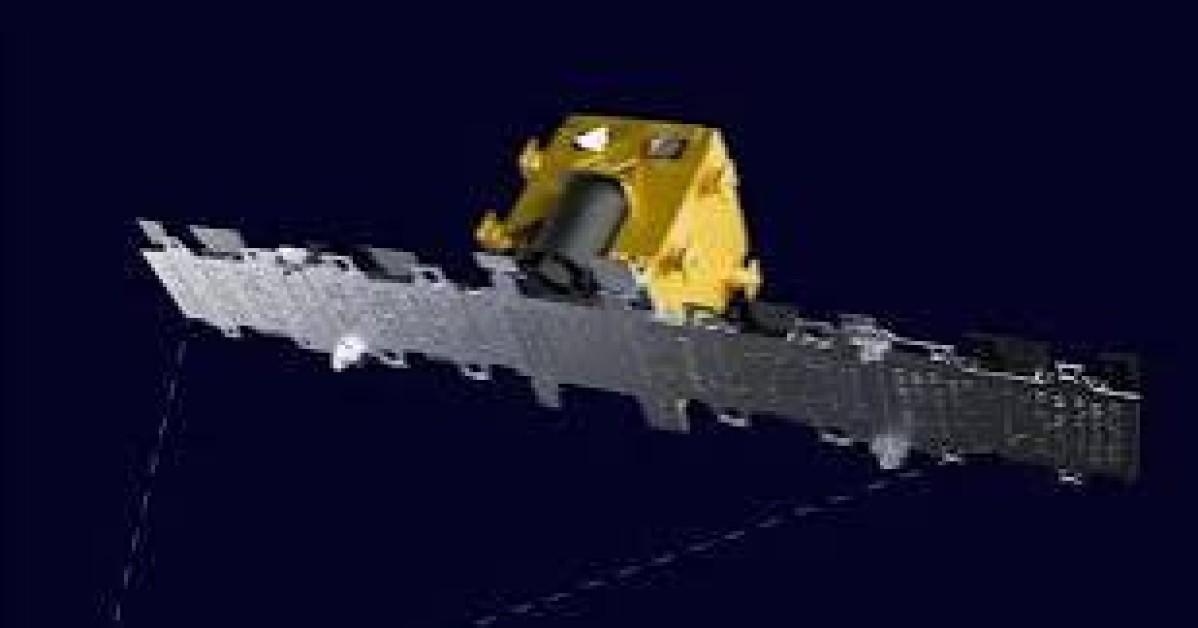
GalaxEye Secures US Patent for Synchronised Multi-Sensor Satellite-Imaging Technology
Indian space technology startup GalaxEye has secured a United States patent for the core architecture behind its OptoSAR imaging system, strengthening the company's intellectual-property position as it develops satellite technology capable of synchronising optical and radar observations of the same location.
The patented system is designed to align and synchronise:
optical sensors
and:
microwave radar sensors
so they can collect spatially and temporally matched observations simultaneously.
The approach addresses a longstanding challenge in Earth observation.
Optical satellites can provide rich visual and spectral information, but their performance can be limited by:
cloud cover,
weather,
and darkness.
Synthetic Aperture Radar, or SAR, can operate:
during the day,
at night,
and through cloud cover,
but produces a fundamentally different type of image.
Traditionally, data from these technologies may be collected by separate satellites or at different times and later combined through post-processing.
GalaxEye's patented architecture instead seeks to synchronise both forms of sensing at the system level.
The company believes this can create more consistent and actionable Earth-observation intelligence for applications ranging from defence and agriculture to disaster response and insurance.
US Patent Covers GalaxEye's Core OptoSAR Architecture

The patent protects the architecture and system GalaxEye developed for:
aligning and synchronising optical and microwave sensors.
The objective is to ensure that both systems observe the same geographical area at substantially the same time and with corresponding spatial alignment.
This is important because conventional multi-sensor Earth observation can suffer from:
temporal gaps,
different viewing geometries,
changing weather conditions,
and spatial misalignment.
If one satellite captures an optical image in the morning while another captures radar data hours or days later, conditions on the ground may have changed.
That can reduce the usefulness of combining the two datasets.
Synchronised acquisition can potentially overcome some of these problems.
GalaxEye Calls Its Technology OptoSAR
GalaxEye refers to its approach as:
OptoSAR.
The name reflects the combination of:
optical imaging
and:
Synthetic Aperture Radar.
Optical imaging provides information similar in principle to photography, although satellite sensors can capture multiple spectral bands beyond ordinary visible-light images.
SAR operates differently.
It actively transmits microwave signals toward the Earth and measures the returned signals.
Because radar doesn't depend on sunlight, SAR can operate:
at night.
Microwave wavelengths can also penetrate many cloud formations, allowing radar satellites to collect data during weather conditions that restrict optical imaging.
Synchronisation Can Produce More Correlated Data
The key value of GalaxEye's architecture lies not simply in having two sensor types on the same satellite.
It lies in:
coordinating their observations.
When optical and radar data are captured at the same time and from the same platform, analysts can potentially compare:
visual information,
spectral characteristics,
surface structure,
moisture,
movement,
and other radar-derived attributes
without worrying that the underlying scene changed significantly between observations.
This can make the resulting dataset more useful for applications requiring:
rapid decisions
and:
high-confidence interpretation.
Patent Strengthens GalaxEye's Intellectual-Property Position
The US patent gives GalaxEye another layer of protection around its core technology.
The same foundational technology has already received:
patent protection in India.
Securing rights in the United States is strategically important because the US is one of the world's most significant markets for:
satellite services,
defence technology,
geospatial intelligence,
remote sensing,
and commercial Earth-observation data.
For an Indian deep-tech startup seeking international customers, intellectual-property protection in major markets can support:
commercial negotiations,
technology partnerships,
fundraising,
and competitive positioning.
GalaxEye Says Patent Is a First for an Indian Startup
GalaxEye has described itself as the:
first Indian startup to receive a US patent specifically for satellite imaging technology.
The claim highlights the company's effort to position itself as an original technology developer rather than simply an integrator of existing satellite components.
That distinction matters in deep technology.
Companies with proprietary architectures and defensible intellectual property can potentially capture more value than businesses relying primarily on:
commodity hardware
or:
third-party technology.
Patent protection can also become important as competition within commercial Earth observation increases globally.
Earth Observation Is Becoming a Major Commercial Market
The patent arrives as demand for satellite-derived Earth intelligence expands across multiple industries.
Commercial satellite imagery is used for applications including:
agriculture,
defence,
insurance,
infrastructure monitoring,
natural-resource management,
maritime tracking,
disaster response,
and environmental observation.
The global commercial satellite-imaging market was valued at approximately:
$6.55 billion in 2024.
Industry projections cited around the patent announcement indicate that the market could exceed:
$20 billion by 2033.
That potential growth is attracting new private companies developing:
higher-resolution sensors,
more frequent revisit times,
specialised imaging technologies,
and AI-driven analytics.
Defence Could Be a Major Use Case
Defence and national security are among the most important potential markets for all-weather satellite imaging.
Military and security organisations need reliable information regardless of:
time of day
or:
weather conditions.
Optical imagery alone can be restricted when clouds obscure the ground.
Radar can provide continuity in those situations.
Synchronising the two can potentially help analysts evaluate:
infrastructure,
vehicles,
terrain changes,
maritime activity,
and other areas of interest
using complementary datasets from the same observation period.
This creates potential relevance for both domestic and international defence customers.
Agriculture Can Benefit From Combined Imaging
Agriculture is another important application.
Optical satellite imagery can help evaluate:
crop health,
vegetation characteristics,
and land cover.
SAR can provide information related to:
soil moisture,
surface conditions,
and crop structure
even when persistent clouds restrict visual observations.
This is especially useful during:
monsoon seasons,
when cloud cover can make conventional optical imagery difficult to obtain.
Synchronised imagery could therefore improve agricultural monitoring across regions where weather frequently limits satellite visibility.
Insurance Companies Can Use Earth-Observation Data
The insurance industry increasingly uses satellite information to:
evaluate risk,
verify claims,
monitor disasters,
and assess property or agricultural damage.
Following events such as:
floods,
cyclones,
wildfires,
or severe storms,
insurers need timely and reliable information.
Cloud cover often persists during and immediately after major weather events.
Radar imaging can therefore be particularly valuable.
Combining radar with optical information when conditions permit can provide a richer picture for:
damage assessment
and:
claims analysis.
Disaster Response Requires Rapid Imaging
Emergency-response agencies also need timely Earth-observation data.
During floods or cyclones, authorities may need to identify:
inundated regions,
damaged infrastructure,
blocked transport routes,
or isolated communities.
Waiting for clear skies can delay situational awareness.
SAR can provide observations despite clouds and darkness.
A synchronised optical-radar system can potentially improve the consistency of data available before, during and after an emergency.
This is one reason all-weather Earth observation is becoming increasingly important for governments and disaster-management agencies.
Maritime Intelligence Is Another Target Market
GalaxEye expects its planned satellite network to support:
maritime intelligence.
Radar technology is particularly valuable over oceans because it can detect:
ships,
surface patterns,
and other maritime activity
over large geographic areas.
Optical imagery can add:
visual confirmation
and:
additional contextual information.
Synchronised sensing could therefore help users monitor:
shipping,
coastal infrastructure,
ports,
offshore assets,
and maritime security.
GalaxEye Plans a 30-Satellite Constellation
The company intends to expand beyond individual satellite missions.
GalaxEye plans to develop a:
30-satellite constellation over the next five years.
A constellation can dramatically increase the commercial usefulness of Earth-observation technology.
A single satellite revisits a given location only when its orbit brings it back over the area.
Multiple satellites reduce the time between observations.
That creates higher:
revisit frequency.
Customers increasingly value frequent observations because many commercial applications depend not only on image quality but also on:
how quickly new data can be obtained.
More Satellites Could Create Recurring Data Revenue
The economics of Earth observation increasingly resemble a data-services business.
Rather than selling only satellites or hardware, operators can generate recurring revenue by selling:
imagery,
analytics,
subscriptions,
tasking services,
and intelligence products.
A 30-satellite constellation could allow GalaxEye to serve customers repeatedly rather than relying on one-time technology contracts.
Potential customers include:
governments,
defence organisations,
agricultural companies,
insurers,
infrastructure operators,
maritime businesses,
and geospatial-data firms.
The larger the constellation becomes, the more frequently the company can potentially observe high-priority locations.
GalaxEye Has Raised Around $21 Million
GalaxEye has raised approximately:
$21 million
in funding so far.
Developing commercial satellite technology requires substantial capital.
Costs extend across:
research and development,
sensor development,
satellite manufacturing,
testing,
launch services,
ground infrastructure,
data processing,
and commercial operations.
Building a full constellation requires even greater investment.
The company's intellectual-property portfolio can therefore become important when raising additional capital to finance future satellites.
GalaxEye Was Founded by IIT Madras Engineers
GalaxEye emerged from India's growing university-linked deep-tech ecosystem.
The company was founded by engineers from:
IIT Madras.
Its founders originally worked together on a student team that competed in the:
SpaceX Hyperloop competition.
The company subsequently shifted toward space technology and Earth observation.
GalaxEye is headquartered in Bengaluru and has become part of India's expanding private-space ecosystem alongside companies developing:
rockets,
satellites,
propulsion systems,
Earth-observation platforms,
and space-data services.
StarOps Acquisition Strengthens Satellite Manufacturing
GalaxEye has also been building more of its satellite capabilities internally.
In August 2026, the company acquired Bengaluru-based:
StarOps.
The spacecraft-engineering company's capabilities can support GalaxEye in areas including:
satellite manufacturing,
systems engineering,
integration,
and mission development.
Bringing more engineering capability in-house can become increasingly important as GalaxEye moves from:
individual technology demonstrations
toward:
a multi-satellite commercial constellation.
A company planning dozens of satellites needs repeatable manufacturing and integration processes rather than treating every spacecraft as a one-off engineering project.
Mission Drishti Took OptoSAR Technology to Space
GalaxEye's OptoSAR architecture is closely associated with:
Mission Drishti.
The company's first satellite was launched on:
May 3, 2026.
The approximately:
190-kilogram spacecraft
combined multispectral optical imaging and Synthetic Aperture Radar on one satellite platform.
The mission represented an important attempt to demonstrate the underlying OptoSAR concept in orbit.
However, subsequent reporting indicated that the satellite mission did not ultimately achieve its intended operational outcome.
That makes the new US patent important from a different perspective: the intellectual property protects the underlying technology architecture even as GalaxEye continues working toward future operational deployments.
Space Technology Requires Iterative Development
Satellite development is inherently difficult.
Spacecraft must survive:
launch vibration,
vacuum,
radiation,
temperature extremes,
power limitations,
and communication constraints.
A technology may perform successfully in terrestrial testing but face unexpected problems once deployed in orbit.
Commercial space companies therefore often develop capabilities through multiple missions.
Failures can be costly, but they also generate engineering data that can influence the next satellite generation.
GalaxEye's planned constellation will ultimately depend not only on patents but also on its ability to convert the architecture into:
reliable,
repeatable,
commercially operable spacecraft.
India’s Private Space Sector Is Expanding Rapidly
GalaxEye's patent comes during a major expansion of India's private space industry.
Policy reforms have opened more parts of the space economy to:
private investment
and:
commercial participation.
Indian startups are now developing businesses across:
launch services,
satellite manufacturing,
Earth observation,
space situational awareness,
propulsion,
communications,
and downstream analytics.
More than:
400 private space companies
were active in India's ecosystem by 2026.
This represents a substantial transformation from a sector that was historically dominated by government institutions.
India Targets a $44 Billion Space Economy
India has set an ambition to significantly expand its share of the global commercial space market.
The country's commercial space economy is targeted to reach approximately:
$44 billion within the decade.
Private companies are expected to play a major role in reaching that objective.
Earth observation is particularly attractive because satellite imagery can be sold repeatedly across industries.
Unlike some areas of the space economy, commercial imaging has a direct link to terrestrial business problems.
Customers aren't purchasing space technology simply because it operates in orbit.
They are paying for information that can improve decisions on Earth.
Competition in Indian Earth Observation Is Increasing
GalaxEye is not alone in targeting the Earth-observation opportunity.
India is building a growing group of commercial satellite companies specialising in different sensing technologies.
Competitors and adjacent players are developing capabilities across:
hyperspectral imaging,
radar imaging,
maritime observation,
geospatial analytics,
and multi-sensor intelligence.
A private consortium led by Pixxel, alongside companies including Dhruva Space, SatSure and PierSight, is also developing a national Earth-observation constellation.
Increasing competition means technology differentiation will become increasingly important.
GalaxEye's patent provides one mechanism for protecting its distinct approach.
Proprietary Technology Can Improve Global Competitiveness
India has historically built world-class space capabilities through:
ISRO
and other government institutions.
The emerging private-space ecosystem introduces a different commercial objective.
Startups must create technology that can compete for:
international customers,
global contracts,
and private capital.
Proprietary intellectual property becomes important in that environment.
A startup with a globally protected technology platform may have stronger negotiating power when dealing with:
customers,
strategic partners,
investors,
and potential acquirers.
The US patent therefore has significance beyond legal protection alone.
Patent Does Not Guarantee Commercial Success
While the patent strengthens GalaxEye's competitive position, intellectual property alone doesn't determine business success.
The company must still demonstrate:
reliable satellite operations,
competitive image quality,
sufficient revisit frequency,
customer demand,
data-processing capability,
and sustainable economics.
Earth-observation businesses also require extensive ground infrastructure and software.
Raw images frequently need to be transformed into:
usable insights.
This means commercial success increasingly depends on combining:
space hardware
with:
data analytics and software.
GalaxEye Needs to Scale From Technology to Operations
The next stage of GalaxEye's development will therefore be less about proving the concept intellectually and more about:
scaling it operationally.
Building 30 satellites requires:
manufacturing discipline,
supply-chain management,
launch access,
capital,
ground infrastructure,
and customer contracts.
The StarOps acquisition addresses part of this challenge by strengthening internal satellite-engineering capability.
The company's funding and commercial pipeline will determine how quickly the planned constellation can be deployed.
Conclusion
GalaxEye's US patent for its synchronised optical-and-radar satellite imaging architecture represents an important intellectual-property milestone for one of India's emerging private space companies.
The patented OptoSAR technology is designed to align optical and microwave sensors so they can collect spatially and temporally matched observations of the same location, combining the visual and spectral strengths of optical imagery with SAR's ability to operate through clouds and darkness.
The technology has potential applications across defence, agriculture, insurance, disaster response, infrastructure and maritime intelligence, markets where consistent and timely Earth-observation data is increasingly valuable.
GalaxEye has raised around $21 million and plans to build a 30-satellite constellation over the next five years, while its recent acquisition of StarOps strengthens its in-house satellite-engineering capabilities.
The US patent gives the startup stronger protection for the architecture behind that strategy. The larger challenge will now be converting proprietary technology into a reliable, scalable satellite network capable of competing for customers in the rapidly expanding global Earth-observation market.
 Related News
POST A COMMENT (0)
All Comments (0)
Replies (0)