





Airbound Raises $37 Million Series A and Expands Andhra Pradesh Drone-Delivery Network Plan
Bengaluru-based aerospace startup Airbound has raised $37 million in Series A funding led by Greenoaks, giving the autonomous-aircraft company fresh capital to expand engineering, manufacturing and commercial deployment as it works toward large-scale drone logistics in India.
The funding round also included participation from DoorDash, Lachy Groom, Lightspeed and Humba Ventures, taking Airbound's total capital raised since its 2023 launch to nearly $50 million. (TechCrunch)
Alongside the fundraising announcement, Airbound highlighted its agreement with the Andhra Pradesh Drone Corporation to develop a large-scale aerial delivery network across the Amaravati Capital Region. The programme is targeting operations across Guntur, Amaravati and Vijayawada, eventually scaling toward 10,000 autonomous flights per day for healthcare, retail and e-commerce deliveries. (Business Standard)
The combination of new venture funding and a real-world state deployment gives Airbound an opportunity to test whether autonomous drones can move beyond limited pilots and become part of India's mainstream logistics infrastructure.
Greenoaks Leads $37 Million Series A

The latest financing was led by investment firm Greenoaks.
New and existing investors participating in the round include:
DoorDash,
Lachy Groom,
Lightspeed,
and Humba Ventures.
The investment follows an $8.65 million seed round raised less than a year earlier and brings Airbound's total funding to nearly $50 million. (TechCrunch)
For a company founded only in 2023, the capital provides substantial resources for moving from engineering development toward commercial-scale operations.
Airbound Will Invest in Engineering and Manufacturing
Airbound plans to use the Series A funding to accelerate three major areas:
engineering,
commercial-scale manufacturing,
and go-to-market operations.
This represents an important transition for the company.
Building a prototype aircraft proves that a technology can fly.
Building thousands of reliable aircraft capable of operating repeatedly in commercial logistics networks is a fundamentally different challenge.
Airbound now needs to industrialise its technology.
DoorDash Joins Airbound Funding Round
The participation of DoorDash is particularly notable because the company operates one of the world's major last-mile delivery platforms.
DoorDash participated through its technology ecosystem as it explores autonomous delivery technologies.
For Airbound, having a major delivery company as an investor potentially provides more than capital.
It creates exposure to the operational economics of high-volume last-mile delivery.
Airbound Wants Flying to Compete With Trucking
Airbound's central engineering objective is ambitious.
The startup wants autonomous aircraft to move individual packages at costs that can eventually compete with road transportation.
Traditional aviation has an obvious disadvantage.
Aircraft need substantial energy simply to lift themselves.
If an aircraft weighs hundreds of kilograms while carrying only a small payload, transporting that payload becomes expensive.
Airbound is attempting to change that ratio.
Company Is Building Extremely Lightweight Aircraft
Airbound's current aircraft, known as TRT, weighs roughly 3.3 pounds, or about 1.5 kilograms, while carrying approximately 2.2 pounds of payload.
Its next version is expected to weigh around 6.6 pounds while carrying up to approximately 11 pounds of cargo. (TechCrunch)
The objective is to eventually build aircraft where the payload represents a much greater proportion of the total flying mass.
Lower mass means lower energy consumption.
And lower energy consumption can reduce delivery cost.
Airbound Uses Tail-Sitter Aircraft Architecture
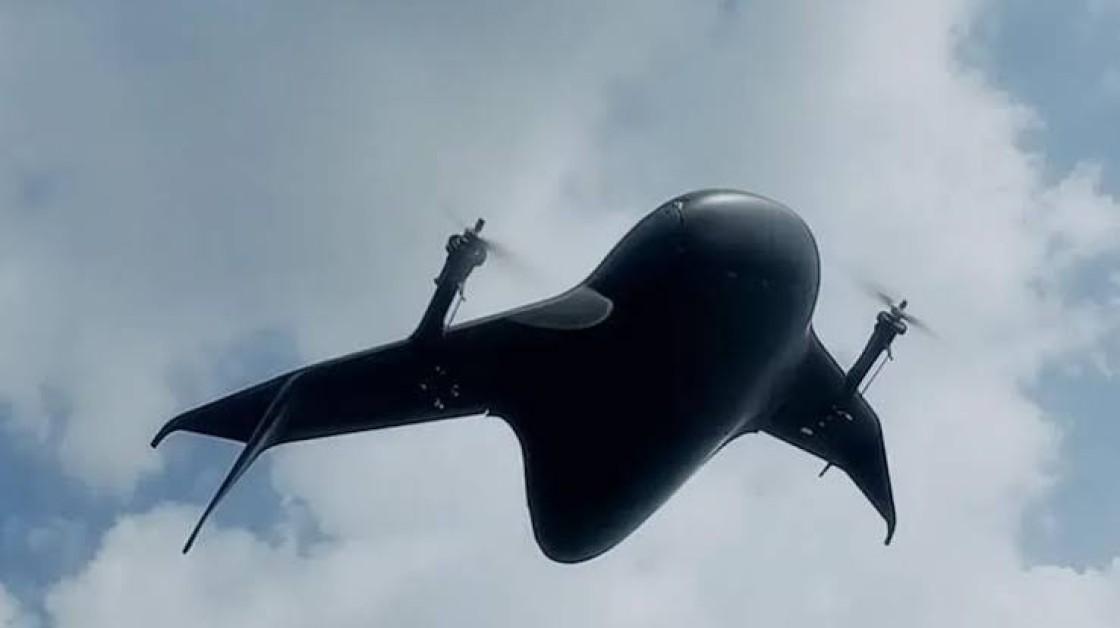
The company's aircraft use an unusual tail-sitter design.
The drone takes off vertically while standing upright.
Once airborne, it transitions into horizontal forward flight.
When it reaches its destination, it can return to vertical orientation for landing.
This architecture attempts to combine two advantages.
Vertical takeoff eliminates the need for a runway.
Fixed-wing-style forward flight can provide greater efficiency over distance than conventional multirotor drones.
Vertical Takeoff Is Critical for Urban Delivery
A logistics aircraft designed for cities cannot depend on conventional airports.
Packages need to move between locations such as:
hospitals,
distribution facilities,
and neighbourhood delivery points.
Vertical takeoff and landing makes it possible to operate from much smaller spaces.
That flexibility is essential if drone logistics is ever going to become a large-scale urban transportation system.
Andhra Pradesh Network Is Major Commercial Test
Airbound's most ambitious near-term deployment is being developed with the Andhra Pradesh Drone Corporation.
The original MoU was signed in June 2026 and covers the development of a scalable drone-delivery network across the Amaravati Capital Region. (Business Standard)
The network is planned around:
Guntur, Amaravati and Vijayawada.
The eventual target is approximately:
10,000 flights every day.
That would represent a dramatically different scale from conventional drone-delivery trials.
Network Is Expected to Begin From Guntur
The deployment is expected to begin around Guntur before expanding toward Amaravati and Vijayawada.
The three-city structure is important because it moves drone delivery beyond point-to-point demonstration flights.
A true logistics network needs multiple origins and destinations.
Packages need to move between different facilities according to changing demand.
That requires far more sophisticated infrastructure than operating a single drone route.
10,000 Daily Flights Would Require Large Fleet
Airbound founder and CEO Naman Pushp estimates that the eventual network could require roughly 250 to 1,000 aircraft, depending on route lengths and utilisation.
He expects the actual requirement to be closer to the lower end of that range. (TechCrunch)
Even 250 continuously operating autonomous aircraft would represent a major operational test.
Fleet management becomes critical at this scale.
Network Will Serve Multiple Industries
The Andhra Pradesh programme is intended to support deliveries across:
healthcare,
retail,
and e-commerce.
This diversification matters because different categories have different logistics requirements.
Medical samples prioritise speed and reliability.
E-commerce focuses heavily on cost.
Retail deliveries can involve high-frequency consumer demand.
A successful network needs to handle all three efficiently.
Healthcare Is Airbound's Existing Commercial Test Case
Airbound has already demonstrated its technology in healthcare logistics.
The company has worked with Narayana Health to transport diagnostic samples between healthcare facilities.
Airbound says it has completed more than 1,000 autonomous flights with Narayana Health without mission failures, reducing sample transportation times from hours to minutes. (Business Standard)
Healthcare provides a compelling early use case because delivery speed can have immediate operational value.
Diagnostic Samples Can Spend Hours on Roads
Airbound's existing Narayana route moves diagnostic samples approximately 2.5 miles in about seven minutes.
The same samples can take three to five hours to move by road when the time required to accumulate enough samples for conventional transport is included. (TechCrunch)
The advantage therefore comes from more than simply flying faster than a vehicle.
Small autonomous aircraft can eliminate the need to wait until enough cargo exists to justify dispatching a driver.
Autonomous Delivery Changes Logistics Economics
Traditional logistics depends heavily on consolidation.
A truck is expensive to operate.
Companies therefore try to fill it with many packages.
That creates:
sorting centres,
delivery hubs,
scheduled departures,
and complex routing systems.
The economics encourage companies to bundle shipments together.
Airbound is betting that extremely lightweight autonomous aircraft can make individual shipment movement economically viable.
Drone Networks Could Reduce Dependence on Hubs
If moving one package becomes inexpensive enough, some shipments may no longer need to travel through several distribution centres.
A package could potentially fly more directly between origin and destination.
That could reduce:
sorting,
handling,
and intermediate transportation.
The result would resemble a distributed logistics network rather than the hub-and-spoke model dominant today.
Quick Commerce Creates Particularly Difficult Benchmark
India has become one of the world's most demanding markets for ultra-fast consumer delivery.
Quick-commerce platforms have conditioned urban customers to expect products within minutes.
Pushp has described India's benchmark as roughly 10-minute delivery at extremely low cost. (Business Standard)
That makes India an unusually demanding environment for drone logistics.
A system capable of competing economically with Indian quick commerce could potentially have applications in many international markets.
Airbound Wants to Become Aircraft Supplier, Not Just Delivery Operator
Airbound's long-term strategy goes beyond building its own delivery network.
Pushp has compared the company's intended role to Boeing rather than an airline.
The ambition is to build aircraft that logistics operators around the world could eventually use. (TechCrunch)
That distinction could fundamentally change Airbound's business model.
Instead of competing with every logistics company, it could eventually supply aircraft and technology to them.
Manufacturing Is Based in Bengaluru
Airbound designs and manufactures its aircraft at a roughly 43,000-square-foot facility in Bengaluru.
Core work on the airframe and other systems remains in-house. (TechCrunch)
Domestic engineering and manufacturing gives Airbound greater control over:
aircraft design,
production,
testing,
and future iterations.
That is particularly important for a company attempting to redesign aircraft economics from first principles.
Regulation Remains Biggest Scaling Challenge
Airbound's technology may be developing quickly, but regulation remains a major constraint.
Large autonomous delivery networks require drones to travel beyond the direct visual range of human operators.
That requires Beyond Visual Line of Sight, or BVLOS, operations.
Pushp has identified regulatory approvals around BVLOS operations as a more significant scaling bottleneck than manufacturing. (TechCrunch)
Without scalable BVLOS approval, thousands of autonomous daily flights would be extremely difficult to operate economically.
Andhra Pradesh Government Can Help Create Regulatory Environment
The Andhra Pradesh agreement is important partly because the state government can help coordinate the environment required for deployment.
The agreement is not simply a conventional government procurement contract.
Airbound expects to generate commercial business from companies using the network, while the state works with the startup around the regulatory and operating framework necessary to enable deployment. (TechCrunch)
This makes the project closer to infrastructure collaboration than a straightforward government purchase.
Drone Traffic Management Will Become Essential
Ten thousand daily flights cannot operate safely without sophisticated coordination.
A large aerial network needs systems capable of managing:
flight routes,
airspace conflicts,
weather,
and emergency situations.
Traditional aviation relies heavily on air-traffic control.
Autonomous drone networks will require increasingly automated equivalents designed for much larger numbers of small aircraft.
Weather Creates Operational Challenges
Drones are more sensitive to weather than conventional ground vehicles.
Conditions such as:
strong winds,
heavy rain,
and thunderstorms
can affect flight operations.
A commercial logistics network therefore needs to maintain reliability even when some routes become temporarily unavailable.
Weather forecasting and dynamic routing will become important parts of the operating system.
Battery Economics Matter
Electric aircraft depend heavily on battery performance.
Energy density determines how much cargo a drone can carry and how far it can travel.
Battery weight can quickly eliminate the efficiency advantages of lightweight aircraft.
Airbound's engineering challenge therefore extends beyond aerodynamics.
Battery technology, motors, electronics and materials all influence operating economics.
Lightweight Materials Can Improve Efficiency
Every gram removed from an aircraft reduces the energy needed to keep it airborne.
This creates strong incentives to use lightweight materials and highly optimised structural designs.
But reducing weight cannot compromise:
strength,
durability,
or safety.
Commercial aircraft need to survive thousands of repeated flight cycles.
The engineering challenge is therefore balancing extreme weight reduction with operational reliability.
Autonomous Systems Can Reduce Labour Costs
Human pilots would make small-package drone delivery economically difficult.
Autonomy changes the equation.
A single operations team can potentially supervise large numbers of aircraft.
As fleet size increases, labour cost per delivery can decline.
This scalability is one reason autonomous flight is central to Airbound's business model.
Safety Will Determine Public Acceptance
Aerial logistics cannot scale on economics alone.
Aircraft will eventually operate over populated areas.
That means reliability requirements need to be extremely high.
A commercial system must account for failures involving:
motors,
communications,
navigation,
and batteries.
Redundant systems and safe emergency behaviour will therefore be essential.
Drone Noise Could Become Another Constraint
Thousands of flights per day also create environmental considerations.
Conventional multirotor drones can produce noticeable noise.
A dense network could therefore face community resistance if aircraft are disruptive.
Airbound's aircraft design will need to optimise not only energy consumption but also acoustic performance.
E-Commerce Could Become Major Market
Once drone economics improve, e-commerce represents an enormous potential market.
Many online orders involve small packages that do not require trucks from a payload perspective.
They use trucks because road logistics currently offers the lowest scalable cost.
If autonomous aircraft approach comparable economics, some deliveries could shift into the air.
Retail Delivery Offers Similar Opportunity
Retail goods frequently move over relatively short urban distances.
Traffic congestion can make road delivery slow and unpredictable.
Aircraft can travel more directly.
That could be particularly valuable for:
urgent purchases,
small consumer goods,
and high-value items.
However, landing and handoff infrastructure remains an important challenge.
Healthcare May Scale Faster Than Consumer Delivery
Medical logistics can justify higher delivery costs because speed often carries greater value.
Examples include:
blood,
diagnostic samples,
and urgent medical supplies.
That makes healthcare a logical early market while aircraft economics continue improving.
Airbound's Narayana Health partnership demonstrates this strategy.
Series A Capital Gives Airbound More Runway
Deeptech companies typically require substantially more capital than conventional software startups.
Airbound must fund:
aircraft engineering,
manufacturing facilities,
flight testing,
regulatory work,
and commercial deployment.
The $37 million Series A therefore provides financial capacity for a capital-intensive development phase.
Deeptech Funding in India Is Expanding
Airbound's financing also arrives during growing investor interest in Indian deeptech companies.
Investors are increasingly funding businesses developing proprietary technology across:
aerospace,
robotics,
and advanced manufacturing.
These companies can take longer to commercialise than software startups, but successful technologies can create significant intellectual-property advantages.
Airbound Remains Early in Commercialisation
Despite thousands of autonomous test and operational flights, Airbound remains at an early stage financially.
The company is still broadly pre-revenue while employing more than 150 people, according to TechCrunch. (TechCrunch)
That makes the next stage particularly important.
The company now needs to demonstrate that technical performance can translate into sustainable commercial economics.
Andhra Pradesh Network Will Test Unit Economics
The 10,000-flight target is important because scale exposes the real economics of autonomous delivery.
Investors will eventually need evidence around:
cost per flight,
energy consumption,
aircraft utilisation,
maintenance,
and delivery reliability.
A technology can work technically while still failing commercially.
The Andhra Pradesh deployment can help answer that question.
Commercial Manufacturing Is Another Major Test
Building a few advanced aircraft differs dramatically from producing hundreds or thousands.
Manufacturing scale requires:
repeatable processes,
supplier networks,
quality control,
and production automation.
Airbound's new capital will help develop these capabilities.
The ability to manufacture reliably could ultimately become as important as the aircraft design itself.
DoorDash Investment Adds Strategic Validation
DoorDash's participation provides an important strategic signal.
A global delivery platform has direct experience with the economics of moving millions of orders.
Its interest suggests autonomous aircraft are increasingly being evaluated as a potential component of future last-mile infrastructure.
However, an investment does not guarantee a commercial deployment between the two companies.
India Could Become Testing Ground for Global Drone Logistics
India combines several characteristics that make it a demanding drone-delivery market:
dense cities,
rapid e-commerce growth,
quick-commerce expectations,
and price-sensitive consumers.
Successfully operating at scale under these conditions would provide valuable evidence that the technology can work elsewhere.
Airbound explicitly views India as a proving ground for its broader ambitions. (Business Standard)
Long-Term Vision Extends to Passenger Transport
Airbound's ambitions eventually extend beyond packages.
The company believes the same fundamental approach to lightweight autonomous flight could ultimately support:
freight,
and passenger transportation.
It has described a future where a journey of roughly 300 kilometres could potentially be completed in around 20 minutes. (IoT Tech News)
That remains a long-term vision rather than an operational capability today.
Cargo Is More Practical Starting Point
Moving packages is substantially easier than transporting people.
Cargo aircraft do not need passenger cabins.
They can be smaller.
Certification requirements can also differ significantly.
Starting with logistics therefore allows Airbound to develop:
autonomy,
manufacturing,
and operating experience
before attempting more complex transportation applications.
Conclusion
Airbound's $37 million Series A funding round represents a major capital injection for one of India's emerging autonomous-aircraft companies as it moves from technology development toward commercial-scale drone logistics.
The round was led by Greenoaks, with participation from DoorDash, Lachy Groom, Lightspeed and Humba Ventures, taking the Bengaluru startup's total funding since 2023 to nearly $50 million. (TechCrunch)
The company plans to deploy the capital across engineering, commercial manufacturing and go-to-market expansion.
Its most important near-term test will be Andhra Pradesh.
Through its agreement with the Andhra Pradesh Drone Corporation, Airbound plans to develop a network across Guntur, Amaravati and Vijayawada, with an eventual target of 10,000 autonomous flights per day supporting healthcare, retail and e-commerce deliveries. (Business Standard)
Airbound has already demonstrated a practical healthcare use case through more than 1,000 autonomous flights with Narayana Health. The next challenge is far larger: proving that lightweight autonomous aircraft can operate reliably, safely and cheaply enough to compete with established road logistics.
If the Andhra Pradesh network reaches meaningful scale, it could become an important test of whether drone delivery can evolve from isolated pilots into genuine transportation infrastructure.
For Airbound, the $37 million financing therefore funds more than additional aircraft. It finances an attempt to answer one of the biggest unanswered questions in autonomous logistics: can moving individual packages through the air eventually become as economically practical as moving them by road?
 Airbound Raises $37 Million Series A to Scale Autonomous Drone Delivery Network FAQs
POST A COMMENT (0)
All Comments (0)
Replies (0)