




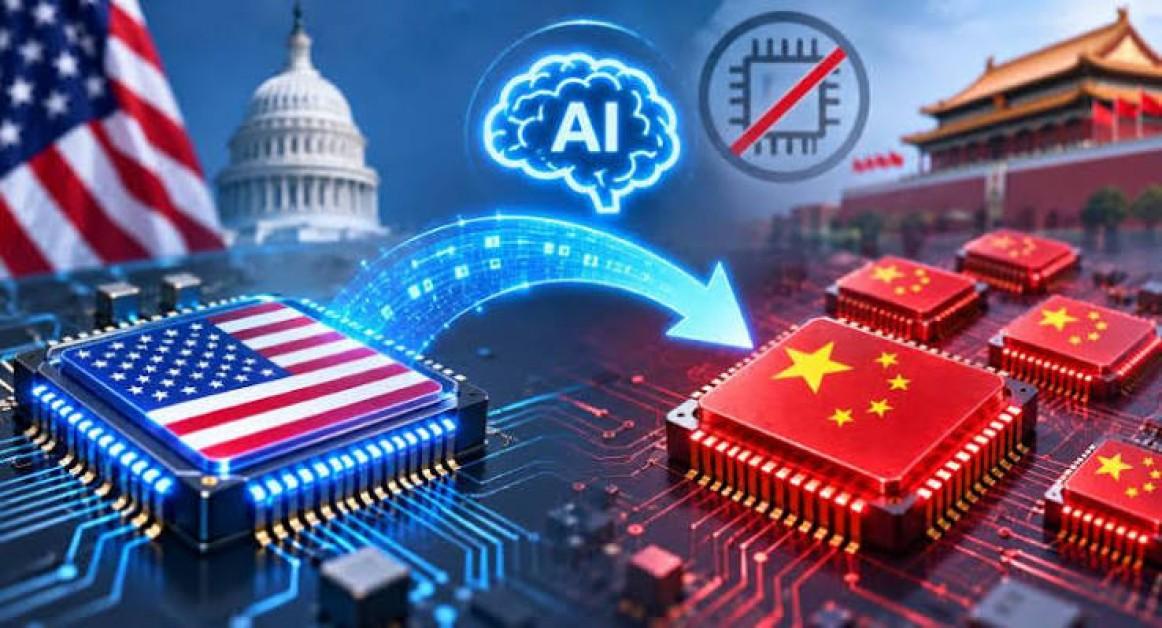
Chinese AI Companies Increasingly Use American Models to Develop Domestic Rivals
Chinese artificial intelligence developers are increasingly using outputs generated by leading American AI models to train domestic systems, adopting techniques that help reduce development costs and partially offset restrictions on access to advanced US semiconductors.
A review of more than 300 Chinese academic papers, patents, corporate disclosures, recruitment notices and government documents, reported on November 17, 2026, reveals that the practice has expanded from academic research into commercial AI development.
The technique, known as AI model distillation, involves using responses generated by a powerful existing model to train another system.
Chinese researchers and companies have used American AI models to generate answers, programming code, multilingual training material and solutions to complex reasoning problems.
These outputs can subsequently be incorporated into training datasets for smaller Chinese-developed models.
The approach has attracted attention because the United States has restricted China's access to advanced AI chips, including certain high-performance processors produced by Nvidia.
By using existing models to generate high-quality training examples, Chinese developers can improve selected capabilities without independently reproducing every computationally expensive stage of development.
However, the practice has also intensified disagreements between Washington and Beijing over intellectual property, commercial competition and the boundaries of acceptable AI development.
Key Developments in China's Use of American AI Models

|
Indicator |
Details |
|---|---|
|
Main development |
Chinese developers using US model outputs for domestic AI training |
|
Technique |
AI model distillation |
|
Research reviewed |
More than 300 documents |
|
Major American models referenced |
OpenAI GPT-4, GPT-4o and o1 |
|
Chinese AI systems involved |
Alibaba Qwen and other domestic models |
|
Research institutions |
Shanghai Jiao Tong University and others |
|
Commercial participants |
Alibaba and Meituan researchers |
|
Primary motivation |
Lower training costs and improve model capabilities |
|
Major constraint |
Limited access to advanced AI semiconductors |
|
US regulatory development |
Additional chip and overseas computing restrictions |
|
Principal controversy |
Intellectual property and model-provider terms |
|
Broader policy objective in China |
Affordable AI deployment across manufacturing |
The findings demonstrate how the competition between American and Chinese AI developers increasingly extends beyond semiconductor manufacturing into access to training data and existing AI capabilities.
What Is AI Model Distillation and Why Is China Using It?
AI model distillation is a machine-learning technique in which a powerful model, often described as the teacher, produces outputs that help train another model, known as the student.
The student model learns from examples generated by the teacher rather than relying exclusively on human-created training material.
For example, a sophisticated AI system may solve a programming problem and provide an explanation of its approach.
Developers can then use that example to train another system to solve similar problems.
The method can also be applied to language translation, mathematical reasoning, question answering and software development.
Distillation is widely used in AI research internationally and is not inherently illegal.
Its attraction lies in the ability to transfer selected capabilities into smaller systems that may require fewer resources to operate.
For Chinese developers, the technique has become particularly relevant because access to high-performance computing infrastructure is constrained by US export controls.
However, distillation cannot reproduce every capability of a leading model or eliminate the need for substantial computing power.
Its effectiveness depends on the quality of training examples, the design of the student model and the resources available for further training.
Reuters Review Reveals Widespread Adoption Across Chinese AI Research
The November 17 investigation examined more than 300 documents covering academic research, corporate development and government policy.
The findings indicate that Chinese researchers have developed increasingly systematic methods for generating and processing training material from American AI systems.
Rather than using foreign models only for occasional research experiments, some developers have created workflows to collect, evaluate and refine model-generated outputs.
These workflows may involve automated prompting, response filtering, quality assessment and subsequent training.
Specialised workers can also prepare generated material for incorporation into training datasets.
The resulting datasets may help domestic models develop particular skills more efficiently.
The documents show that the technique has been applied to multilingual tasks, complex reasoning and coordination between AI agents.
The findings do not establish that every major Chinese AI model relies on American-generated training data.
They do, however, demonstrate that distillation has become an important component of the country's broader AI development ecosystem.
Shanghai Jiao Tong University Used OpenAI Models to Improve Qwen
One example emerged from research published by Shanghai Jiao Tong University in November 2024.
Researchers selected approximately 5,000 answers generated by OpenAI's o1 reasoning model.
They subsequently used GPT-4o mini to translate and process the material.
The project produced approximately 10,750 bilingual training examples.
These examples were used to further train Alibaba's Qwen2.5-72B model.
The research demonstrated how outputs from an advanced American model could become reusable training material for another AI system.
The process allowed researchers to incorporate examples of complex reasoning into a domestic model.
However, the researchers also acknowledged potential limitations.
They cautioned that excessive dependence on model distillation could discourage original innovation.
If developers consistently rely on capabilities generated elsewhere, they may become dependent on advances made by competing research organisations.
The study therefore illustrates both the commercial attraction and strategic risks of using foreign models for domestic AI development.
Alibaba Researchers Used GPT-4 and GPT-4o for Multilingual Training
Alibaba researchers described another approach in an April 2025 research paper.
The project used OpenAI's GPT-4 and GPT-4o models to generate training material in languages other than Chinese.
Researchers subsequently refined and evaluated the responses before using them to train smaller Qwen models.
Multilingual capability is important for AI companies seeking international customers.
Models that perform well across different languages can support applications involving translation, customer service, document analysis and software development.
Developing high-quality multilingual datasets can be expensive.
Some languages have fewer publicly available training resources than English.
Using powerful existing models to generate examples offers one way to expand training material.
However, the quality of the resulting system depends on the reliability of the generated data and the methods used to evaluate it.
The research demonstrates how distillation can support international expansion by improving capabilities beyond a model's original language strengths.
Meituan Researchers Used American AI to Train Agent Coordination
A February 2026 research paper involving Shanghai Jiao Tong University and Chinese technology company Meituan described another application.
Researchers used GPT-4o to generate plans for coordinating AI agents working together on programming problems.
AI agents are software systems designed to carry out tasks, sometimes involving multiple steps or interactions with other systems.
Coordinating several agents can require planning, task allocation and evaluation of intermediate results.
The researchers used generated examples to help train a smaller model to organise such activities.
This approach differs from simply teaching a model to answer individual questions.
It focuses on developing the ability to manage sequences of actions and coordinate specialised tasks.
Such capabilities are relevant to software development, industrial automation and enterprise technology applications.
The research also shows how model-generated training data can be used to develop specialised AI systems without reproducing every capability of the original model.
US Semiconductor Restrictions Increase China's AI Development Costs
The growing use of distillation is closely connected to restrictions on China's access to advanced semiconductors.
Training large AI models requires substantial computing capacity.
High-performance graphics processing units are widely used because they can perform the parallel calculations required for machine learning.
American companies, particularly Nvidia, supply many of the advanced processors used in AI development.
The United States has imposed export controls on certain high-performance chips and related technologies.
Washington argues that the restrictions are necessary to address national security concerns and prevent advanced computing capabilities from supporting sensitive military or intelligence applications.
China has criticised the restrictions, arguing that they interfere with legitimate technological and economic development.
The controls have complicated access to some of the most capable processors available internationally.
Chinese developers have consequently explored alternative strategies, including domestic semiconductor development, more efficient algorithms and overseas computing arrangements.
AI distillation is another approach within this broader response.
US Announces Additional AI Chip Restrictions in November 2026
The semiconductor dispute intensified on November 16, 2026, when the US administration announced additional restrictions on access to advanced AI chips.
The new measures target shipments of certain high-performance processors to countries that have been used as locations for overseas computing facilities serving Chinese customers.
The affected markets include Malaysia, Singapore, Thailand, Indonesia and Brazil.
The regulations also introduce additional requirements for overseas data centres providing substantial computing capacity to companies headquartered in China.
Some operators will need to obtain US export licences to continue supplying covered services.
The measures are intended to prevent restricted users from accessing advanced computing resources indirectly through foreign facilities.
This development is important because some Chinese AI companies have used overseas data centres to obtain computing power unavailable through direct domestic purchases.
The new restrictions could increase operating costs and complicate model development.
However, the measures do not amount to a blanket prohibition on all access to American AI services.
Overseas Data Centres Become a New Focus of Technology Controls
Southeast Asia has emerged as a major centre for AI infrastructure investment.
Countries including Malaysia, Singapore and Thailand have attracted substantial investment in data centres and related facilities.
Some of these operations provide computing services to international customers, including Chinese technology companies.
The latest US restrictions extend regulatory scrutiny beyond the physical shipment of semiconductors.
They also address the provision of computing services through overseas facilities.
This creates new compliance obligations for certain data-centre operators.
Providers may need to assess customers' ownership structures, intended uses and computing requirements.
The changes could affect companies that depend heavily on Chinese AI developers for revenue.
They may also influence investment decisions concerning new data-centre projects.
For Chinese developers, reduced access to overseas computing infrastructure could increase the importance of domestic hardware and efficient model-development techniques.
Distillation Cannot Fully Replace Advanced AI Chips
Although distillation can reduce some development costs, it does not eliminate the need for advanced computing infrastructure.
Training a smaller model still requires processors, memory, storage and energy.
Developers must also perform testing, evaluation and additional optimisation.
Furthermore, a distilled model may reproduce only selected behaviours of the original system.
It does not automatically acquire the teacher model's complete reasoning ability, knowledge or reliability.
Performance can also deteriorate if generated training examples contain errors.
Developers must therefore invest in data quality, model architecture and independent research.
The technique is best understood as a way to improve training efficiency rather than a complete substitute for advanced semiconductor technology.
China's long-term AI competitiveness will continue to depend on its ability to develop computing hardware, software systems and original research capabilities.
OpenAI and Anthropic Restrict Certain Uses of Model Outputs
The expansion of distillation has created disagreements over how outputs from commercial AI systems may be used.
American AI companies generally distinguish between permitted use of their services and activities that violate contractual restrictions.
OpenAI's terms restrict certain uses of its outputs to develop competing models, subject to specified exceptions.
Anthropic also maintains restrictions concerning the use of its systems to train competing AI models without permission.
These provisions are relevant because distillation can involve generating large quantities of outputs specifically for training another system.
However, not every instance of distillation violates intellectual property law.
Legal and contractual assessments depend on the applicable terms, the methods used and the circumstances of the activity.
The distinction between ordinary AI research and prohibited commercial extraction has become an increasingly important regulatory question.
Companies developing AI systems across international markets must consider both intellectual property rules and service-provider agreements.
Washington Raises Intellectual Property Concerns With Beijing
US officials have raised concerns that some Chinese developers may be using American AI systems to train competitors on an industrial scale.
During discussions in Chengdu in July 2026, American Commerce Department officials raised the issue with Chinese regulators.
The discussions focused on the collection and reuse of outputs from leading American AI models.
US officials warned that certain practices could potentially amount to intellectual property theft.
Chinese officials defended distillation as a standard AI development technique.
They also indicated openness to addressing conduct that constituted intellectual property violations.
However, the discussions did not produce concrete commitments resolving the disagreement.
The issue has since become another source of tension in the broader US-China technology relationship.
Washington's concerns extend beyond the use of model outputs to questions about the commercial value of AI research and the protection of proprietary technology.
China Says AI Distillation Is a Standard Development Technique
China has defended the use of model distillation as an established practice within artificial intelligence research.
The technique is used internationally to develop smaller, more efficient systems.
Chinese officials and researchers argue that its use should not automatically be treated as improper.
However, the controversy concerns more than the technical process itself.
The central disagreement involves how outputs are collected, whether contractual restrictions are respected and whether proprietary capabilities are being extracted without authorisation.
Some Chinese developers have reportedly sought guidance from domestic regulators on the boundary between ordinary use of foreign AI systems and organised collection of outputs for training.
This indicates that legal uncertainty is becoming a practical concern for the industry.
Greater regulatory clarity could influence how companies design training workflows and access foreign AI services.
Beijing Encourages AI Distillation for Manufacturing Applications
Chinese government policy has increasingly emphasised the use of affordable AI systems across industrial sectors.
A national AI and manufacturing policy package published by eight government agencies in January 2026 supported model training, fine-tuning and distillation for industrial applications.
The objective is to make AI more accessible to manufacturers and other businesses.
Large frontier models can be expensive to operate.
Smaller specialised models may be more practical for companies that need AI systems to perform a limited set of tasks.
For example, manufacturers may use AI for equipment monitoring, production scheduling, quality inspection or technical documentation.
Such applications do not necessarily require the full capabilities of the largest available models.
Distillation can help developers create smaller systems designed for specific industrial requirements.
However, Chinese policy documents encouraging distillation do not explicitly instruct companies to use American models without authorisation.
Smaller AI Models Could Support China's Industrial Automation Strategy
China's manufacturing sector provides a substantial potential market for specialised AI applications.
Factories increasingly use digital systems to monitor equipment, coordinate production and improve operational efficiency.
AI models can support these processes by analysing data, identifying anomalies and assisting workers.
However, deploying large models across industrial facilities can be costly.
Smaller models may offer advantages in environments with limited computing capacity or strict latency requirements.
They may also be easier to deploy on local servers and industrial devices.
Distillation can support the development of such systems by transferring selected capabilities from larger models.
This approach aligns with China's interest in expanding AI adoption beyond major technology companies.
The commercial opportunity lies in making AI useful and affordable for a wider range of industrial businesses.
China's Domestic Semiconductor Industry Faces Growing Pressure
Restrictions on advanced American processors have increased the strategic importance of China's domestic semiconductor industry.
Chinese technology companies are investing in alternative AI chips, computing systems and software frameworks.
However, developing processors that can compete with leading international products requires substantial investment and specialised expertise.
Challenges include semiconductor manufacturing, memory technology, packaging, software compatibility and production yields.
AI developers also require reliable tools for training and deploying models on different hardware platforms.
The expansion of domestic semiconductor capabilities could reduce dependence on foreign suppliers over time.
Nevertheless, technological progress is uneven, and access to advanced manufacturing equipment remains a significant constraint.
The use of model distillation therefore complements rather than replaces China's efforts to strengthen its domestic chip industry.
US-China AI Competition Expands Beyond Hardware
The dispute illustrates how international competition in artificial intelligence is becoming more complex.
Earlier technology restrictions focused heavily on access to advanced semiconductors and manufacturing equipment.
The latest developments show that access to model outputs, training datasets and computing services is also becoming strategically important.
AI development depends on several interconnected resources.
These include computing hardware, algorithms, training data, research expertise and access to commercial models.
Restrictions affecting one component can encourage developers to find alternatives elsewhere.
For example, limited hardware access can increase incentives to improve training efficiency.
Similarly, restrictions on model outputs may encourage greater investment in independently generated datasets.
The competition between China and the United States therefore involves a wider technology ecosystem rather than semiconductor supply alone.
China's AI Industry Faces Risks From Dependence on Foreign Models
While distillation can accelerate development, it may also create long-term strategic risks.
Researchers have warned that excessive reliance on existing foreign models could discourage original breakthroughs.
A developer that primarily learns from another company's outputs may become dependent on the teacher model's capabilities.
If access to the original system is restricted, future development could become more difficult.
There are also concerns about the reliability and diversity of generated training data.
Repeatedly training models on outputs from other AI systems may reinforce errors or narrow the range of information available.
Companies must therefore balance efficiency gains with investment in original research and independently collected data.
For China, technological independence remains a major policy objective.
Continued dependence on American models could complicate that goal even if distillation helps reduce some short-term computing constraints.
What the Developments Mean for American AI Companies
American AI developers face a complicated commercial environment.
Their models are increasingly used internationally for research, business applications and software development.
This creates opportunities to generate revenue from subscriptions and application programming interfaces.
However, widespread use of model outputs to train competitors may raise concerns about protecting investments in frontier AI research.
Developing advanced models requires substantial expenditure on computing infrastructure, research teams and data preparation.
Companies may therefore strengthen contractual restrictions, monitoring systems and enforcement mechanisms.
At the same time, overly restrictive access policies could limit legitimate research and commercial adoption.
The challenge is to protect proprietary technology while maintaining the broader benefits of AI innovation.
Implications for Global Semiconductor and Cloud Companies
The expansion of US export controls has implications for semiconductor manufacturers and cloud infrastructure providers.
Companies supplying advanced processors must comply with restrictions governing customers, destinations and end uses.
Cloud providers may also face additional obligations when supplying computing services to covered entities.
These requirements can increase compliance costs and complicate international operations.
Data-centre operators in Southeast Asia may be particularly affected because the region has attracted significant investment in AI infrastructure.
Some facilities may need to reassess customer relationships or obtain additional regulatory approvals.
For semiconductor companies, restrictions can limit access to certain markets.
However, global demand for AI computing remains substantial, creating opportunities in other regions.
The financial impact will depend on the scope of the regulations and how companies adapt their operations.
What Happens Next in the US-China AI Technology Dispute?
The latest developments suggest that AI training methods and access to computing services will remain important issues in US-China economic relations.
Washington is seeking to strengthen restrictions on advanced semiconductor technology and indirect access to computing infrastructure.
Beijing is encouraging domestic AI development and wider deployment of affordable models across manufacturing.
Chinese developers may continue investing in distillation, efficient algorithms and domestic hardware.
However, greater regulatory scrutiny could influence how they use outputs from foreign models.
American AI companies may also increase enforcement of contractual restrictions concerning competitive model training.
The outcome will depend on technological progress, regulatory decisions and negotiations between the two countries.
The broader challenge is balancing national security concerns, intellectual property protection and international scientific innovation.
Conclusion
Chinese AI developers are increasingly using American model outputs to train domestic systems as restrictions on advanced semiconductor technology reshape the global artificial intelligence industry.
A review of more than 300 documents shows that model distillation has expanded from academic research into commercial development.
Researchers associated with Shanghai Jiao Tong University, Alibaba and Meituan have described methods for using American AI models to generate training material for Chinese systems.
The approach can reduce certain development costs and improve specialised capabilities, but it cannot fully replace advanced computing infrastructure or original research.
The practice has also created disagreements over intellectual property and the contractual restrictions imposed by American AI companies.
New US semiconductor and overseas computing restrictions announced in November 2026 have added further pressure on Chinese developers.
For China, the challenge is to expand AI capabilities while reducing dependence on foreign hardware and technology.
For the United States, the issue is how to protect sensitive technology without unnecessarily restricting legitimate innovation.
The growing importance of model distillation demonstrates that the global AI competition now extends beyond chips into training data, software capabilities and access to existing AI systems.
 Chinese AI Developers Use US Models for Training as Semiconductor Export Restrictions Tighten FAQs

POST A COMMENT (0)
All Comments (0)
Replies (0)