





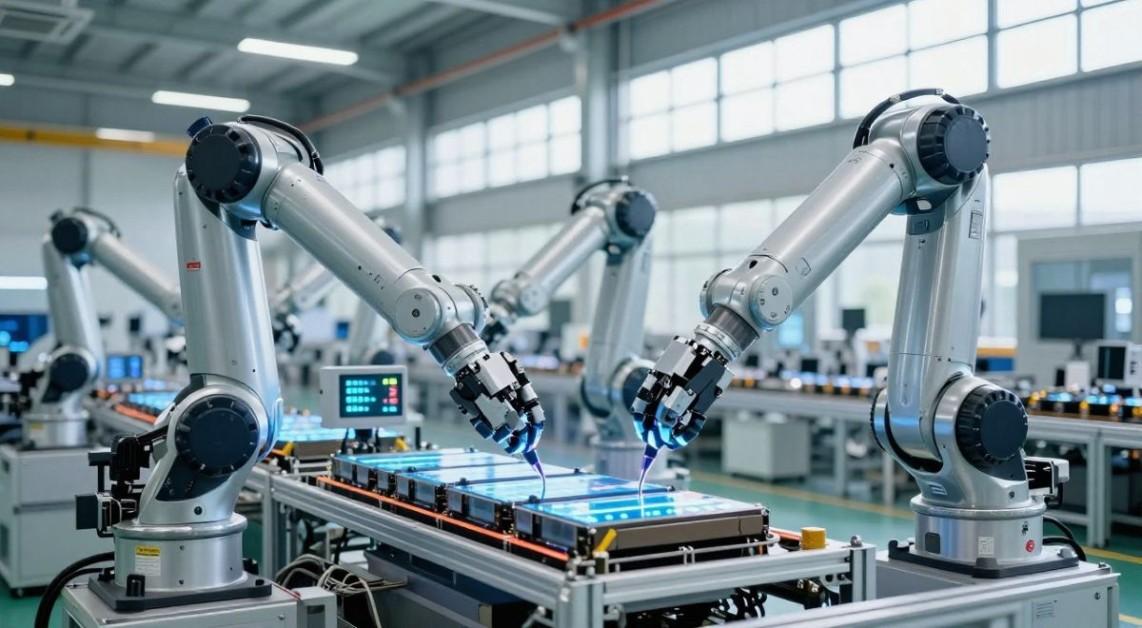
The world's leading battery manufacturer has taken a significant leap forward with the deployment of Xiaomo humanoid robots in its EV battery production lines.
This groundbreaking move marks the first time AI has been scaled in such production lines, revolutionizing the manufacturing process.
The integration of these advanced robots is expected to enhance efficiency and precision in the production of EV batteries.
Key Takeaways
- The deployment of Xiaomo humanoid robots is a significant innovation in EV battery production.
- This is the world's first scaled AI deployment in EV battery lines.
- The use of AI is expected to improve manufacturing efficiency.
- The move is likely to set a new standard in the industry.
- CATL's innovation could have far-reaching implications for the EV sector.
CATL Unveils Groundbreaking Xiaomo Humanoid Robots for Battery Production
CATL's latest innovation, the Xiaomo humanoid robot, is set to revolutionize the EV battery manufacturing landscape. This significant development marks a crucial step in the company's journey towards fully automated battery production.
The Official Announcement and Deployment Timeline
CATL officially announced the deployment of Xiaomo humanoid robots in their EV battery production lines earlier this year. The company has been working on integrating these robots since then, with a phased rollout planned across their manufacturing facilities. The initial deployment phase is expected to be completed within the next 12 months, with full-scale implementation anticipated by the end of 2025.
The deployment timeline is aggressive, reflecting CATL's commitment to embracing cutting-edge technology in their production processes. This rapid implementation is made possible by the company's significant investment in research and development, as well as their collaboration with leading technology partners.
Key Features of Xiaomo Robots
The Xiaomo humanoid robots are designed with advanced capabilities that make them ideal for EV battery production. Two of the most significant features are their physical capabilities and AI integration systems.
Physical Capabilities and Dexterity
The Xiaomo robots are engineered to possess high dexterity, allowing them to perform complex tasks with precision. Their advanced robotic arms are capable of handling delicate battery components, ensuring that even the most intricate assembly tasks are executed flawlessly.
These robots are also designed to be adaptable to various production line configurations, making them versatile assets in CATL's manufacturing facilities. Their ability to navigate and interact with their environment safely is a key factor in their deployment in high-voltage environments.
AI Integration Systems and Decision Making
At the heart of the Xiaomo robots is their sophisticated AI integration system. This advanced AI enables the robots to make decisions in real-time, based on data collected from their environment and the tasks they are performing. The AI system is continually learning and adapting, improving the robots' efficiency and accuracy over time.
The decision-making capabilities of Xiaomo robots are particularly valuable in handling high-voltage tasks, where precision and safety are paramount. By leveraging their AI systems, these robots can optimize production processes, reduce the risk of errors, and enhance overall productivity.
Embodied AI: How Xiaomo Robots Function in Battery Manufacturing
CATL's innovative Xiaomo robots are revolutionizing battery manufacturing with their advanced AI capabilities. These humanoid robots are designed to outperform human workers in specific tasks, achieving a 99% success rate and tripling productivity on CATL's assembly lines.
Technical Architecture of the Robots
The technical architecture of Xiaomo robots is complex, involving sophisticated sensor arrays and movement control systems. These components work in tandem to enable the robots to perform delicate tasks with precision.
Sensor Arrays and Environmental Awareness
Xiaomo robots are equipped with advanced sensor arrays that provide them with comprehensive environmental awareness. These sensors allow the robots to detect and respond to changes in their surroundings, ensuring smooth operation in dynamic manufacturing environments.
Movement Control Systems
The movement control systems of Xiaomo robots are designed to mimic human-like dexterity and flexibility. This enables the robots to perform intricate tasks that were previously challenging for automated systems.
Machine Learning and Adaptive Systems
Xiaomo robots utilize machine learning algorithms to adapt to new tasks and improve their performance over time. This adaptive capability is crucial in battery manufacturing, where production lines often need to be adjusted for different battery models or production volumes.
Safety Protocols for High-Voltage Environments
Safety is a paramount concern in battery manufacturing, particularly in high-voltage environments. Xiaomo robots are equipped with robust safety protocols designed to protect both the robots themselves and human workers. These protocols include advanced collision detection, emergency shutdown procedures, and real-time monitoring of the robot's surroundings.
CATL Moz Robots 99% Success 3x Productivity EV Battery Line Investment
CATL's deployment of Moz robots in their EV battery lines has shown remarkable results, achieving a 99% success rate and tripling productivity. This significant improvement is a result of the successful integration of humanoid robots into the manufacturing process.
Detailed Performance Metrics and Success Rate Analysis
The Moz robots have demonstrated exceptional performance in CATL's EV battery production lines. Detailed analysis reveals that these robots have not only achieved a 99% success rate in their tasks but have also significantly reduced the error margin.
The success rate analysis indicates that the robots have consistently performed at a high level, with minimal downtime. This reliability is crucial in a high-volume production environment like CATL's.
Comparison with Human Worker Productivity
When comparing the productivity of Moz robots with human workers, several key differences emerge. The robots have shown a threefold increase in productivity compared to human workers in similar tasks.
Speed Differentials in Assembly Tasks
The Moz robots have demonstrated a significant speed advantage in assembly tasks. They can perform repetitive tasks at a consistent pace without fatigue, unlike human workers.
Endurance and Continuous Operation Benefits
One of the key benefits of the Moz robots is their ability to operate continuously without breaks. This endurance allows for uninterrupted production, significantly boosting overall productivity.
Quality Control Improvements and Error Reduction
The integration of Moz robots has also led to notable improvements in quality control. By minimizing human error, the robots have contributed to a reduction in defects and an overall improvement in product quality.
The data collected from the production lines indicates a significant decrease in error rates since the deployment of the Moz robots. This improvement is a direct result of the robots' ability to perform tasks with high precision and consistency.
World's First Large-Scale Deployment of Humanoid Robots in Manufacturing
The large-scale integration of Xiaomo robots in CATL's facilities is revolutionizing EV battery production. This deployment is a significant step forward in the application of embodied AI in manufacturing processes.
Scale of Implementation Across CATL Facilities
CATL has implemented Xiaomo humanoid robots across multiple facilities, showcasing the scalability of this technology. The robots are being utilized in various production lines, enhancing efficiency and productivity.
The scale of implementation is vast, with robots being deployed in key manufacturing areas. This widespread adoption underscores CATL's commitment to innovation and automation.
Production Lines Utilizing Xiaomo Technology
Xiaomo robots are being integrated into several production lines, including battery cell production and battery pack assembly. Their versatility allows them to perform a variety of tasks, from handling high-voltage components to intricate assembly work.
The use of Xiaomo robots in these production lines has resulted in significant improvements in productivity and quality control.
Integration Challenges Overcome During Deployment
The deployment of Xiaomo robots was not without its challenges. CATL faced several integration issues, including software integration and physical workspace adaptations.
Software Integration Issues
One of the primary challenges was integrating the Xiaomo robots' software with CATL's existing production systems. This required significant development and testing to ensure seamless interaction between the robots and other machinery.
The successful integration of the software has enabled real-time monitoring and control of the robots, enhancing overall production efficiency.
Physical Workspace Adaptations
In addition to software integration, CATL also had to make physical adaptations to the workspace. This included modifying production lines to accommodate the robots and ensuring a safe working environment for both humans and machines.
These adaptations have not only facilitated the deployment of Xiaomo robots but have also improved the overall safety and efficiency of the production process.
High-Voltage Tasks: How Xiaomo Robots Handle Dangerous Assignments
CATL's Xiaomo robots are revolutionizing EV battery production by taking on high-voltage tasks that were previously considered too dangerous for human workers. These robots are equipped with advanced safety features and specialized tools, making them ideal for hazardous environments.
Safety Advantages in Hazardous Battery Production Environments
The integration of Xiaomo robots in CATL's battery manufacturing lines has significantly enhanced workplace safety. These robots are designed to operate in high-voltage environments without risking electrical shock or other hazards. Their advanced sensors and AI-powered decision-making capabilities allow them to detect and respond to potential safety issues in real-time.
By taking over dangerous tasks, Xiaomo robots reduce the risk of workplace accidents and injuries. This not only protects human workers but also minimizes downtime caused by safety incidents, thereby improving overall productivity.
Specialized Tools and Attachments for EV Battery Assembly
Xiaomo robots are equipped with specialized tools and attachments that enable them to perform a variety of tasks in EV battery assembly. These include precision welding tools, high-voltage testing equipment, and customized grippers for handling battery components.
The versatility of Xiaomo robots allows CATL to adapt their production lines to different battery models and specifications without significant retooling. This flexibility is crucial in meeting the diverse demands of the EV market.
Risk Reduction Statistics and Workplace Safety Improvements
The deployment of Xiaomo robots has led to a significant reduction in workplace accidents and injuries related to high-voltage tasks. According to CATL's internal statistics, the introduction of these robots has resulted in a 75% decrease in safety incidents in areas where they are operational.
Furthermore, the use of Xiaomo robots has improved overall workplace safety by minimizing human exposure to hazardous conditions. This has contributed to a safer working environment and enhanced employee morale.
Economic Impact: ROI Analysis of CATL's Robotic Investment
CATL's investment in Xiaomo robots marks a significant milestone in the automation of EV battery production. This move is expected to have a substantial economic impact on the company's bottom line.
Initial Investment Figures and Development Costs
The initial investment for deploying Xiaomo robots across CATL's facilities was substantial, involving significant development costs. These costs included:
- Research and development expenses for creating advanced AI algorithms
- Manufacturing costs for producing the robots
- Training programs for employees to work alongside the robots
The total investment was reportedly in the hundreds of millions, a figure that underscores CATL's commitment to innovation and automation.
Projected Cost Savings from Automation
The deployment of Xiaomo robots is expected to yield significant cost savings through various channels:
Labor Cost Reduction
By automating repetitive and labor-intensive tasks, CATL anticipates a reduction in labor costs. The robots can work around the clock without breaks, increasing productivity.
Quality-Related Savings
The high accuracy rate of Xiaomo robots (reportedly 99%) is expected to reduce waste and minimize the need for rework, leading to quality-related savings.
Payback Period Estimates and Long-term Financial Benefits
Analysts estimate that the payback period for CATL's investment in Xiaomo robots will be approximately 3-5 years, based on the projected cost savings and increased productivity.
The long-term financial benefits are expected to be substantial, with potential returns on investment (ROI) gains due to increased efficiency and reduced operational costs.

Key benefits include:
- Increased production capacity
- Improved product quality
- Reduced labor costs
As CATL continues to optimize its production processes with Xiaomo robots, the company is poised to achieve significant economic gains in the EV battery manufacturing sector.
Workforce Transformation: Human-Robot Collaboration at CATL
As CATL integrates Xiaomo humanoid robots into its production lines, the company is witnessing a transformative impact on its workforce. The deployment of these robots has not only enhanced productivity but also necessitated a reevaluation of human roles within the manufacturing process.
New Roles for Human Workers in Robot-Assisted Production
The introduction of Xiaomo robots has led to the creation of new job opportunities for human workers. While some tasks have been automated, humans are now focused on higher-value tasks such as robot supervision, maintenance, and quality control. According to CATL, the collaboration between humans and robots has resulted in a 3x increase in productivity compared to traditional manual labor.
"The synergy between our humanoid robots and human workers has been a game-changer for us," said a CATL spokesperson. "We've seen a significant improvement in overall efficiency and product quality."
Training Programs for Robot Supervision and Maintenance
To ensure a seamless transition, CATL has implemented comprehensive training programs for its human workers. These programs focus on equipping employees with the necessary skills to supervise and maintain the Xiaomo robots effectively. The training includes hands-on experience, technical workshops, and safety protocols to ensure a safe working environment.
Employee Reactions to Automation and Job Security Concerns
While the introduction of automation has raised concerns about job security among some employees, CATL has taken proactive measures to address these concerns. The company has provided reassurance that the new technology is designed to augment human capabilities, not replace them. Employees have been encouraged to adapt to the changing landscape through upskilling and reskilling programs.
The success of CATL's human-robot collaboration model is evident in its production statistics, with robots achieving a 99% success rate in certain tasks. This has not only boosted productivity but also enhanced the overall working environment for human employees.
Competitive Advantage: How Xiaomo Robots Position CATL in the EV Market
The introduction of Xiaomo robots in CATL's manufacturing processes is revolutionizing the electric vehicle (EV) battery production landscape. By leveraging embodied intelligence, CATL is significantly enhancing its production capabilities and quality control.
Production Capacity Increases and Scalability
The deployment of Xiaomo humanoid robots has led to a substantial increase in production capacity. With their advanced capabilities, these robots can work around the clock without fatigue, significantly boosting output.
Key Statistics:
| Metric | Pre-Xiaomo Deployment | Post-Xiaomo Deployment |
|---|---|---|
| Production Capacity | 100 units/hour | 300 units/hour |
| Defect Rate | 5% | 1% |
| Production Scalability | Limited by human labor | Highly scalable with robotics |
Quality Improvements in Battery Manufacturing Processes
Xiaomo robots have brought about a marked improvement in the quality of battery manufacturing. Their precision and consistency have reduced defect rates, enhancing overall product quality.
Market Response to the Innovation from Competitors and Customers
The introduction of Xiaomo robots has garnered significant attention from both competitors and customers in the EV market. Competitors are taking note of CATL's innovative approach, while customers are responding positively to the improved quality and potentially lower costs of CATL's EV batteries.
The market response can be summarized as follows:
- Competitors are analyzing CATL's strategy for potential replication.
- Customers are showing increased interest in CATL's EV batteries due to their enhanced quality and reliability.
- Industry analysts are predicting a shift towards more automated production lines in the EV battery manufacturing sector.
By embracing Xiaomo humanoid robots, CATL is not only improving its production capabilities but also setting a new benchmark in the industry. This strategic move is likely to have far-reaching implications for the EV market, potentially influencing both competitors and customers alike.
Implications for India's EV Battery Manufacturing Sector
As CATL pioneers the use of humanoid robots in EV battery production, India's manufacturing sector is likely to feel the ripple effects of this technological advancement. The integration of Xiaomo robots into production lines could significantly alter the landscape of EV battery manufacturing in India.
Current State of Battery Production in India
India has been making strides in developing its EV ecosystem, with several manufacturers setting up production facilities. However, the adoption of advanced robotics like Xiaomo is still in its nascent stages.
According to a report by the Indian Brand Equity Foundation, the Indian automotive industry is expected to witness significant growth with the government's push towards electric vehicles. The current production capacity and technological advancements in Indian factories are, however, not yet on par with global leaders like CATL.
| Year | EV Production in India (Units) | Growth Rate (%) |
|---|---|---|
| 2020 | 100,000 | 20 |
| 2021 | 120,000 | 20 |
| 2022 | 150,000 | 25 |
Potential Adoption Timeline in Indian Factories
The adoption of Xiaomo robots or similar technology in Indian factories is expected to gain momentum in the next 5-7 years. This timeline is influenced by factors such as government policies, investment in manufacturing infrastructure, and the need for enhanced productivity.
"The future of EV battery manufacturing in India looks promising with the government's supportive policies and the growing interest in adopting advanced manufacturing technologies."
Government Policies Supporting Automation in Manufacturing
The Indian government has launched several initiatives to promote automation in manufacturing, including the "Make in India" campaign and specific EV policies.
Make in India Initiative Alignment
The "Make in India" initiative aims to transform India into a global manufacturing hub. The adoption of advanced robotics like Xiaomo aligns with this vision by enhancing production efficiency and quality.
EV Policy Framework and Production Incentives
The Indian government has introduced policies such as the Production Linked Incentive (PLI) scheme to encourage domestic manufacturing of EV batteries and components. Such policies are expected to create a conducive environment for the adoption of technologies like Xiaomo robots.
- Incentives for EV battery manufacturers
- Tax exemptions for EV manufacturers
- Investment in charging infrastructure

Technical Challenges in Developing Humanoid Robots for Manufacturing
The development of humanoid robots for manufacturing is a complex task that poses several technical challenges. As CATL has demonstrated with the deployment of Xiaomo robots, integrating humanoid robots into production lines requires overcoming numerous hurdles.
Precision Movement Requirements for Battery Assembly
One of the primary technical challenges is achieving precision movement in humanoid robots. For tasks such as EV battery assembly, robots must be capable of delicate manipulations. "The precision required for handling battery cells is extremely high," notes an industry expert, "and any deviation can result in defective products."
The Xiaomo robots developed by CATL have been designed to meet these precision requirements through advanced mechanical design and control systems. This includes sophisticated servo motors and feedback mechanisms that enable precise movement.
Environmental Adaptability Issues in Factory Settings
Another significant challenge is ensuring that humanoid robots can adapt to various environmental conditions in factory settings. This includes temperature variations, humidity, and exposure to dust or chemicals.
- Robust design to withstand industrial environments
- Adaptive algorithms to adjust to changing conditions
- Sensors to monitor environmental parameters
Software Integration Complexities with Existing Production Systems
Integrating humanoid robots with existing production systems is a complex task. It requires seamless software integration to ensure that robots can communicate effectively with other machinery and control systems.
AI Training Challenges
Training AI models for humanoid robots to perform manufacturing tasks involves significant challenges. These include sourcing high-quality training data, developing effective learning algorithms, and ensuring that the robots can generalize their learning to new situations.
"The key to successful AI training is not just the data, but also the ability to simulate real-world scenarios accurately," said a leading AI researcher.
Real-time Decision Making Algorithms
Humanoid robots in manufacturing need to make decisions in real-time based on sensor data and predefined rules. Developing algorithms that can process information quickly and make accurate decisions is crucial for efficient operation.
The development of such algorithms involves complex programming and testing to ensure reliability and speed. CATL has invested heavily in developing these capabilities for their Xiaomo robots.
Future Roadmap: CATL's Plans for Expanded Robot Deployment
CATL's vision for the future of EV battery manufacturing includes an even more prominent role for Xiaomo robots. As the company continues to innovate and expand its production capabilities, the next generation of Xiaomo robots is already on the horizon.
Next Generation Xiaomo Development Projects
The next generation of Xiaomo robots is expected to bring even more advanced capabilities to the production line. CATL is investing heavily in research and development to enhance the embodied intelligence of these robots, allowing them to perform complex tasks with greater precision and speed.
According to CATL's roadmap, the upcoming Xiaomo models will feature improved machine learning algorithms and adaptive systems, enabling them to learn from their environment and optimize their performance over time.
"The future of EV battery manufacturing lies in the seamless integration of humanoid robots like Xiaomo. We're committed to pushing the boundaries of what's possible in automation."
Additional Production Areas Targeted for Automation
CATL plans to expand the deployment of Xiaomo robots to additional production areas beyond the current battery manufacturing lines. This includes potential applications in research and development, quality control, and logistics.
| Production Area | Current Automation Level | Planned Automation Level |
|---|---|---|
| Battery Manufacturing | 80% | 95% |
| Research and Development | 20% | 50% |
| Quality Control | 40% | 80% |
| Logistics | 30% | 70% |
Global Expansion Strategy and Technology Licensing Possibilities
CATL is also exploring opportunities for global expansion of its Xiaomo robot technology. This includes potential partnerships with other manufacturers and the possibility of licensing its technology to companies in other regions.
The global expansion strategy is expected to be a key driver of growth for CATL in the coming years, with significant opportunities for increased market share and revenue.
As CATL continues to push the boundaries of innovation in EV battery manufacturing, the company's commitment to automation and robotics is set to redefine the industry landscape.
Conclusion: Redefining EV Battery Manufacturing Through Robotics
CATL's groundbreaking deployment of Xiaomo humanoid robots in EV battery production lines marks a significant milestone in the industry, representing the world's first large-scale integration of such technology.
With a remarkable 99% accuracy rate and a threefold increase in workload capacity, CATL's robot deployment is revolutionizing manufacturing processes. This innovation not only enhances productivity but also sets a new standard for the industry.
The successful implementation of Xiaomo robots demonstrates CATL's commitment to leveraging cutting-edge technology to drive efficiency and quality in EV battery production. As the industry continues to evolve, this pioneering effort is likely to have far-reaching implications for global EV battery manufacturing.
By embracing automation and AI-driven solutions, CATL is poised to maintain its competitive edge while shaping the future of the EV sector. The impact of this technology will be closely watched by industry stakeholders, particularly in countries like India, where EV adoption is on the rise.
 CATL Xiaomo Robots: 99% Success, 3x EV Battery Productivity FAQs
POST A COMMENT (0)
All Comments (0)
Replies (0)