





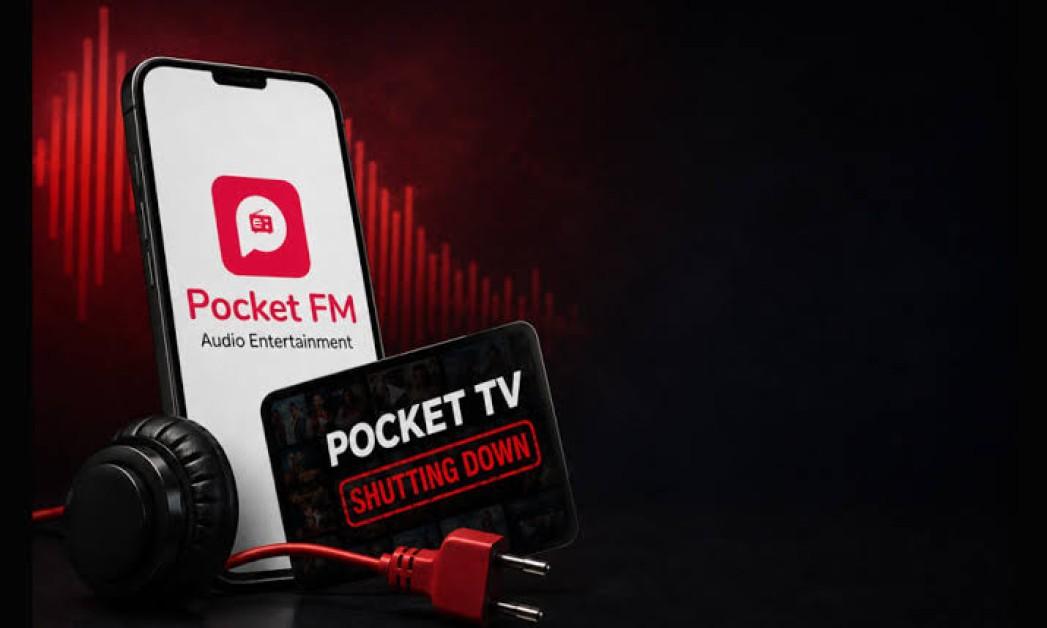
Pocket FM Re-Enters Microdrama Market With Pocket Saga and AI-Generated Animated Short Series
Pocket Entertainment, the parent company of Pocket FM, has re-entered India's fast-growing microdrama market with Pocket Saga, only about two months after shutting down its earlier short-drama experiment Pocket TV.
The new platform takes a noticeably different approach.
Rather than relying primarily on conventional live-action microdramas, Pocket Saga currently focuses heavily on animated short series, including anime-style programming and AI-generated video adaptations of existing Pocket FM stories.
Pocket Saga has emerged from the company's earlier Pocket Toons product, an AI-first comics platform launched in February 2025. It now positions itself as a mobile short-series service offering thousands of bite-sized episodes across genres such as fantasy, romance, romantasy, drama, supernatural fiction, action, mystery and thrillers.
The platform also carries forward one of Pocket FM's most distinctive commercial models: micropayments rather than mandatory monthly subscriptions.
Viewers receive some episodes free, can unlock additional episodes through advertisements and rewards, or purchase virtual coins to continue watching.
The return suggests Pocket Entertainment has not abandoned the microdrama opportunity after Pocket TV. Instead, it appears to be testing whether AI-driven production, animation and adaptation of its existing story library can create more sustainable economics for short-form entertainment.
Pocket Entertainment Returns Just Two Months After Pocket TV Exit

Pocket Entertainment's renewed push comes shortly after its previous microdrama venture was discontinued.
The company shut down:
Pocket TV
in June 2026.
At the time, Pocket Entertainment CEO Rohan Nayak described Pocket TV as an experiment intended to help the company understand the emerging microdrama category.
The company identified a major challenge:
retaining users after the initial acquisition period.
Microdrama platforms can attract viewers quickly through highly dramatic clips and aggressive digital marketing.
The harder task is turning those newly acquired users into repeat viewers who continue paying for content.
That distinction has major implications for the economics of the business.
Pocket TV Exposed Retention Challenges
Short-form serialized drama has an appealing consumer proposition.
Episodes are:
brief,
mobile-friendly,
highly dramatic,
and designed around cliffhangers.
That can generate rapid engagement.
But user acquisition can also be expensive.
If consumers watch only briefly and then stop using the service, the platform may struggle to recover the money spent acquiring them.
Nayak had indicated that the economics of the prevailing microdrama model were not necessarily as attractive as they initially appeared.
That helps explain why Pocket Entertainment closed Pocket TV despite growing interest in the category.
Company Said Pocket TV Produced Important Learnings
The shutdown did not mean Pocket Entertainment had concluded that microdramas themselves lacked potential.
Nayak said the experiment had helped the company identify what he described as a potentially disruptive approach to the market.
At the time, the company did not disclose what that approach would involve.
Pocket Saga now appears to offer part of the answer.
The new proposition combines:
Pocket Entertainment's existing story intellectual property,
short-form video,
animation,
AI-generated adaptations,
and:
micropayment monetisation.
That is materially different from simply returning with another version of Pocket TV.
Pocket Saga Is Built From Pocket Toons
Pocket Saga is effectively a revamped version of:
Pocket Toons.
Pocket Entertainment launched Pocket Toons in February 2025 as an:
AI-first comics platform.
The company also introduced Blaze, an AI-powered studio designed to help creators produce comic content more quickly.
Pocket Saga expands the concept from static or comic-style storytelling toward short-form video.
That gives Pocket Entertainment a potential pathway from:
audio stories
to:
comics
to:
animated video.
The same underlying intellectual property can potentially be adapted into multiple entertainment formats.
AI-Generated Animated Series Become Key Differentiator
The most notable element of Pocket Saga is its current emphasis on:
AI-generated animated video.
The service features animated short series, including anime-style content and video versions of stories that already exist within the broader Pocket FM ecosystem.
This potentially gives Pocket Entertainment a different cost structure from traditional microdrama producers.
Live-action drama requires:
actors,
directors,
sets,
locations,
costumes,
camera crews,
post-production,
and scheduling.
AI-assisted animation can potentially reduce several of those production constraints.
Whether Blaze Powers Pocket Saga Is Not Yet Confirmed
Pocket Entertainment previously created Blaze as an AI production tool for the Pocket Toons ecosystem.
However, it has not been publicly confirmed that Blaze is the technology currently powering Pocket Saga's animated video production.
That distinction is important.
Pocket Saga clearly contains AI-generated content, but the precise production pipeline has not been fully disclosed.
The broader strategic direction is nevertheless clear:
Pocket Entertainment is attempting to use AI to increase the volume and lower the cost of visual storytelling.
Existing Pocket FM Stories Provide Content Pipeline
One of Pocket Saga's potentially strongest advantages is Pocket Entertainment's existing story library.
Pocket FM has already built a large catalogue of serialized audio fiction.
Those stories provide:
characters,
plots,
episode structures,
cliffhangers,
and audience data.
Instead of creating every short series from scratch, Pocket Entertainment can potentially adapt proven stories into visual formats.
That can reduce one of the largest risks in entertainment:
not knowing whether a story will resonate with audiences.
Audio Success Can Inform Video Adaptation
Pocket FM can observe how audio stories perform before deciding which ones deserve adaptation.
Metrics can potentially reveal:
which stories attract listeners,
where audiences stop listening,
which characters generate interest,
and which episodes produce strong retention.
Those insights can then influence animation or video development.
This creates a more data-driven adaptation pipeline than traditional entertainment development, where considerable production money may be committed before audience behaviour is known.
Pocket Saga Offers Thousands of Bite-Sized Episodes
Pocket Saga describes itself as a short-series platform containing:
thousands of bite-sized episodes.
Its content spans genres including:
fantasy,
romance,
romantasy,
drama,
royal stories,
supernatural fiction,
action,
mystery,
and thriller.
These categories closely resemble genres that perform strongly in serialized digital fiction.
They are particularly suitable for cliffhanger-driven storytelling.
A supernatural romance or revenge drama, for example, can be broken into many short episodes ending at moments designed to encourage viewers to continue.
Vertical Video Is Built for Mobile Consumption
Pocket Saga is designed around:
vertical video.
That format reflects the viewing behaviour created by platforms such as short-video and social-media apps.
Users can consume content without rotating their phones.
Episodes are designed for quick viewing sessions.
This makes microdramas fundamentally different from conventional television.
The format is not merely a shorter television episode.
It is entertainment designed from the beginning for:
mobile screens,
short attention windows,
and continuous scrolling behaviour.
Pocket Saga Uses Pay-Per-Episode Model
Pocket Saga does not rely primarily on a conventional monthly streaming subscription.
Instead, it uses a:
pay-per-episode micropayment model.
Users can watch an initial set of episodes without paying.
Additional episodes can then be unlocked using virtual currency.
This closely resembles Pocket FM's established monetisation architecture.
The approach allows consumers to spend incrementally rather than committing to a recurring subscription.
Users Can Earn or Purchase Coins
Viewers have several methods for accessing more content.
They can:
receive daily free episodes,
watch advertisements,
collect rewards,
or:
buy virtual coins.
Those coins can then be used to unlock individual episodes.
This creates multiple monetisation layers.
Users unwilling to pay directly can still generate advertising revenue.
More engaged viewers can purchase coins.
Highly engaged consumers may continue spending over long periods as they follow multiple serialized stories.
No Mandatory Monthly Subscription
Pocket Saga explicitly positions its model against conventional subscription streaming.
The service emphasises:
no mandatory monthly subscription.
This could appeal to consumers who do not want another recurring entertainment bill.
India's streaming market already contains numerous subscription services competing for household spending.
Microtransactions offer an alternative.
Instead of asking a consumer to decide whether an entire service is worth paying for every month, Pocket Saga asks whether the:
next episode
is worth unlocking.
That is a very different behavioural proposition.
Cliffhangers Become Central to Monetisation
The micropayment model makes story structure commercially important.
If every paid unlock happens between episodes, the end of each episode becomes a monetisation moment.
Writers therefore need to create strong:
cliffhangers,
reveals,
conflicts,
and unanswered questions.
The viewer should feel compelled to discover what happens next.
This explains why genres involving:
revenge,
romance,
fantasy,
family conflict,
and supernatural twists
are particularly common in microdrama ecosystems.
AI Could Change Microdrama Unit Economics
Pocket Saga's biggest experiment may ultimately concern:
production economics.
Microdrama platforms require enormous volumes of fresh content.
Traditional video production can make that expensive.
If a platform needs hundreds or thousands of episodes to maintain engagement, even relatively cheap productions can create substantial costs.
AI-generated animation could lower the cost per episode.
That would allow the platform to test far more stories without taking the financial risk associated with conventional production.
Lower Production Costs Could Support More Experimentation
Imagine two entertainment models.
In the first, producing a new series requires:
actors,
locations,
shooting schedules,
and significant upfront capital.
The company may be able to test only a limited number of concepts.
In the second, AI tools substantially reduce production requirements.
The company could potentially produce:
more pilots,
more genre variations,
and more adaptations
for the same budget.
Most may fail.
But the successful stories can be expanded rapidly.
That experimentation model resembles software development more closely than traditional television production.
AI Can Make Content Supply More Elastic
Streaming platforms traditionally face a fundamental constraint:
content production takes time.
AI could make supply more elastic.
If a particular genre suddenly becomes popular, a platform using AI-assisted workflows could potentially respond faster.
Production teams might be able to generate:
new character designs,
backgrounds,
storyboards,
voice elements,
and animation
far more rapidly than conventional studios.
This speed could become a competitive advantage in short-form entertainment.
Quality Remains Critical Risk
Lower production costs do not automatically create successful content.
Audiences still care about:
storytelling,
characters,
emotion,
visual quality,
and consistency.
Poor AI-generated animation can quickly become repetitive or visually distracting.
The technology therefore needs to improve economics without destroying entertainment value.
This may become the central challenge for Pocket Saga.
The platform needs to prove that viewers will pay repeatedly for AI-assisted stories rather than merely sample them because the format is novel.
Retention Is Still the Core Test
Pocket TV's experience makes one metric particularly important:
retention.
The industry has already demonstrated that consumers can be attracted to short-form drama.
The larger commercial question is whether those consumers remain engaged.
Pocket Saga therefore needs to improve:
repeat viewing,
series completion,
daily return rates,
and monetisation per user.
If AI reduces production cost but users still leave quickly, the business model may remain difficult.
Pocket Saga Can Use Daily Episode Releases to Build Habit
The platform releases new free episodes regularly.
This mechanism can help create:
daily viewing habits.
Serialized entertainment historically uses scheduled releases to encourage audiences to return.
Pocket Saga can apply the same psychology in a mobile environment.
A consumer might open the application daily to see whether another episode is available.
If the viewer does not want to wait, they can use coins to continue immediately.
This combines:
habit formation
with:
monetisation pressure.
Advertising Provides Alternative Monetisation
Advertisements create another path.
A consumer who does not want to pay can watch advertising in exchange for additional access.
This is especially relevant in price-sensitive entertainment markets.
The model allows Pocket Saga to monetise users at multiple spending levels.
One viewer may spend nothing but watch ads.
Another may occasionally buy coins.
A highly engaged user may spend substantially more.
This flexible monetisation structure can be more effective than forcing all consumers into a single subscription price.
India’s Microdrama Market Is Growing Rapidly
Pocket Entertainment is returning at a time when India's microdrama category is attracting substantial investment.
Industry estimates cited around the sector suggest the Indian market crossed roughly:
$300 million in 2025
and could reach:
$1.5 billion by the end of 2026.
Longer-term projections put the opportunity substantially higher by 2030.
Such forecasts should be treated as industry estimates rather than guaranteed outcomes.
Even so, the competitive activity suggests media and technology companies believe mobile-first serial fiction has significant potential.
Competition Has Intensified Dramatically
Pocket Saga is not entering an empty market.
Competition now includes both specialist startups and much larger entertainment or technology platforms.
Companies active in or entering the category include:
Amazon,
JioHotstar,
ZEE5,
Kuku,
Eloelo's Story TV,
Dashverse,
and:
ShareChat's Quick TV.
The presence of well-funded companies raises the competitive bar considerably.
Pocket Entertainment therefore needs more than consumer demand.
It needs a differentiated production and monetisation model.
Flipkart Is Also Entering Microdramas
The category has expanded beyond conventional media businesses.
Flipkart has also moved into microdramas through partnerships with content companies including:
Terribly Tiny Tales
and:
Pratilipi.
For an e-commerce platform, entertainment can serve another purpose.
Short-form stories can increase:
time spent inside the app,
frequency of visits,
and overall user engagement.
That creates strategic value even when the entertainment product itself is not the company's primary business.
Microdramas Can Become Engagement Infrastructure
This explains why microdramas are attracting companies from very different sectors.
For a pure entertainment platform, the objective is direct content monetisation.
For an e-commerce or social platform, the objective may also include:
retention,
advertising,
commerce,
and cross-selling.
Short-form drama is therefore increasingly becoming a form of:
engagement infrastructure.
It gives users another reason to open an application regularly.
Pocket Entertainment Has Different Strategic Advantage
Pocket Entertainment's advantage is different from that of Amazon or Flipkart.
It already operates a serialized storytelling platform through Pocket FM.
That provides experience in:
episodic fiction,
creator ecosystems,
micropayments,
user retention,
and story monetisation.
The company therefore does not need to learn serialized digital storytelling from the beginning.
Its challenge is converting that expertise successfully from:
audio
into:
video.
Audio Remains Pocket FM's Core Business
Even during the Pocket TV shutdown, Pocket Entertainment made clear that:
audio remained the majority of its business.
Pocket FM has continued focusing on global expansion of its audio entertainment platform.
Pocket Saga should therefore not necessarily be interpreted as a strategic pivot away from audio.
Instead, it appears more like an adjacent format.
The company can potentially use its core audio catalogue to create additional monetisation opportunities through animation and short video.
One Story Could Generate Multiple Products
This creates an interesting intellectual-property model.
A successful story could begin as:
audio fiction.
It could then become:
a comic,
an animated short series,
or potentially another video format.
Each adaptation extends the commercial life of the same intellectual property.
This resembles strategies used by major entertainment franchises, but AI could make adaptation much cheaper.
If Pocket Entertainment can establish a repeatable system, the company could extract significantly more value from successful stories.
AI Could Make Adaptation Faster
Traditional adaptation from audio to visual entertainment is expensive.
Scripts need to be rewritten.
Characters need casting.
Locations must be selected.
Production can take months.
AI-assisted animation can potentially shorten that process.
Existing audio narratives already provide:
dialogue,
plot,
characters,
and episodic structure.
A production system can then focus on transforming those elements into visual form.
That is potentially much easier than creating entirely new video intellectual property.
Creator Economics Could Eventually Change
Pocket FM has built part of its content supply through creators and writers.
If their stories can be adapted into additional formats, the economics of creator participation could change.
Successful intellectual property could potentially generate value across:
audio,
visual,
and other digital formats.
However, the precise commercial terms governing AI adaptations and creator participation will be important.
As AI-generated entertainment expands, questions involving:
rights,
consent,
compensation,
and ownership
are likely to receive increasing attention across the industry.
AI Entertainment Raises Intellectual-Property Questions
Generative AI makes content production easier, but it introduces legal and commercial complexity.
Platforms need clarity around:
training data,
character ownership,
artwork rights,
voice usage,
and adaptation permissions.
When an existing story is converted into animated video, the platform must ensure it holds appropriate rights for that transformation.
As the industry grows, AI content governance could become as important as production efficiency.
Anime-Style Content Broadens Audience Appeal
Pocket Saga currently contains anime-style animated programming.
Anime-inspired visual storytelling has become increasingly mainstream among younger digital audiences.
The format works especially well with:
fantasy,
action,
supernatural fiction,
and romantasy.
These are also categories prominent within Pocket Saga.
Animation allows creators to portray:
fantastical settings,
powers,
creatures,
and elaborate worlds
without the visual-effects budgets required for live action.
Fantasy Is Well Suited to AI Animation
Consider a fantasy series involving:
dragons,
magical kingdoms,
supernatural transformations,
and large battles.
Producing that story through live action could require significant visual-effects expenditure.
Animation removes many physical constraints.
AI-assisted animation could reduce them further.
This creates an economic reason for Pocket Saga to emphasise fantasy-heavy genres.
Stories that would be expensive to film can potentially become commercially viable as animated microdramas.
Romantasy Fits Short-Form Serialized Storytelling
Pocket Saga also highlights:
romantasy
as a category.
Romantasy combines romantic storytelling with fantasy settings and has become increasingly visible across publishing and digital entertainment.
It is particularly suited to serialisation because stories can combine:
relationships,
conflict,
world-building,
betrayal,
and supernatural stakes.
Each of those elements provides opportunities for cliffhanger endings.
The category therefore fits both the narrative and commercial mechanics of microdrama.
Recommendation Systems Will Matter
With thousands of episodes available, discovery becomes a major challenge.
A user cannot manually browse everything.
Pocket Saga therefore needs strong recommendation systems capable of identifying:
which genre,
story,
character,
or narrative style
a viewer is most likely to enjoy.
Personalisation can directly influence retention.
The faster a platform connects users with a compelling series, the greater the probability they will continue watching and eventually spend money.
Short-Drama Competition Will Increasingly Focus on Retention
The next phase of India's microdrama market may therefore look very different from the first.
Early competition often focused heavily on:
downloads
and:
user acquisition.
As the industry matures, platforms are likely to focus more closely on:
retention,
engagement,
monetisation,
and production efficiency.
A platform that acquires millions of users but cannot keep them may ultimately be less valuable than one with a smaller but highly engaged audience.
Pocket Entertainment's own Pocket TV experience has already demonstrated this lesson.
Consolidation Could Follow Rapid Expansion
The large number of entrants also raises the possibility of eventual market consolidation.
Not every microdrama platform is likely to maintain:
content spending,
marketing budgets,
and user acquisition
indefinitely.
Companies with stronger:
distribution,
intellectual property,
capital,
or production technology
could eventually gain advantage.
Others may exit, merge or focus on narrower niches.
Pocket Saga's AI-first model appears designed partly to reduce the cost pressure associated with that competition.
Production Cost Could Become Deciding Factor
A microdrama platform needs a constant pipeline of stories.
Unlike a conventional film service where a few major releases can drive engagement, short-series users may consume enormous amounts of content quickly.
That makes:
cost per episode
a critical variable.
If AI allows Pocket Saga to produce significantly more usable content for the same capital, the company could achieve better unit economics than platforms depending entirely on live-action production.
The real question is whether lower-cost content generates equivalent engagement.
AI Can Personalise Content in Future
Beyond production, AI may eventually enable more personalised entertainment.
Platforms could potentially experiment with:
different trailers,
alternate thumbnails,
localised dialogue,
language versions,
or even audience-specific story presentation.
Such personalisation could improve conversion.
However, highly personalised content would also create new questions around:
creative consistency,
consumer transparency,
and rights management.
Pocket Saga's current significance is therefore not only the content it offers today but the direction it suggests for AI-native entertainment.
Regional-Language Expansion Could Be Important
India's entertainment market is deeply multilingual.
Microdramas can become significantly larger if platforms adapt content across:
Hindi,
Tamil,
Telugu,
Bengali,
Marathi,
and other languages.
AI could potentially reduce the cost of:
translation,
dubbing,
subtitle generation,
and localisation.
That would make one story economically viable across multiple language markets.
For a company already experienced with India's diverse audio audience, this could become a significant opportunity.
Global Expansion Could Eventually Follow
Pocket FM already operates internationally.
If Pocket Saga develops a successful production model, the visual format could potentially travel across borders more easily than some audio programming.
Genres such as:
fantasy,
romance,
revenge,
and supernatural drama
have broad international appeal.
Animation can also reduce some cultural and production barriers associated with live-action casting.
A story can be localised through:
language,
voice,
and visual adjustments
without reshooting an entire series.
Microdrama Could Become AI-Native Entertainment Category
Many existing entertainment formats are adopting AI gradually.
Microdrama may develop differently.
Because the category itself is relatively new, production systems can be built around AI from the beginning.
That could make it one of the first entertainment segments where:
AI-assisted scripting,
visual generation,
localisation,
recommendation,
and monetisation
are integrated into a single production pipeline.
Pocket Saga is an early example of that possibility.
Human Storytelling Still Determines Success
Technology alone will not determine the winners.
Viewers return because they care about:
characters,
conflict,
emotion,
surprise,
and resolution.
AI can make production cheaper and faster.
It cannot guarantee compelling storytelling.
Pocket Entertainment's larger advantage may therefore come from combining AI production with years of data about which serialized narratives actually keep audiences listening.
The company needs both capabilities.
Pocket Saga Is More Than a Simple Relaunch
Calling Pocket Saga a straightforward replacement for Pocket TV misses the strategic difference.
Pocket TV tested the conventional microdrama proposition.
Pocket Saga appears to test a more vertically integrated model based on:
existing intellectual property,
AI-generated animation,
mobile-first distribution,
and Pocket FM-style micropayments.
This may allow Pocket Entertainment to attack the same consumer opportunity with a substantially different cost base.
Whether that model works will depend on retention and willingness to pay.
Conclusion
Pocket Entertainment's launch of Pocket Saga marks a rapid return to India's microdrama market, but with a significantly different strategy built around AI-generated animation, existing Pocket FM intellectual property and micropayment-based viewing.
The move comes roughly two months after the company shut down Pocket TV, an experiment that exposed the difficulties of retaining users and achieving sustainable economics in short-form drama.
Pocket Saga has evolved from the earlier Pocket Toons AI-first comics platform and currently features animated series, anime-style programming and AI-generated adaptations of existing Pocket FM stories.
The service offers thousands of bite-sized episodes across genres including fantasy, romance, romantasy, supernatural fiction, drama, action, mystery and thrillers.
Its commercial model closely resembles Pocket FM: viewers receive some content free, can earn access through advertising and rewards, or purchase virtual coins to unlock additional episodes without committing to a monthly subscription.
The strategic question is whether AI can solve one of microdrama's biggest problems.
If substantially lower production costs allow Pocket Saga to generate more content while Pocket Entertainment's existing story data improves selection, the company may be able to build stronger unit economics than its previous experiment.
But production efficiency alone will not be enough.
Retention, storytelling quality and repeat monetisation will ultimately determine whether Pocket Saga represents a sustainable second attempt at microdrama or simply another experiment in India's increasingly crowded short-form entertainment market.
 Related News
POST A COMMENT (0)
All Comments (0)
Replies (0)